
Industrial Relations Stability Is a Strategic Competitive Advantage
By Sanjeevv Shekhar
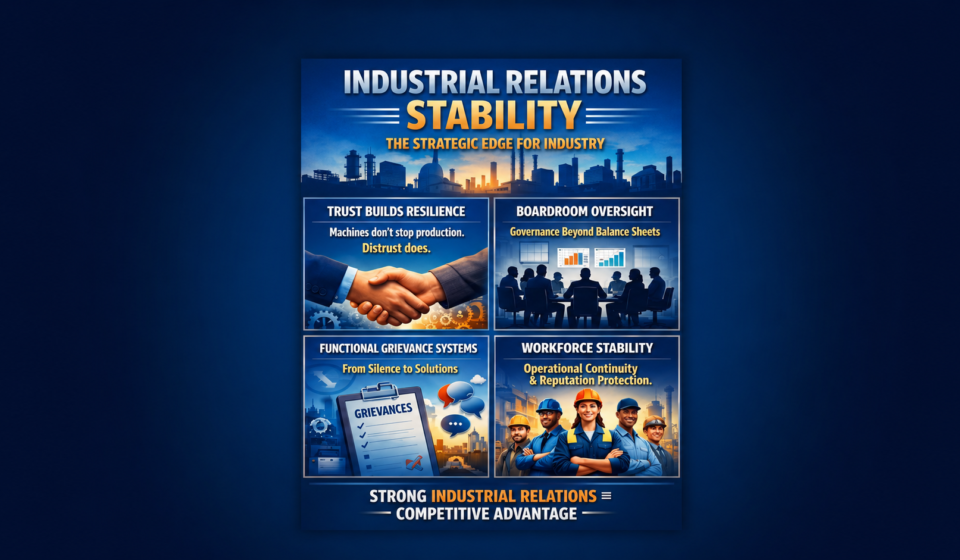
Machines don’t stop production. Distrust does. In 2012, Maruti Suzuki’s Manesar plant became the stage for one of the most dramatic industrial unrests in Indian corporate history. Production lines halted, reputations suffered, and financial losses mounted. What began as simmering dissatisfaction among workers escalated into a crisis that shook the entire automotive sector. The incident was not about machines breaking down. It was about trust breaking down.
Now contrast this with ITC’s Paperboards and Specialty Papers Division. Here, grievance redressal systems are structured, welfare programmes are visible, and communication is open. Even during raw material shortages and regulatory challenges, production continued without major disruption. Workforce stability became ITC’s shield against external shocks.
TVS Motors offers another lesson. By investing in skill development, continuous training, and collaborative union relations, the company has avoided prolonged strikes. In a fiercely competitive automotive sector, this stability has become a strategic advantage. It shows that industrial relations are not a soft issue. They are operational resilience, reputational protection, and governance maturity.
In my experience, organisations with stable industrial relations environments are often able to withstand business disruptions better than those with superior infrastructure but weak workforce engagement. The reason is simple: employees and contract workers support institutions where communication remains visible, grievances are heard, and dignity at work is protected.
Today, investors, proxy advisory firms, and institutional stakeholders are increasingly examining governance beyond balance sheets. Board oversight now extends into workforce culture, contractor governance, labour welfare, and crisis preparedness. Recent shareholder activism and governance scrutiny in India have clearly demonstrated that boards are being evaluated not only on profitability, but also on how responsibly they manage people ecosystems.
These examples highlight a truth that boards can no longer ignore. Industrial relations are not just about HR policies. They are about governance. Workforce culture, contractor governance, and labour welfare are part of boardroom oversight.
Labour unrest rarely begins with agitation. It begins with silence. It begins with delayed communication, inconsistent policies, contractor dissatisfaction, or a visible disconnect between leadership intent and workforce reality. Boards must therefore ask tougher questions. Are grievance mechanisms genuinely functional or only procedural? Is contractor governance monitored with the same seriousness as financial controls? Are employee sentiment indicators discussed periodically at leadership level? Is workforce stability integrated into enterprise risk discussions?
The implementation of India’s new Industrial Relations Rules has reinforced the importance of structured grievance systems, worker representation, and workforce governance mechanisms. These are not compliance checkboxes. They are signals of governance maturity.
Machines don’t stop production. Distrust does. From Maruti’s unrest to ITC and TVS’s resilience, Indian industry shows us that workforce trust is not a soft issue. It is governance maturity and competitive advantage. Boards must start asking tougher questions, because industrial relations stability is strategy.
Industrial relations stability is not a soft issue. It is operational resilience, it is reputational protection, it is governance maturity and overall it is a competitive advantage.
(THE WRITER IS A CORPORATE AFFAIRS, GOVERNMENT RELATIONS AND HUMAN CAPITAL LEADER WITH OVER THREE DECADES OF EXPERIENCE ACROSS THE POWER, INFRA-STRUCTURE AND MEDIA SECTOR)