The Chariot of a Developed India: What Jagannath’s Rath Yatra Can Teach Us
By Dr Rajeev Kamal Bittu
Every year, on the second day of the bright fortnight of Ashadha, millions gather in Puri to witness the Rath Yatra of Lord Jagannath. To many, it is a magnificent religious festival. Yet, beyond its devotional appeal, the Rath Yatra is also a profound civilisational metaphor. It speaks of social inclusion, public participation, environmental responsibility, family values and collective duty—principles that remain relevant to India’s aspiration of becoming a developed nation by 2047.
One of the most striking aspects of the festival is that the deity leaves the sanctum and comes among the people. Symbolically, it reflects a vision of public life in which institutions do not remain distant from society but engage with every citizen. In the Indian civilisational tradition, religion has rarely been confined to ritual alone; it has also served as a framework for ethical conduct, social cohesion and public welfare.
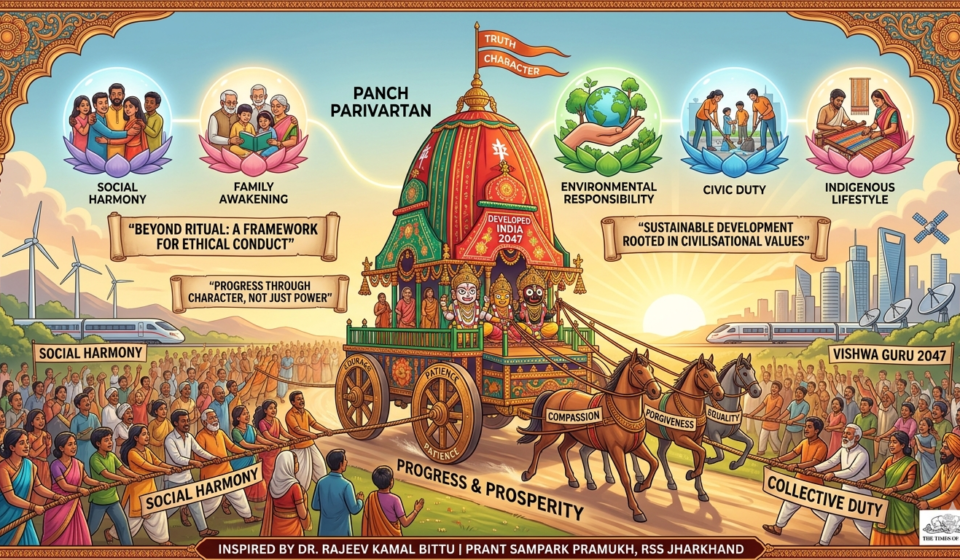
The ideals embodied in the Rath Yatra resonate with the values reflected in the Rashtriya Swayamsevak Sangh’s Panch Parivartan (Five Transformations) initiative—social harmony, family awakening, environmental responsibility, civic duty and a preference for indigenous lifestyles. Whether viewed as cultural ideals or social priorities, these themes address some of the most pressing challenges confronting contemporary India.
The deeper symbolism of the chariot finds a timeless expression in Tulsidas’s Ramcharitmanas. When Vibhishana worries about how Rama will defeat Ravana without a grand chariot or armour, Rama explains that true victory rests not on material strength but on moral virtues. Courage and patience are the wheels of the chariot; truth and character its flag; wisdom, self-restraint and service its horses; compassion, forgiveness and equality its reins. The message is clear: enduring success is founded on character rather than power alone.
This metaphor has contemporary relevance. A nation seeking long-term progress requires more than economic growth, technological advancement and military capability. These are indispensable instruments of national strength, but they must be guided by ethical values, social trust and civic responsibility. Material progress without moral direction risks becoming unsustainable.
The Rath Yatra itself offers several lessons in this regard. The ropes of the chariot are pulled by thousands of people irrespective of caste, class or region, demonstrating the ideal of social harmony through shared participation. Lord Jagannath’s journey alongside Balabhadra and Subhadra reflects the enduring significance of the family as the primary institution for transmitting values across generations. The annual construction of the chariots from specially selected timber also reminds us that natural resources must be used with restraint, gratitude and responsibility. Environmental stewardship is not merely about conservation; it is about maintaining a balanced relationship with nature—a principle deeply embedded in India’s civilisational ethos.
Equally significant is the culture of voluntary service surrounding the festival. Thousands of volunteers contribute selflessly to ensure that millions can participate safely and peacefully. Such civic commitment illustrates that a strong nation is sustained not only by efficient institutions but also by citizens willing to place collective welfare above personal convenience.
The festival also sustains local artisans, traditional craftsmen and indigenous skills, demonstrating that cultural heritage and economic self-reliance can reinforce one another. In an era of globalisation, strengthening local enterprise is not simply an economic choice; it is also an affirmation of cultural confidence.
India’s aspiration to become a developed nation by 2047 will undoubtedly depend upon economic expansion, scientific innovation, modern infrastructure and national security. Yet the chariot of a developed India cannot move on power and resources alone. Character, social cohesion, environmental responsibility and civic consciousness provide the moral direction that makes development sustainable. Power gives a nation capacity; values determine how that capacity is exercised.
The enduring appeal of the Rath Yatra lies precisely in this message. It reminds us that lasting national progress is achieved when material prosperity is balanced by ethical purpose, cultural continuity and collective responsibility. In that sense, the journey of Jagannath’s chariot is not merely a religious procession; it is an enduring reminder that the strongest foundations of a developed India are ultimately built upon character as much as capability.

(Bittu is a Chartered Accountant who is also the Prant Sampark Pramukh, Rashtriya Swayamsevak Sangh, Jharkhand)