
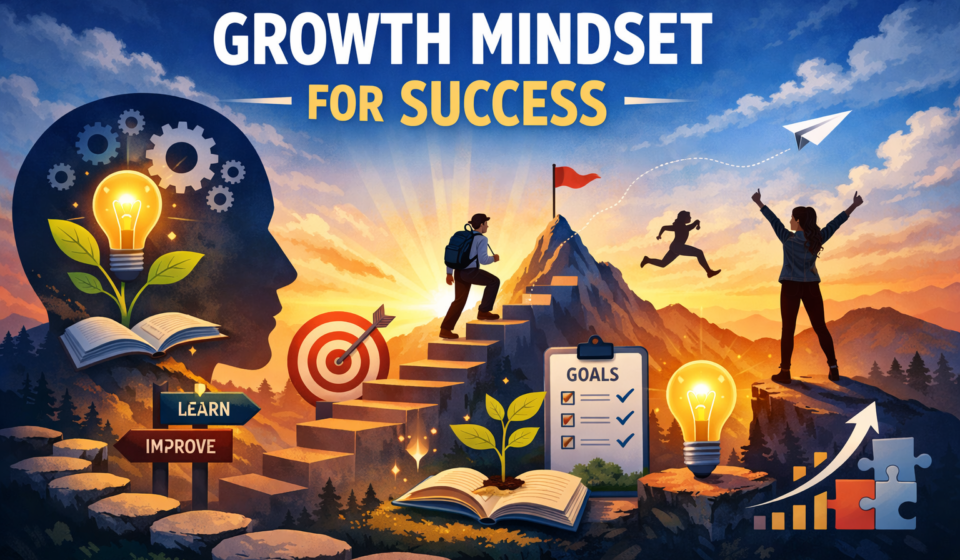
Growth mindset for lasting success
By Anupama Mohla
We often admire people who perform exceptionally well and assume they were born with something the rest of us don’t have. More talent,a sharper mind,greater confidence. It is an easy explanation because it makes us believe that excellence belongs to a fortunate few.
Reality is usually less dramatic.
Over the years, it has been noticed that the biggest difference between people whoachieve outstandingly and those who remain stuck is not ABILITY. The greatest barrier is the MINDSET we adopt.
Think about the last time you had to speak in front of a group, attend an important interview, or make a difficult decision. Chances are, your biggest challenge was not the task itself. It was the stream of thoughts running alongside it. What if I forget? What if I make a mistake? What will people think?
The mind has an interesting habit. Whatever we ask it to look for, it begins to find. As the saying goes, wherever the attention goes, energy flows. If we search for reasons to fail, it presents us with doubts. If we look for possibilities, the brain starts focusing on opportunities that were always there but hidden behind fear.
That simple shift can change the way we perform.
Many of us spend years trying to avoid mistakes. We choose the safer option, stay within familiar territory and hesitate before taking on something that might expose our weaknesses. It feels sensible, but there is a huge cost. We stop stretching ourselves. We stop learning.
People who consistently excel are not free from fear. They refuse to let fear overtake their decisions. They walk into challenges asking a different question: What can I change here? The focus moves away from protecting the self and towards handling the situation. Surprisingly, that is often when confidence begins to appear.
Confidence, after all, is rarely the starting point. It grows from preparation, repeated effort and the willingness to keep showing up, especially after things have not gone according to plan.
The same is true of failure. We often treat it as evidenceof our abilities when, in reality, it is information and feedback. Every setback tells us something—about our strategy, our preparation or the skills we still need to develop. The lesson is we cannot keep repeating the same behaviour and expect a different result.
There is another misconception worth letting go of. We celebrate dramatic breakthroughs but overlook the discipline and consistency that creates them. Peak performance is seldom one extraordinary act. More often, it is the result of ordinary actions repeated with focus and consistency. Small improvements, made day after day, eventually become difficult to ignore.
Perhaps the most powerful question we can ask ourselves is not, “Am I good enough?” But “What can I learn from this?” One question invites fear. The other invites growth.
The circumstances around us will not always be kind. There will be criticism, uncertainty and disappointments. None of us can avoid them. What we can choose is the meaning we attach to those experiences.
In the end, the greatest barrier to success is rarely outside us. More often, it is the story we have been telling ourselves for years. The encouraging part is that stories can be rewritten. And when the story changes, our choices—and often our lives—begin to change with it.
(Anupama is a Practising Parenting &Behavioural Coach, Psychologist, Hypnotherapist, NLP Master Practitioner and Author)