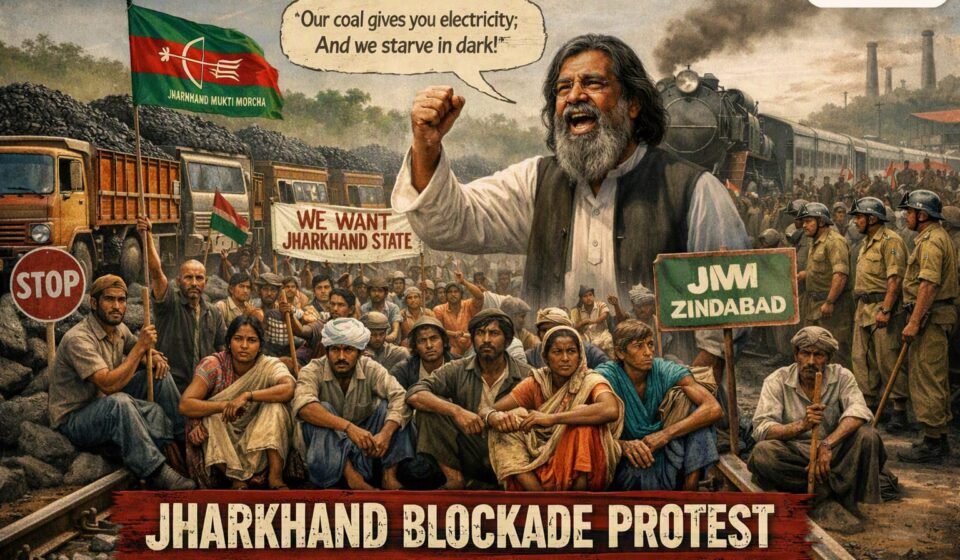
“Our coal gives you electricity; And we starve in dark”: Shibu Soren decries
Down Memory Lane- VII
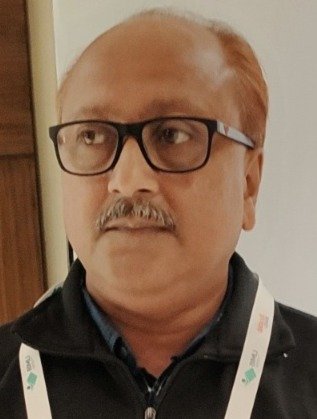
– By Gautam Sarkar
During the 1990s, the struggle to secure the rights of tribal and indigenous communities over their water, land and forests took an increasingly militant turn. In Santhal Pargana, the separate statehood movement led by Shibu Soren and Suraj Mandal under the banner of the Jharkhand Mukti Morcha (JMM) became particularly intense in early 1993.
Although the All Jharkhand Students’ Union (AJSU) and JMM had jointly launched the movement in the late 1980s, it assumed an increasingly explosive character from the beginning of the 1990s. Santhal Pargana made the most significant contribution to the struggle. In Chotanagpur and Singhbhum, the JMM leadership was largely in the hands of Shailendra Mahato, while Surya Singh Besra led the AJSU.
Santhal Pargana was Shibu Soren’s principal area of political activity. Over the years, he had played a major role in virtually dismantling the region’s age-old curse – the mahajani system, under which moneylenders exploited and dispossessed the poor. As a result, he enjoyed widespread support, mostly in the tribal heart-lands.
The Paharia movement against the British in 1780, regarded as one of the earliest tribal uprisings against British rule in the Indian subcontinent, and the Santhal Hul (rebellion) of 1855, led by Sidhu and Kanhu, left a deep historical legacy in the region. Nearly 135 years after the Santhal rebellion, the economic blockade launched in support of a separate Jharkhand state had begun to keep the then Bihar government on edge.
The Jharkhand Coordination Committee (JCC), bringing together the AJSU, JMM, smaller political parties, student organisations and ordinary local people, initially tried various means to press for a separate state. But to mount more pressure on the Bihar and Central governments, the economic blockade was launched.
Collecting reports for The Times of India, I had to travel to different parts of Santhal Pargana. I often encountered railway and road blockades there. Many times, I saw desperately poor villagers, dressed in dirty, torn clothes, sitting across the road and stopping traffic. When I asked them, they would tell me that they had taken to the streets on the instructions of their “Guruji” – Shibu Soren – to demand a separate state.
I remember one occasion when I was caught in such a blockade. I was eventually taken to Dumka by Durga Soren, Shibu Soren’s eldest son.
Santhal Pargana shared geographical boundaries with West Bengal and the northeastern parts of Bihar, and huge quantities of coal, stone, sand, valuable timber and other forest produce were transported by road and rail to different parts of the country. But the economic blockade brought this movement to a complete standstill. The government was losing lakhs of rupees in revenue every day. The Rajmahal Colliery in Godda district and the Chitra Colliery in Deoghar had come to a complete halt.
Several JMM leaders, including Stephen Marandi, Hemlal Murmu, Thomas Hansdak, Simon Marandi and many others, blocked major roads and railway tracks for days on end. I particularly remember an incident in front of the Chitra Colliery, where dozens of coal-laden trucks stood stranded while JMM leader Shashank Shekhar Bhokta and other activists sat on the road in protest.
Pointing towards Bhokta, Shibu Soren jokingly said to me, “Look, Bhokta is sitting here and stopping the coal-laden trucks so that you people in Bihar don’t get electric light anymore. You use our coal to light your homes, but why is it that ordinary people in this coal-rich region, and indeed across southern Bihar, cannot even afford two proper meals a day? We have endured enough oppression all these years. No more.”
That day, I was stunned by Shibu Soren’s words and could think of no reply because by then, I had already seen and understood the plights and miseries of the desperately poor people of Santhal Pargana – a region blessed with abundant natural resources.
At the time, Shibu Soren and his colleagues had demonstrated what could happen when ordinary, innocent people were driven to the point of rebellion. At the same time, through the economic blockade of Santhal Pargana, Soren was also laying out his political calculations for gaining power in the future.
A brief look at history: in 1995, the government was compelled to establish the Jharkhand Autonomous Council (JAC), and in 2000, it finally conceded to the creation of the full-fledged state of Jharkhand.
(to be concluded…. )