
The Purpose of Devotion Is to Cultivate Positive Emotions: Paramahamsa Swami Niranjanananda
Devotees Immerse Themselves in the Ocean of Bhagavata Katha
By Kumar Krishnan
Munger
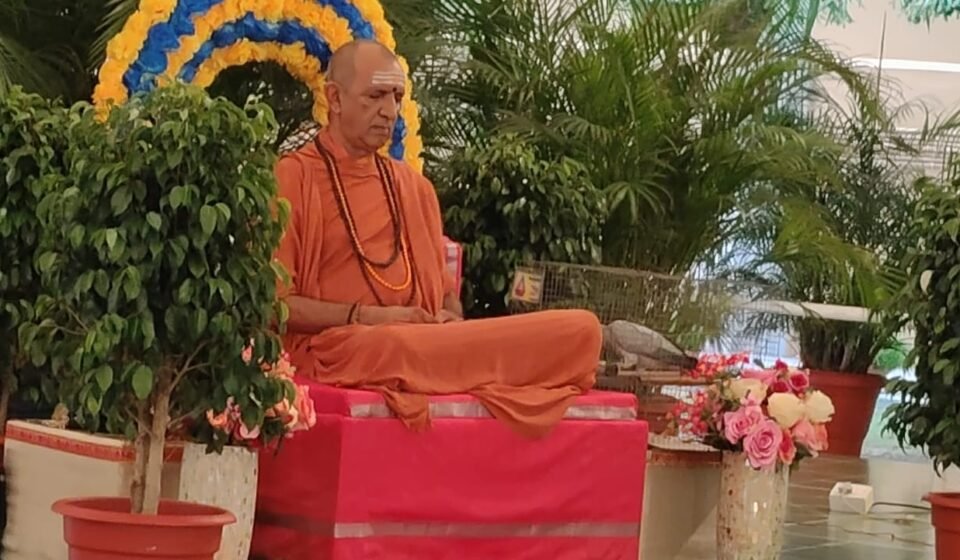
Paramahamsa Swami Niranjanananda Saraswati has said that the true purpose of devotion is to make human emotions positive, pure and refined. Unless emotions are transformed into positivity, the spirit of true devotion cannot arise. For this, a person must retain mastery over the direction of his emotions and keep their ‘remote control’ in his own hands. It is only through inner purification that devotion to the Divine becomes a natural experience.
He was addressing devotees on the second day of the Chaturmas observance at the Sannyasa Peetha of Paduka Darshan in Munger, where the Srimad Bhagavata Katha was being held. He said that just as a person cleans his home, so must he cleanse the mind of the dust of ignorance that settles upon it. When the mind is cleansed, thoughts become pure; purified thoughts refine emotions; and, in time, the individual turns towards the Divine.
Swami Niranjanananda said that devotion, knowledge and renunciation should not be viewed as separate paths. They are interconnected dimensions of spiritual life. The Narada Bhakti Sutra describes devotion as the awakening of supreme love. Bhakti, therefore, is not merely a matter of ritual, worship or religious observance; it is a transformative discipline that nurtures love, compassion and a positive outlook within the human being.
On the occasion, the renowned Manas Kokila of Bhagalpur, Krishna Mishra, immersed the devotees in the devotional spirit through her narration of the Srimad Bhagavata. The sacred discourse began with the chanting of “Sri Krishna Govinda Hare Murare, O Lord Narayana, Vasudeva.” The auspicious invocation included the hymns “Om Krishnaya Vasudevaya Haraye Paramatmane…” and “Sachchidananda Rupaya Vishvotpattiadihetave…”.
Referring to the birth anniversary of Swami Satyananda Saraswati, Krishna Mishra explained the profound spiritual realisation expressed in the words, “Rama is within me, and I am within Rama.” She interpreted the statement as an expression of the essential unity of the individual soul and the Supreme Being, in which the sense of separate ego ultimately dissolves.
Describing the Lord’s Maya as a “bewitching enchantress of countless forms,” she said that Maya entangles human beings in a multitude of appearances, desires and attractions. The way beyond such delusion is shown by the Sadguru, who guides the seeker away from the distractions of the external world and towards the inward journey. The purpose of devotion, she said, is not merely to seek God as something external, but to awaken within oneself that consciousness which is intrinsically connected with the Divine.
The episode of King Parikshit was presented as a profound spiritual teaching on mortality, repentance and liberation. After learning that he was destined to die on the seventh day as a consequence of a sage’s curse, Parikshit renounced his kingdom and made the sacred bank of the Ganga his place of contemplation. There he listened to the Bhagavata for seven days from Shukadeva. The episode conveys the timeless message that even the fear of death can be transformed into an opportunity for divine remembrance, self-examination and spiritual wisdom.
The central message of the Bhagavata Katha is that while external circumstances are not always within human control, the direction of one’s emotions, outlook and consciousness remains within one’s own hands. This inner purification ultimately lifts devotion beyond ritual and transforms it into a path of spiritual realisation.