Minerals, Federalism and the Jharkhand Question
By Mahesh Poddar
(Former Member of Parliament, Rajya Sabha)
Jharkhand has every reason to be sensitive about minerals. For decades, coal, iron ore and other minerals have left our soil to fuel India’s growth. We have also lived with what mining leaves behind — pressure on land and forests, displacement, damaged infrastructure and communities waiting for development to reach them.
It is, therefore, natural that the MMDR Amendment Act, 2026 has caused concern in Jharkhand. But a question of taxation and economic policy should not become a contest between Jharkhand and the Centre. The issue originates in the Supreme Court’s 2024 judgment in Mineral Area Development Authority v. SAIL. By an 8:1 majority, the nine-judge Constitution Bench held that royalty is not a tax and recognized the legislative competence of States to tax mineral rights.
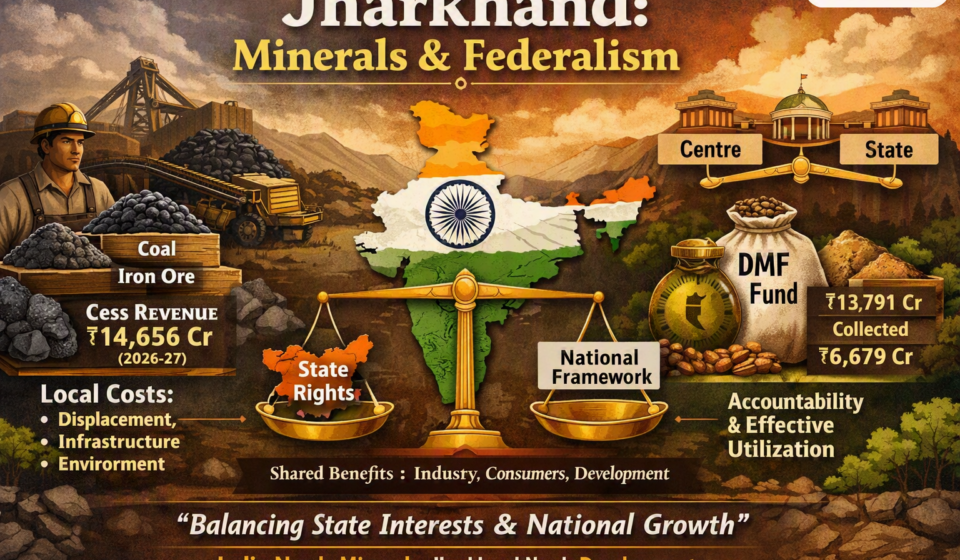
Jharkhand subsequently imposed a cess on mineral-bearing land. The amount is substantial. In its 2026-27 Budget, the State expects ₹14,656 crore from this cess. Its concern over the amendment is, therefore, understandable. But public policy cannot be decided by looking at one revenue head alone. Iron ore mined in Jharkhand travels into steel, engineering, railways and construction. Coal powers industries far beyond the State. Any additional cost imposed at the mine travels through this chain and is ultimately borne by industry and consumers.
There is an important parallel from the introduction of GST. When the GST Bill was being discussed in Parliament, I had argued that if the 28 internal economic boundary walls within the country could be removed, the national economy would gain significantly. The results are now visible. The rapid expansion of India’s economy demonstrates the value of reducing barriers between States and creating a more integrated national market.
This explains the Centre’s rationale. India cannot have a mineral economy where every producing State creates separate layers of taxes and cesses without a predictable national framework. Mining involves large investments and long time horizons. Fiscal uncertainty has a cost.
The amendment seeks to bring such levies within conditions and restrictions prescribed under the Central framework. To describe this simply as an attempt to take away Jharkhand’s rights misses an important part of the picture.
Consider the District Mineral Foundation (DMF). It was the Narendra Modi Government which, through the 2015 amendment to the MMDR Act, gave DMF statutory backing. Its principle was straightforward: a part of the value generated through mining must return to the people and areas bearing its consequences. DMF is funded by statutory contributions from mining leaseholders. It is meant for drinking water, healthcare, education, nutrition, livelihoods and other needs of mining-affected areas. The figures from Jharkhand deserve attention. By April 2025, more than ₹13,791 crore had been collected under DMF in the State, while expenditure was about ₹6,679 crore.
So, while demanding additional fiscal space, should we not also ask why thousands of crores already available specifically for mining-affected communities have remained unspent? This does not mean Jharkhand should receive less. The State bears genuine environmental, infrastructural and social costs and deserves a fair economic return. But a fair return and unrestricted taxation are not the same thing.
Nor should mineral taxation be confused with tribal land rights. Land ownership, acquisition, Scheduled Areas and protections available to tribal communities are governed by their respective constitutional and legal frameworks. Mixing the two issues may help politics, but not public understanding.
It is also important to remember that the Narendra Modi Government created this mechanism so that money from mining could reach the States and, especially, the affected districts. It is unfortunate that questions and objections are now being raised by those who governed the country for decades, but did not make comparable efforts to understand this problem or create an effective mechanism to ensure that mining-affected communities benefited from the wealth generated from their land.
If Jharkhand believes the amendment causes an unfair fiscal burden, it can place its numbers before the Centre and seek an appropriate arrangement. If constitutional competence is disputed, judicial review remains available. Protest is a democratic right. But a movement must also tell people the complete story. Jharkhand should ask what it receives for the minerals taken from its soil. It should equally ask how effectively the thousands of crores already available for mining-affected people are being used.
The experience of DMF utilization also deserves closer scrutiny. In mining regions such as Bokaro, the facilities and visible development that people should have received from these funds have often not matched the amounts available. There have also been serious questions and allegations regarding the use of funds, some of which appear to have remained buried in files rather than being brought to a satisfactory conclusion. Had the State Government taken stronger ownership of the issue and exercised sustained supervision over the utilization of DMF funds, the people of these regions might have seen far more tangible development.
India needs its minerals. Jharkhand needs development from its minerals. Good policy must achieve both.