
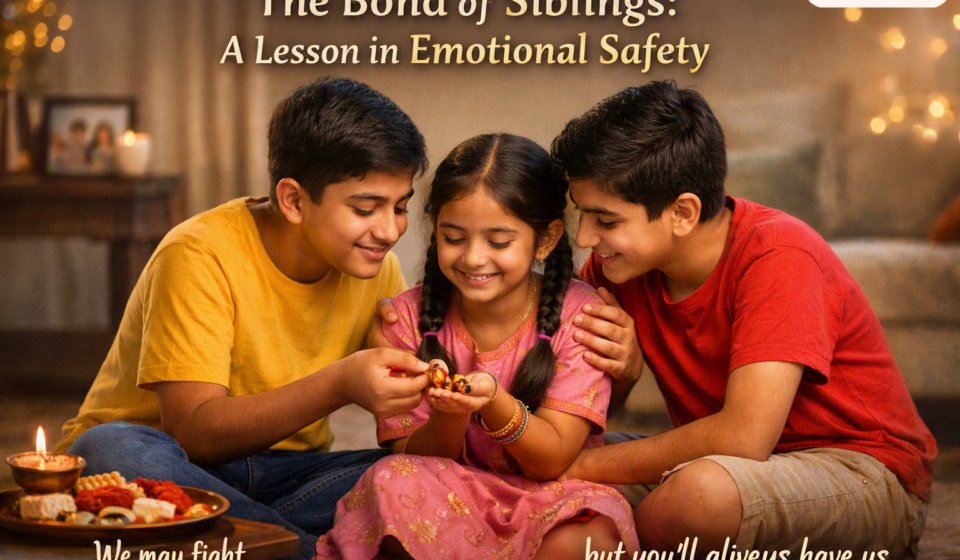
Beyond the Rakhi: What Sibling Bonds Teach Us About Emotional Safety
By Anjali Singh
I am the youngest sister of two elder brothers, and growing up, one of our favourite “time-pass activities” was teasing each other, competing over the smallest things and occasionally driving our parents a little crazy.
Who would bat first? Who would bowl? Who would get the bigger share of the best mangoes? During family trips, who would sit near the window? Almost anything could become a matter of serious sibling negotiation.
One Raksha Bandhan morning, when I was about eight, my brothers had been arguing since they woke up about who would get the bigger piece of Dairy Milk later. By the time I brought out the rakhi plate, they were still glaring at each other.
I tied the first rakhi on my elder brother’s wrist. He immediately declared that it looked better than the one I was about to tie on my younger brother.
Naturally, that started another round of “Mine is nicer!”
Then, in the middle of their bickering, both suddenly stopped, looked at me and, without planning it, each pressed a small toffee into my hand.
The disagreement resumed within minutes, of course.
In that brief, funny moment, they had quietly agreed on one thing: their little sister was to be looked after.
Those noisy, slightly ridiculous mornings remain some of my happiest childhood memories. Looking back, I realise there was something comforting underneath the chaos: I knew I mattered to both of them, even when they were busy trying to outdo each other.
That small moment also taught me something I understand more clearly today. Emotional safety is not always expressed through serious conversations or grand gestures. Often, children experience it through ordinary acts of care—a shared treat, a familiar presence or the reassurance that someone will stand by them even after an argument.
When we talk about children’s emotional well-being, we often think about marks, school, screen time and the pressures children face today. These conversations matter.But emotional well-being is also shaped in quieter moments at home, especially through children’s earliest relationships with siblings, cousins and caregivers.
Home is where children first learn about relationships. Siblings can become early teachers of sharing, negotiation, boundaries, empathy and repair. Children may not know these words, but they experience them every day.
They learn that someone can irritate them and still love them. They learn that being upset does not mean walking away forever.
Children do not need relationships without disagreements. They need relationships in which disagreements can be repaired. That, to me, is emotional safety—the quiet assurance that love will still be there afterwards.
This may be one reason Raksha Bandhan continues to hold such a special place in our lives. The traditional idea of protection has gradually become more mutual. Sisters protect brothers, brothers support sisters, and siblings become each other’s sounding boards, cheerleaders and, sometimes, much-needed reality checks.
The promise is no longer simply, “I will protect you.”
It is: “I am here with you.”
Even the way we celebrate has changed. My niece sends Rakhi and sweets to my son online. Personalised rakhis arrive at our doorstep, gifts are ordered with a few clicks, and siblings living in different cities or countries celebrate through video calls.
The ritual has changed, while the feeling has travelled intact.
That feeling may be more important than ever. Children today navigate academic expectations, social comparison, digital distractions and pressures that adults may not always see. Having someone with whom they can simply be themselves can be deeply reassuring.
As families become smaller and many children grow up without siblings, we may need to be more intentional about creating such relationships. A cousin, close friend, mentor or trusted adult can also offer a child a sense of belonging and emotional safety.
The real gift of Raksha Bandhan is imperfect, reliable love.
This Raksha Bandhan, perhaps we can pause and ask:
Do the people around me feel safe enough to disagree with me, make mistakes and still know they belong?
Emotional safety is not a home without arguments. It is not the absence of raised voices, hurt feelings or slammed doors. It is the confidence that conflict will not erase connection—that someone can say, “I am angry,” and still know, “I am loved.”
My brothers did not always protect me from life, and they certainly did not protect me from sibling quarrels. They gave me something more lasting: the knowledge that love could survive disagreement.
That little toffee, pressed into my hand in the middle of their bickering, was their cheeky way of saying what I understand much better today:
“We may not always agree. We may even drive one another crazy. You will still have us.”
Perhaps that is the promise every child deserves—not a perfect relationship, but a dependable one; not a conflict-free home, but a home where people find their way back to one another.
———————
Anjali Singh, founder of Paramarsh by AS, works with students, parents, educators and corporates on emotional well-being, career clarity and holistic growth.