Economic blockade: the ultimate weapon for separate Jharkhand
By Gautam Sarkar
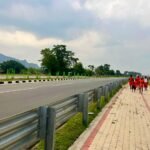
As far as the eye could see, the land stretched in endless shades of green. In the distance, the Rajmahal Hills pierced the horizon, guarding one of India’s oldest tribal heartlands — the Santhal Pargana.In early 1994, family obligations drew me back from the Northeast. Seeking work, I approached the editor of The Times of India in Patna. Instead of sending me elsewhere, he offered me an assignment in the Santhal Pargana, not far from my hometown of Bhagalpur. The moment the name was mentioned, memories of train journeys past the Rajmahal Hills came alive. I could not refuse.I still recall that first day. At dawn, I boarded a bus from Bhagalpur to Dumka. After crossing Mandar Hill, the road opened into a panorama of breathtaking greenery. Four hours later, I arrived at Dumka bus stand.The only person I knew there was Subhashini Didi, a lecturer at S. M. College, Bhagalpur. Her husband, Professor Stephen Marandi — scholar, man of few words, and senior leader of the Jharkhand Mukti Morcha (JMM) — was Shibu Soren’s trusted lieutenant. At his residence, I found crowds of tribal villagers seeking help. He welcomed me warmly, making me feel at home.My arrival coincided with a turbulent period. Southern Bihar was in the grip of an intense mass movement for a separate Jharkhand. The JMM, the All Jharkhand Students Union (AJSU), tribal leaders, activists, and ordinary villagers were united in their demand. Their grievance was clear: Patna’s long-standing control had deprived them of the wealth from minerals and forests. Despite living amidst abundance, they endured poverty, exploitation, and neglect.A day later, Professor Marandi introduced me to Shibu Soren — Guruji, Dishom Guru, the “world leader.” Despite his busy schedule, he spoke to me at length. At the time, he was deeply engaged in the campaign for an economic blockade — halting the transport of minerals and forest produce to pressure the government.Guruji explained that the royalty paid by the Centre was negligible, and whatever funds trickled down through Patna rarely reached southern Bihar. This systematic deprivation, he argued, had condemned the region to backwardness and dependency.That same day, I met villagers at Marandi’s home. Their stories shocked me. Decades after Independence, they still lived with unimaginable hardships. Reflecting on the indifference of politicians and officials, I felt deeply ashamed.Around then, The Times of India had introduced columns inviting public opinion on the blockade. I recall publishing one such piece by Professor Ashok Kumar Das of Sahibganj College. His arguments in support of the blockade echoed precisely the grievances I had heard from villagers in Dumka.
(To be concluded …)