
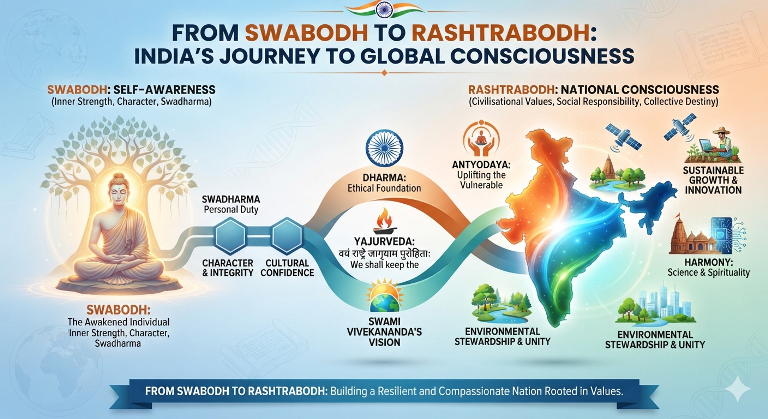
From Self-Awareness to National Consciousness
By Dr. (CA) Rajeev Kamal Bittu
India’s rise as a global power will depend not only on economic strength and technological advancement but also on an awakened citizenry rooted in civilisational values.
India today stands at a defining moment in its civilisational journey. As the nation aspires to become a developed economy and an influential global power, an equally important question demands attention: What kind of society will sustain this rise? Economic growth, technological innovation and political stability are indispensable, but they cannot alone build a resilient nation. Lasting national strength emerges from awakened citizens who possess character, cultural confidence and a deep sense of responsibility towards society. This is where the Indian idea of Swabodh—self-awareness—assumes profound significance.
The journey from Swabodh to Rashtrabodh (national consciousness) reflects one of India’s oldest civilisational insights. The Yajurveda declares, “वयं राष्ट्रे जागृयाम पुरोहिताः”, calling upon enlightened individuals to keep the nation awake and vibrant. The message is clear: national regeneration begins not with institutions alone but with individuals who recognise their duties towards the larger collective.
Self-awareness in the Indian tradition extends far beyond personal success or individual identity. It begins with understanding one’s Swadharma—the responsibilities that arise from one’s nature, values and conduct. Such awareness naturally broadens from the individual to the family, society and ultimately the nation. National consciousness, therefore, is not manufactured through slogans or legislation; it evolves through character, discipline and shared cultural values.
Political independence, achieved in 1947, fulfilled a historic aspiration. Yet genuine freedom is a continuing process. A nation becomes truly free when its people think independently, preserve confidence in their civilisational heritage and shape their future according to their own cultural ethos. Intellectual dependence can persist long after political colonialism ends. The challenge before contemporary India is therefore not merely economic development but civilisational self-confidence.
The wisdom of India’s scriptures remains remarkably relevant. The injunction “स्वाध्यायात् मा प्रमदः” reminds us never to neglect self-study and introspection, while the Bhagavad Gita urges, “उद्धरेदात्मनाऽत्मानं नात्मानमवसादयेत्”, calling upon every individual to elevate oneself through inner strength. These teachings cultivate self-reliance, moral courage and social responsibility—the essential qualities of responsible citizenship.
Swami Vivekananda observed that every nation has a distinctive mission. India’s enduring contribution has been to harmonise material progress with ethical values and spiritual insight. The Vedic declaration “कृण्वन्तो विश्वम् आर्यम्” expresses this universal aspiration to ennoble humanity. The foundation of this vision is Dharma—not merely religion, but the principle that sustains individuals, society and the natural order. Development divorced from ethical responsibility ultimately weakens both society and the environment.
These ideas are not abstract philosophical ideals; they find expression in everyday life. The six dimensions of Swabodh articulated by Shri Mohan Bhagwat—Bhajan, Bhojan, Bhraman, Bhavan, Bhasha and Bhusha—highlight how devotion, food, travel, architecture, language and attire reflect deeper cultural values. Similarly, the broader societal vision of Panch Parivartan emphasises family cohesion, social harmony, environmental responsibility, Swadeshi, civic duty and respect for Indian languages. Together, they encourage citizens to live consciously while remaining rooted in India’s civilisational ethos.
India’s development model must also reflect this balance. Economic prosperity should be guided by the principle of Antyodaya, ensuring that the benefits of growth reach the most vulnerable. Sustainable development should arise from India’s long-standing reverence for nature, where rivers are honoured as mothers, forests as sacred spaces and the Earth herself is addressed in the Atharva Veda: “माता भूमिः पुत्रोऽहं पृथिव्याः”. Environmental stewardship thus becomes a cultural value rather than merely a policy objective.
Likewise, education should aim beyond employability. A nation requires not only skilled professionals but also ethically grounded citizens capable of balancing individual aspirations with social obligations. Science and technology provide powerful tools for national advancement, but culture and values determine the direction in which those tools are used.
History offers repeated evidence that India’s greatest periods of resurgence have emerged through renewed civilisational confidence. From the Vedic sages and the Buddha to Adi Shankaracharya, Chanakya, Chhatrapati Shivaji Maharaj and Mahatma Gandhi, transformative leadership has consistently drawn strength from inner awakening before inspiring wider social and national renewal.
The world today confronts crises of conflict, environmental degradation, consumerism and social fragmentation. Material progress alone has not delivered lasting peace or human fulfilment. India’s civilisational philosophy offers a complementary vision that seeks harmony between science and spirituality, prosperity and restraint, rights and duties, and individual freedom and collective responsibility.
As India moves towards becoming a leading global power, its greatest strength will lie not merely in economic indicators or geopolitical influence but in citizens who combine competence with character and ambition with responsibility. Political freedom was won by previous generations. Our responsibility is to deepen that freedom by nurturing self-aware individuals who contribute to a confident, cohesive and compassionate nation.
Ultimately, the path from Swabodh to Rashtrabodh is the path from personal transformation to national renewal. When citizens awaken to their higher purpose, the nation rediscovers its enduring civilisational mission—not only for its own progress but also for the larger welfare of humanity.

(Bittu is Prant Sampark Pramukh
Rashtriya Swayamsevak Sangh, Jharkhand)