Bamboo Can Transform Jharkhand If We Build the Right Ecosystem
OPINION
By Prof. Anant Kumar
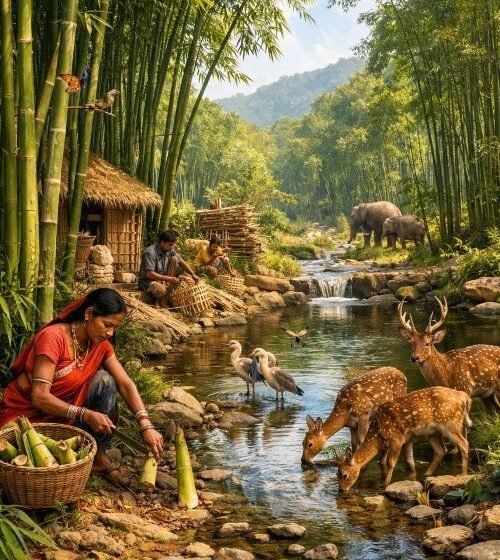
Bamboo has long been part of the social, cultural, and economic fabric of Jharkhand. For generations, tribal and rural communities have relied on it for housing, handicrafts, baskets, and everyday household items. However, despite abundant bamboo resources and craftsmanship, Jharkhand has failed to harness them as a strategic economic asset. Particularly when the world seeks climate-friendly materials and sustainable livelihoods, bamboo may offer Jharkhand an opportunity to address rural poverty, unemployment, climate resilience, and green industrialisation.
Bamboo has potential and can be promoted in Jharkhand to advance the green economy by building the right ecosystem to replace timber, plastic, steel, and even concrete across construction, furniture, packaging, textiles, engineered boards, and bioenergy. Jharkhand, blessed with suitable agro-climatic conditions and extensive forest landscapes, is well-positioned to change this narrative if it builds the right ecosystem and adopts a comprehensive bamboo development strategy.
The state has a comparative advantage for promoting a green economy, considering the availability of a variety of bamboo species across several districts, including Ranchi, Gumla, Lohardaga, Dumka, Deoghar, Latehar, and West Singhbhum. These species support a wide range of enterprises, including furniture, engineered bamboo boards, handicrafts, bamboo housing, agarbatti sticks, edible shoots, eco-packaging, and utility products. This diversity offers Jharkhand an opportunity to build multiple value chains rather than depend on a single product category.
Interestingly, despite these opportunities, the bamboo sector in Jharkhand remains underdeveloped for various reasons, including the absence of a bamboo-specific state policy and the lack of a required ecosystem. Most bamboo is still harvested from natural forests, while scientific bamboo cultivation on private and community lands remains negligible. In addition, there is a shortage of quality nurseries, treatment facilities, seasoning plants, and modern processing infrastructure. Consequently, artisans are forced to use low-quality raw materials, undermining product durability, and market competitiveness.
Another concern is the lack of a supportive market ecosystem. Most artisans continue to produce traditional products for local markets, with little to no design innovation, branding, packaging, or digital marketing capabilities. Weak inter-departmental coordination, inadequate financial support, poor logistics, and fragmented producer groups further undermine the sector’s competitiveness. Women artisans, despite being the backbone of bamboo crafts in many districts, often lack access to enterprise development, market information, and formal financing.
The answer, therefore, lies not merely in promoting bamboo cultivation but in developing an integrated bamboo ecosystem. This requires connecting farmers, artisans, entrepreneurs, researchers, financial institutions, designers, industries, and markets through a coordinated institutional framework. It is equally important to develop bamboo as a viable livelihood option and to support artisans, as many are leaving this work because it is no longer profitable and they struggle to meet day-to-day expenses due to poor demand and low market prices. There is a need to view bamboo as an economic ecosystem rather than an isolated craft activity.
The priority must be a dedicated Jharkhand Bamboo Industrial and Livelihood Policy that provides long-term direction for the sector. Such a policy should promote bamboo plantation on degraded lands, community lands, private farms, coal mine overburden areas, and watershed regions by converging with Viksit Bharat – Guarantee for Rozgar and Ajeevika Mission – Gramin (VB-G RAM G), the National Compensatory Afforestation Fund Management and Planning Authority (CAMPA), watershed development, and the National Bamboo Mission to create green employment, restore degraded landscapes, and strengthen climate resilience.
Second, the state should establish bamboo industrial clusters with Common Facility Centres (CFCs) that will provide treatment plants, machinery, testing laboratories, design support, incubation facilities, and shared marketing infrastructure. Well-governed CFCs can significantly reduce production costs and enable artisans and micro-enterprises to produce standardised, high-quality products for national and international markets.
Third, investment in research, innovation, and skill development is equally important. Partnerships among technical institutions, universities, design schools, and industry can help develop new product lines in engineered bamboo, modular housing, furniture, eco-friendly packaging, bamboo composites, activated carbon, and biochar. Bamboo entrepreneurship should become an attractive career option for rural youth, rather than a traditional occupation.
There is a need to recognise bamboo’s environmental dividends. It matures in three to five years, sequesters significant amounts of carbon dioxide, prevents soil erosion, restores degraded landscapes, and supports biodiversity. Large-scale bamboo plantations could generate substantial carbon credits, ease pressure on timber resources, and promote the use of low-carbon construction materials. In an era of climate uncertainty, bamboo is not merely an economic crop; it is a climate solution.
Jharkhand stands at a critical juncture, poised to build a vibrant green economy rooted in local resources, skills, and entrepreneurship. With visionary policy, institutional convergence, private investment, and community participation, bamboo can become a cornerstone of inclusive development, creating thousands of green enterprises, empowering tribal communities and women, and positioning Jharkhand as India’s leading bamboo economy.

The author is a Professor at Xavier Institute of Social Service, Ranchi. The views expressed are personal.
Email: pandeyanant@hotmail.com)