
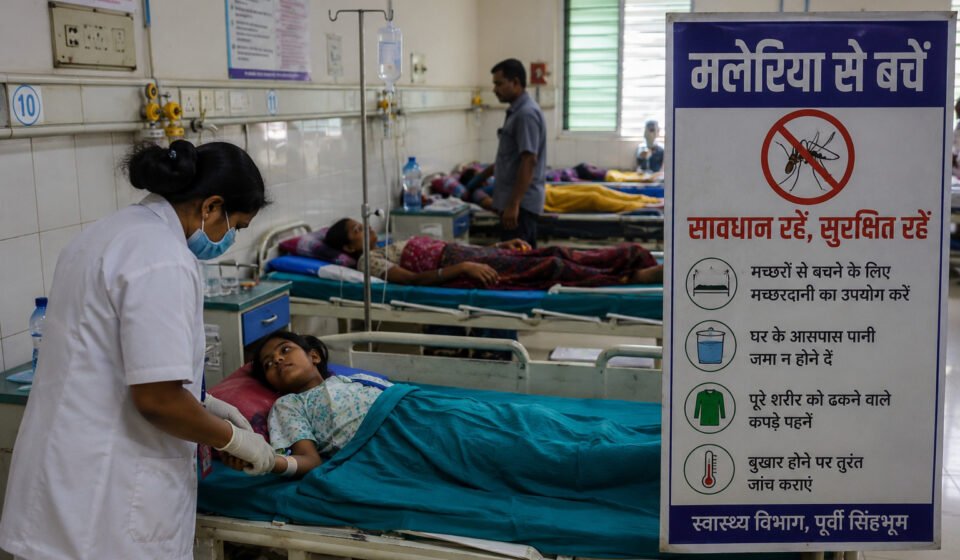
Malaria cases surge in East Singhbhum, over 1,800 infections reported in two weeks
Pioneer News Service
Jamshedpur
East Singhbhum district is witnessing a sharp rise in malaria cases, with 1,826 infections reported over the past 14 days, prompting the Health Department to intensify surveillance, treatment and preventive measures across affected areas. On Saturday alone, 110 new malaria cases were detected during extensive screening drives.
The outbreak has been most severe in Potka block, where repeated screening campaigns have been carried out following several cerebral malaria cases and related deaths in recent weeks. Health teams have been conducting door-to-door surveys, fever screening and rapid malaria tests in vulnerable villages.
Medical officials have intensified malaria surveillance in high-risk villages by distributing medicines, conducting awareness campaigns and advising residents to seek immediate medical attention if they develop fever or other symptoms. Special emphasis is being placed on early diagnosis and prompt treatment to prevent severe complications such as cerebral malaria.
With malaria cases beginning to appear in urban areas as well, civic authorities have launched an intensified anti-mosquito campaign. Regular fogging and anti-larval spraying are being carried out in waterlogged areas, drains and mosquito breeding sites.
Officials said that whenever a malaria patient is identified, a special containment drive covering a one-kilometre radius around the patient’s residence will be undertaken to curb further transmission.
Health authorities have appealed to residents to use mosquito nets, eliminate stagnant water around their homes, maintain cleanliness and report fever cases without delay. Officials said public cooperation would play a vital role in controlling the spread of malaria during the ongoing monsoon season.
Clinical breakdowns reveal a highly aggressive transmission pattern, with the Plasmodium falciparum (PF) strain accounting for an overwhelming 1,361 cases, while the Plasmodium vivax (PV) strain was detected in 326 patients. The worst-hit pockets include rural and tribal-dominated belts such as Potka, Musabani, Dumaria, and Ghatshila, where monsoon-induced water stagnation has rapidly accelerated vector breeding.
In response to the growing health emergency, Ajay Kumar Singh, the Additional Chief Secretary of the Health, Medical Education, and Family Welfare Department, has directed the Mahatma Gandhi Memorial Medical College and Hospital (MGMMCH) to lead a comprehensive on-ground investigation.
A specialized team from MGMMCH’s Department of Preventive and Social Medicine (PSM) is invading the worst-affected villages. The team has been tasked with studying the transmission chain, reviewing living and environmental conditions, and analyzing every single malaria-related casualty to rule out or establish medical negligence. Principal of MGMMCH, Dr. Sanjay Kumar, confirmed he has requested extensive daily case trackers from District Civil Surgeon Dr. Sahir Pal.
As scrutiny intensifies over the handling of the outbreak in the hard-hit Potka block, the administration has taken stringent punitive actions. Dr. Rajani Mahakaud, the Medical Officer In-Charge of the local Community Health Centre (CHC), has been placed under immediate suspension. Furthermore, 11 doctors posted at the same facility have been served with formal show-cause notices for failing to contain the early spread.
Previously, the district administration had also sealed a private clinic in Potka for alleged medical negligence after it failed to correctly treat a young student showing clear symptoms.
While public panic regarding “brain malaria” has escalated following the deaths of multiple children in Potka, Civil Surgeon Dr. Sahir Pal has stepped in to clarify the medical realities.