Pioneer News Service
Ranchi
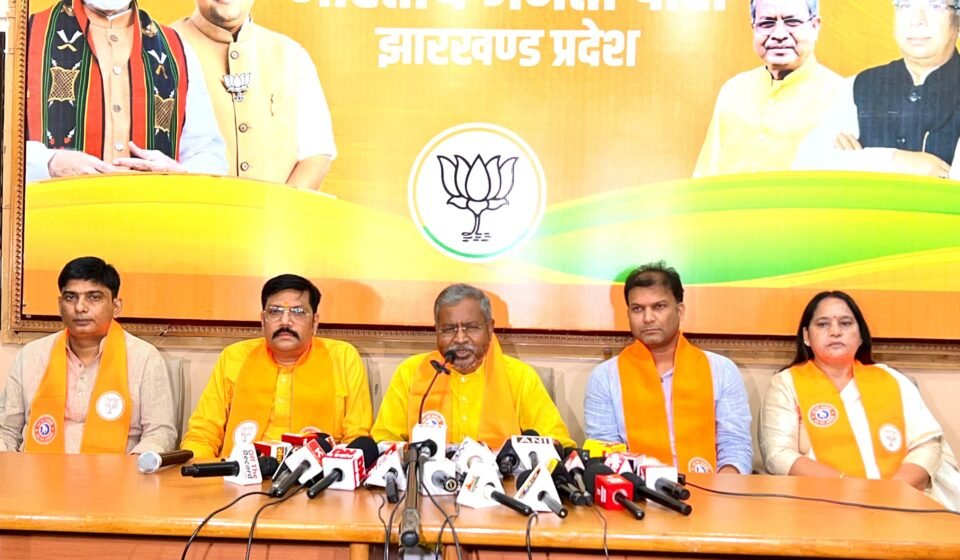
BJP leader and Leader of the Opposition Babulal Marandi stated that Jharkhand—a state rich in mineral wealth—has failed to realize its full potential due to policy failures, administrative lethargy, and a lack of transparency. Despite possessing approximately 40 percent of the country’s mineral resources, the state lags behind in mining revenue, production, employment generation, and the auctioning of new mines; this constitutes an injustice to the youth and the economy.
He noted that the situation appeared alarming during his recent visit to the Saranda region of Chaibasa. Several mines have remained closed for years because their leases were neither renewed nor re-auctioned after expiration. This has had a direct impact on employment, led to increased migration of the youth, and caused the local economy to stagnate.
Jamda market, once a hub of economic activity, is currently grappling with a downturn. Incomes have fallen, purchasing power has weakened, and small businesses have suffered. The closure of mines has affected not only the laborers but also the transport, hospitality, retail, and small-scale industrial sectors. He cited Barbil in Odisha—located just 20 kilometers from Jamda—as a contrasting example, where timely auctions have led to increased production and employment. This disparity stems not from a lack of resources, but from a lack of political will and administrative competence.
Marandi pointed out that since 2019-20, 434 mineral blocks have been auctioned across the country; of these, Odisha accounted for 45 and Chhattisgarh for 41, whereas Jharkhand saw the auction of only three blocks. Such a low number of auctions over six years reflects administrative failure, which has adversely impacted production, employment, and revenue.
He added that the impact on production is also evident. Between 2018-19 and 2024-25, Odisha’s iron ore production rose from 120 million tonnes to 180 million tonnes, while Jharkhand’s output remained stagnant at 23 million tonnes. This highlights a failure in mining management and policy. Jharkhand also lags behind in terms of revenue generation. Despite possessing 40 percent of the country’s mineral resources, the state’s mining revenue stood at ₹22,000 crore in 2025-26, whereas Odisha earned ₹46,000 crore with just 17 percent of the resources.
He noted that the condition of stone quarries in Chaibasa is also poor. In Noamundi, seven out of nine mines are closed. The ACC plant in Jhinkpani, operational since 1946, is set to shut down on August 16, affecting approximately 1,600 families.
Marandi stated that there is a serious lack of transparency regarding the utilization of the DMFT fund. Between 2016 and 2026, approximately ₹3,700 crore was accumulated in West Singhbhum, yet no annual reports, budgets, or project details have been made public. The last website update dates back to 2018, leaving local people deprived of their rights.
State media in-charge Yogendra Pratap Singh, state spokesperson Sandeep Verma, Shobha Yadav, and Mrityunjay Sharma were also present on this occasion.