Kumar Prabhat
Dumka
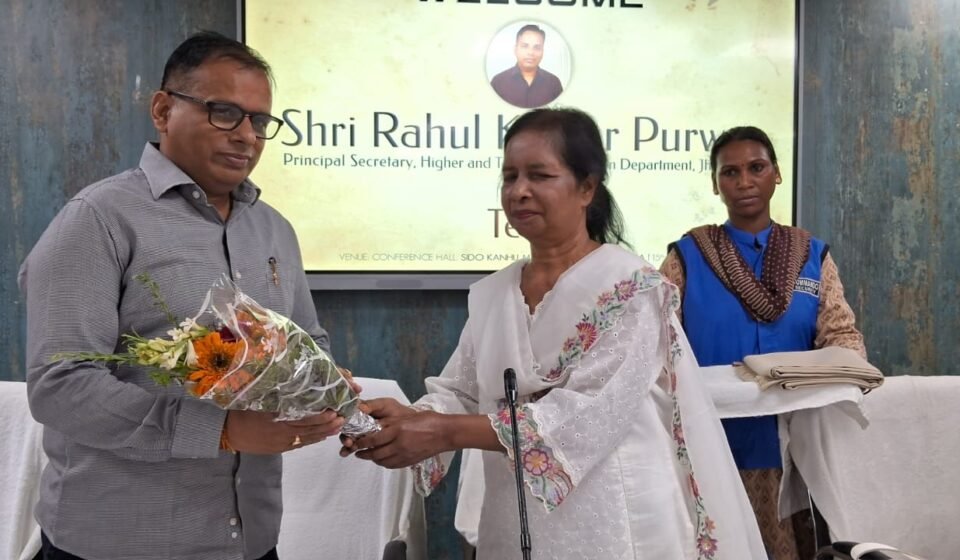
Jharkhand is set to witness a major transformation in its higher and technical education sector as the state government rolls out an ambitious reform agenda aimed at aligning academic institutions with industry requirements, boosting employability, and reducing youth migration. The announcement was made by Higher and Technical Education Department Principal Secretary Rahul Kumar Purwar after reviewing the functioning of Sido Kanhu Murmu University (SKMU) in Dumka.
The government plans to restructure technical education by creating region-specific academic clusters tailored to local economic strengths. While clusters in Godda and Dumka have already been initiated, another is being planned for Sahibganj. The initiative seeks to harness the industrial and traditional strengths of the Santhal Pargana region, particularly the textile sector, enabling students to become entrepreneurs and job creators instead of merely seeking employment.
To strengthen technical education infrastructure, the state has proposed establishing an Engineering College in Sahibganj, a Dairy Engineering College in Hansdiha, and six to seven new polytechnic institutes. Infrastructure expansion is also underway at long-established institutions, including SP College and Millat College, to improve academic facilities.
Addressing the long-standing shortage of faculty and administrative staff, the government will implement the State University Service Commission Act to expedite appointments and promotions. Following a comprehensive review of sanctioned posts and reservation rosters, the department plans to launch a large-scale recruitment drive in the first half of 2027 to fill permanent positions for teachers, registrars, finance officers and principals across state universities.
Purwar also announced the introduction of a unified academic calendar to ensure timely admissions, examinations and declaration of results. The state will fully implement the National Education Policy (NEP), offering multiple entry and exit options that allow students to earn certificates, diplomas, degrees, honours with research and integrated master’s qualifications at different stages of their academic journey.
The revised curriculum will incorporate courses aligned with Jharkhand’s economic potential, including eco-tourism, hospitality, agribusiness, floriculture and horticulture, with the objective of creating a skilled workforce suited to local industries.
Meanwhile, Dumka is also emerging as a centre for science education and public outreach. The city’s newly built planetarium is scheduled to open next month, while the adjoining Science Centre is expected to be structurally completed by November, with its exhibits becoming operational next year.
Speaking on the occasion, Purwar said the reforms are intended to modernize higher education, strengthen institutional governance and create greater employment opportunities for students within Jharkhand itself.