
The AI Debate Is Asking the Wrong Question
BY: DEVANSHU JHA
(PART 1)
Artificial intelligence will not simply replace jobs. It will relocate India’s next economic constraint. Every major technological revolution has been accompanied by the same fear: machines will replace human labour. Artificial intelligence (AI) has amplified that anxiety unlike any previous innovation. As AI systems begin writing software, analysing financial data, diagnosing diseases and automating routine office work, the dominant public debate has become narrowly focused on one question: How many jobs will AI destroy?
It is an important question. But it is no longer the most important one. The real question is this: Where will AI relocate India’s next economic constraint?
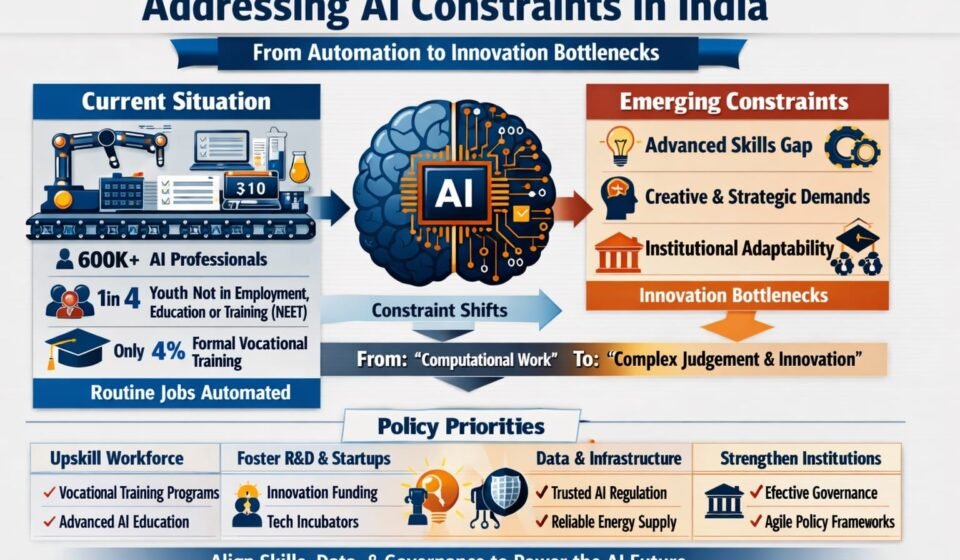
India stands at a remarkable technological moment. The country’s AI ecosystem is expanding at one of the fastest rates in the world. According to recent industry estimates, India’s domestic AI market is projected to exceed US$17 billion by 2027, supported by over 600,000 AI professionals, nearly 2000 AI start-ups, robust digital public infrastructure and the 10,000 crore India AI Mission. The Government has also highlighted that India ranks among the world’s leading AI-ready economies, with AI talent acquisition growing by about 33% annually.
Yet this technological optimism coexists with an uncomfortable reality. According to the Periodic Labour Force Survey (PLFS), youth unemployment among those aged 15-29 remains around 15%, while nearly one in four young Indians are not in employment, education or training (NEET). Compounding this challenge, only about 4% of India’s workforce has received formal vocational training: a share far below that of countries such as Germany, Japan and South Korea, where vocational education and apprenticeship systems are deeply embedded in industrial development.
At the same time, businesses are increasingly reporting shortages of advanced AI talent, systems architects and domain specialists even as AI investments accelerate. The issue, therefore, is not simply whether India possesses the right technological building blocks, but whether the complementary capabilities needed to translate AI into productivity are evolving at the same pace. Otherwise, the economy’s binding constraint will migrate to whichever complementary capability lags behind.
This paradox exposes a deeper flaw in the way we think about technological change. Economic debates usually assume that new technologies either eliminate constraints or create opportunities. Reality is more subtle. Technologies rarely eliminate structural constraints; they relocate them. Every innovation relaxes one bottleneck while simultaneously exposing another. Steam engines reduced dependence on human muscle but created new constraints in urban sanitation and public health. The internet lowered information costs but elevated cybersecurity and data governance into strategic priorities.
AI will follow the same pattern. Its greatest impact will not be the disappearance of work but the migration of economic bottlenecks.
This phenomenon may be called constraint transmogrification: the process by which the resolution of one binding constraint generates another elsewhere because complementary capabilities fail to evolve at the same pace. Constraint transmogrification refers to the process through which resolving one binding constraint causes another complementary capability to become the economy’s new binding constraint because different capabilities evolve at different rates. When AI automates repetitive cognitive work, the scarcity shifts from computation to creativity, from routine execution to complex judgement, from information processing to institutional adaptability. The constraint no longer lies in producing knowledge; it lies in converting knowledge into productive economic capability.
Consider India’s globally competitive IT services industry. For decades, its comparative advantage rested on a vast pool of engineers delivering standardised coding, testing and business-process services. Generative AI is now beginning to automate many of these routine tasks. Conventional analysis therefore asks whether programmers will lose jobs. That diagnosis is incomplete. The more profound transformation lies elsewhere. As routine programming becomes increasingly automated, India’s competitive advantage will depend less on the quantity of software engineers and more on the quality of product architects, AI researchers, cybersecurity experts, chip designers, interdisciplinary innovators and entrepreneurial firms capable of creating new technologies rather than merely implementing existing ones.
The binding constraint is already moving. Yesterday it was access to digital technology. Tomorrow it may be the capacity to innovate, govern and adapt. The countries that recognise this migration early will not merely use AI more effectively; they will shape the next phase of global economic leadership. The AI revolution will not be won by the countries that deploy the largest language models or build the fastest supercomputers. It will be won by those that recognise where the next binding constraint is emerging and act before it becomes a crisis. Yesterday the constraint was digital infrastructure. Tomorrow it may be advanced skills, trusted data, entrepreneurial finance, electricity for AI infrastructure or institutional capacity. Economic leadership in the AI age will therefore belong not to the fastest adopters of technology, but to the fastest synchronisers of complementary capabilities.
To be continued…..
(Devanshu Jha is a public policy expert and thought leader .He is an alumnus of London School of Economics, Lee Kuan Yew School of Public Policy and IIM RANCHI.)