
By Sanjeevv Shekhar
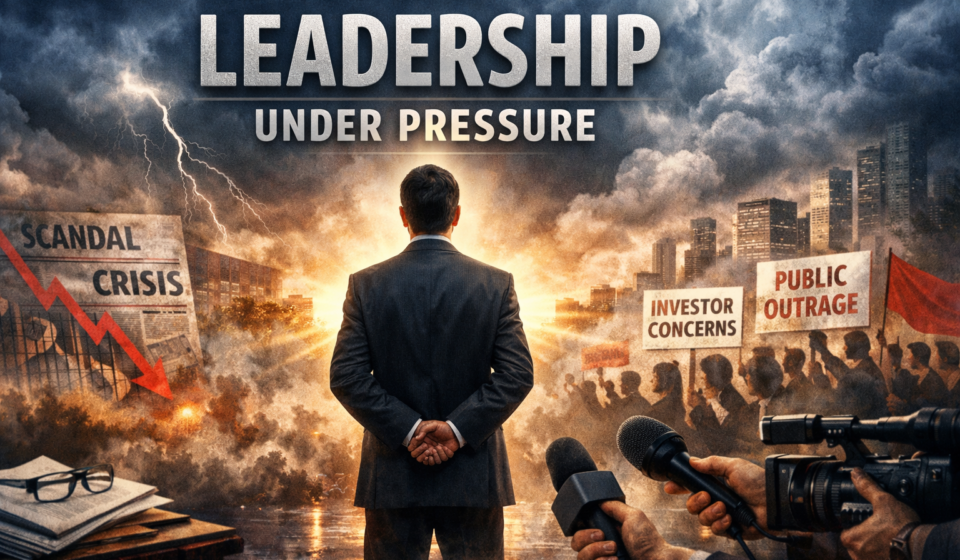
It is easy to lead when business is doing well. Revenue is growing, markets are supportive and stakeholders are happy. But these are not the moments that define leadership. The true character of a leader becomes visible when an institution faces criticism, uncertainty and intense public scrutiny.
In my three decades of experience in Corporate Affairs, Government Relations and Reputation Management, I have realised that every organisation will face difficult times. What separates great leaders from ordinary ones is not the absence of a crisis. It is the way they respond to it. Ethical leadership is about remaining calm, standing by facts, respecting institutions and keeping the confidence of employees and stakeholders intact.
A recent example is the Adani Group. On 24 January 2023, Hindenburg Research published a report that triggered one of the most significant corporate challenges in recent years in India. The Group came under intense public scrutiny, its market valuation witnessed a sharp decline and uncertainty spread across investors and stakeholders. During this difficult period, the organisation continued its business operations, engaged with investors and regulators and focused on restoring confidence through institutional processes and long-term business fundamentals. More importantly, Chairman Gautam Adani urged employees to remain calm, stay committed to their work and have faith that the organisation would emerge stronger through facts, transparency and resilience. The episode also demonstrated how external allegations and market sentiment can severely test an organisation’s reputation, making ethical leadership and stakeholder confidence even more critical. Separately, Hindenburg Research announced in early 2025 that it was winding up its operations. These developments underline an important governance lesson. Institutions should respond to pressure through facts, transparency, and due process rather than through panic or aggression.
Indian corporate history offers another important lesson. During 1985 to 1988, Reliance Industries became the target of what later came to be known as the Bear Cartel episode, when a group of market operators attempted to weaken investor confidence through aggressive short selling of the company’s shares. Instead of reacting emotionally, Dhirubhai Ambani remained focused on strengthening stakeholder confidence. He placed his faith in business performance, transparent communication and the trust of lakhs of retail investors. The company not only weathered the challenge but went on to become one of India’s most respected corporate institutions.
These examples are not about comparing companies. They are about understanding what ethical leadership looks like when institutions come under pressure. Every Board should pay close attention to how leaders behave during such moments. Do they protect the organisation’s values? Do they communicate with honesty? Do they reassure employees? Do they remain committed to governance even when the path becomes difficult?
Financial results are important, but they do not tell the complete story. Leadership should also be measured by courage, integrity and the ability to inspire confidence during challenging times. After all, every crisis has an expiry date. The reputation built through ethical leadership lasts much longer.
(THE WRITER IS A CORPORATE AFFAIRS, GOVERNMENT RELATIONS AND HUMAN CAPITAL LEADER WITH OVER THREE DECADES OF EXPERIENCE ACROSS THE POWER, INFRA-STRUCTURE AND MEDIA SECTOR)