
-By Abhinav Shankar
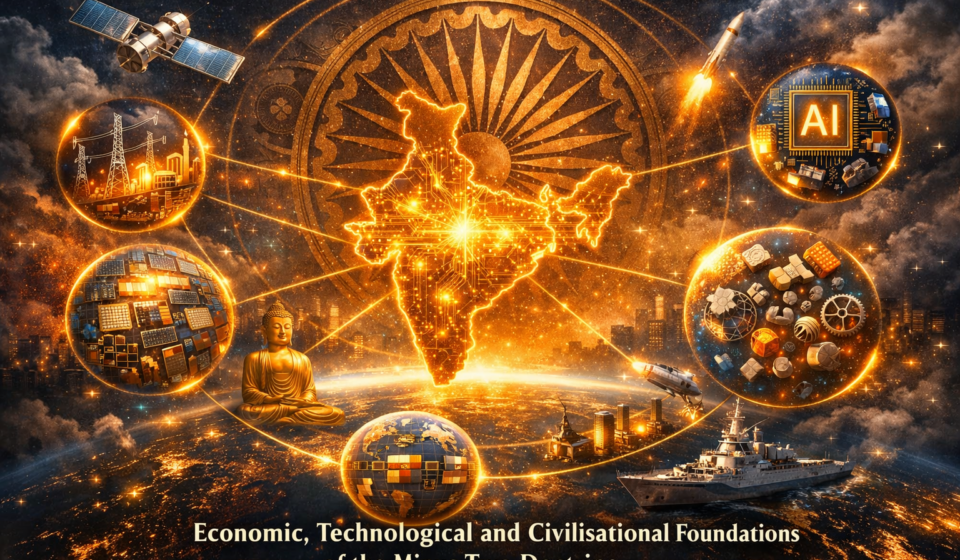
CONCLUDING PART 3:- Economic, Technological and Civilisational Foundations of the Minus Two Doctrine
The economic dimension of Minus Two may ultimately prove even more transformative. For decades globalisation encouraged efficiency through concentrated supply chains. The emerging geopolitical era rewards resilience instead. India increasingly seeks not isolation but indispensable integration. The objective is not autarky.
It is mutual dependence. Manufacturing corridors, semiconductor ecosystems, logistics connectivity, energy partnerships, digital public infrastructure and trade diversification are all designed around a single strategic principle: make India’s growth so deeply embedded within global production networks that disrupting India becomes prohibitively expensive for everyone. Economic gravity becomes strategic insurance. Technology forms the second pillar. Artificial intelligence, quantum computing, semiconductor fabrication, cyber capabilities, space systems, critical minerals, telecommunications and digital infrastructure are no longer economic sectors. They are theatres of sovereignty.
A nation dependent upon foreign algorithms, foreign cloud infrastructure, foreign chip supply chains and foreign digital payment architecture cannot claim genuine strategic autonomy. India’s investments in indigenous digital public infrastructure, AI capabilities, semiconductor manufacturing, trusted telecom ecosystems and critical mineral partnerships therefore represent something larger than industrial policy. They constitute strategic decolonisation for the technological age.
History demonstrates that geopolitical independence follows technological independence far more reliably than diplomatic declarations.
Hard power naturally follows. India’s military modernisation increasingly reflects preparation for long-duration competition rather than isolated conflicts. Indigenous aircraft, warships, missile systems, drones, cyber capabilities and integrated command structures all contribute towards a defence posture designed not simply to defend territory but to preserve strategic decision-making freedom. Civilisational states understand a timeless truth. Soft power earns admiration. Hard power preserves autonomy. Yet the most intriguing aspect of Minus Two lies not in military capability or economic strategy. It lies in psychological transformation. For much of independent India’s history, foreign policy debates revolved around managing external powers.
The emerging doctrine reverses the equation. The question is no longer how India fits into American strategy or Chinese strategy. The question increasingly becomes how American and Chinese strategies must adjust to India. This inversion represents a profound intellectual shift. It reflects confidence born from economic scale, demographic weight, technological ambition and civilisational continuity. Critics may dismiss such thinking as strategic overreach. History suggests otherwise. Every durable centre of power first appeared implausible. The United States was once viewed as an isolated republic distant from European affairs. Post-war Japan seemed destined for permanent dependence. China itself spent decades dismissed as merely the world’s manufacturing base before translating economic power into geopolitical influence.
Power accumulates gradually before appearing suddenly. India’s trajectory increasingly follows this historical rhythm. The coming international order is unlikely to be bipolar. Nor will it remain unipolar. It will be genuinely multipolar but only if multiple powers possess genuine strategic independence. That independence cannot be borrowed. It must be built. The phrase “strategic autonomy” has long been part of India’s diplomatic vocabulary. Too often, however, it has been interpreted as the freedom to avoid difficult choices. Minus Two gives it a sharper meaning. Strategic autonomy becomes the capacity to make difficult choices without external permission.
It means possessing the economic resilience to withstand sanctions, the technological capability to resist digital coercion, the military strength to deter aggression, the diplomatic reach to shape coalitions and the civilisational confidence to pursue national objectives independent of ideological approval from any external capital. This is not anti-American. Nor is it anti-Chinese. It is unapologetically pro-Indian. The world has become accustomed to viewing India through the prism of great-power competition. India is beginning to construct a different reality. One in which the most important geopolitical equation of the twenty-first century may not be Washington versus Beijing. It may instead become Washington minus dependence, Beijing minus vulnerability and India at the centre of its own strategic orbit.
(Abhinav Shankar is an Amazon best selling Author, Technocrat & a Commentator on geopolity, economy & public policy matters.)