
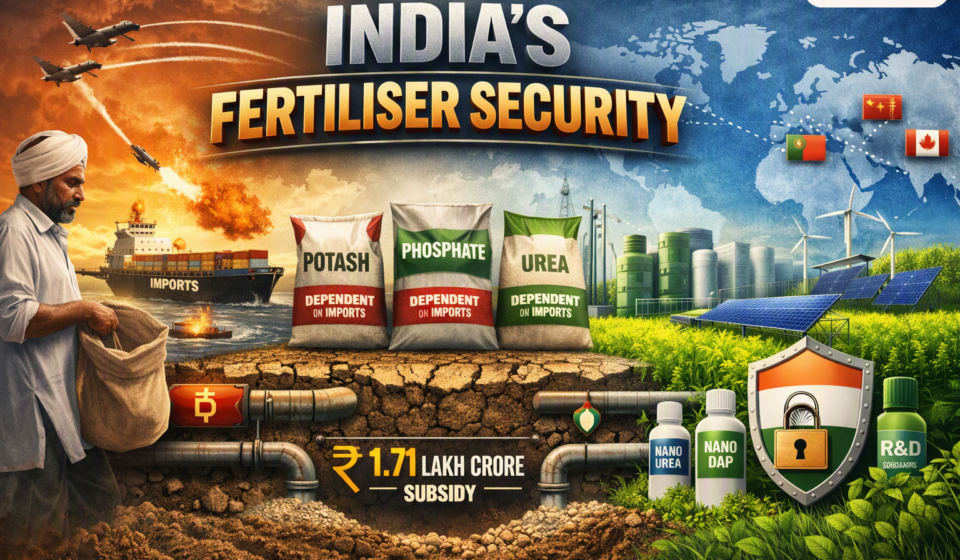
India’s Fertiliser Crisis Is a National Security Risk
By Aditya Raj Tak
A fragile global supply chain, rising geopolitical risk and a subsidy-heavy system are exposing a critical weakness in India’s agricultural backbone. India can feed 1.4 billion people, yet the nutrients that make its harvests possible still come largely from abroad. As the ongoing West Asia conflict disrupts global shipping and trade routes, India’s dependence on imported fertilisers is no longer merely an agricultural challenge. It is a national security risk. At its core, the problem is simple: we own our land, but not our soil.
The contradiction is stark. India is one of the world’s largest fertiliser consumers and a major food exporter, yet remains heavily dependent on imported soil nutrients. Indian agriculture runs on nitrogen, phosphorus and potassium. India has significantly expanded domestic urea production over the past decade. But even domestic production depends heavily on imported natural gas, meaning India’s apparent self-reliance in nitrogen remains tied to overseas supply chains. Since the West Asia conflict escalated, New Delhi has had to lean harder on Beijing for urea imports, pushing urgently to secure and expand China’s 2026 export allocation as Gulf-sourced gas for domestic production ran short.
This move should give every policymaker pause. China has a well-documented history of restricting fertiliser exports abruptly to protect its own domestic priorities, a pattern in place since 2021 and one that leaves trading partners with little warning. Outsourcing our food security to that supply chain is not a fallback. It is a gamble. Phosphate imports are facing disruption of their own. Morocco’s fertiliser producers, reliant on Middle East sulphur and ammonia, have seen those supplies squeezed by the Strait of Hormuz shutdown, tightening the phosphate India can source from one of its largest suppliers. Sanctions on Russia and Belarus are constraining potash supply, a mineral for which India does not even maintain strategic reserves.
Parliament’s Standing Committee on Chemicals and Fertilizers has flagged that India is almost entirely import-dependent for potash and heavily import-dependent for phosphatic fertilisers and their raw materials. Every bag of muriate of potash that goes into a Punjab wheat field or a Maharashtra sugarcane crop has sailed in from Canada, Russia or Belarus, three countries sitting at the centre of global geopolitical fracture lines.This dependency is not marginal. Fertilisers remain indispensable to India’s agricultural productivity. Any prolonged disruption in supply would reduce yields, raise cultivation costs and threaten food security. India’s response so far has relied heavily on subsidies.
Between 2017-18 and 2021-22, fertiliser consumption rose modestly, while subsidy expenditure more than doubled, driven largely by global price movements. This is not farmer support as much as it is shock absorption. India is paying more to import more, even as soil health deteriorates from nitrogen overuse and farmers remain exposed to global price volatility. The pattern is not new: the Comptroller and Auditor General had earlier found that over 90% of the subsidy increase between 2004-09 was driven by international fertiliser prices, not by improvements in farm welfare.
To put the current numbers in perspective: India’s fertiliser subsidy bill for FY27 was budgeted at approximately Rs 1.71 lakh crore, a figure that already approaches India’s entire defence capital expenditure of Rs 2.19 lakh crore and one the Fertiliser Ministry has since asked to nearly double, with officials warning the bill could cross Rs 3 lakh crore if the West Asia disruption persists. We are on track to spend as much subsidising imported soil nutrients as we do on capital defence procurement, and yet we treat one as a strategic priority and the other as a procurement problem. The next phase of India’s agricultural transition must focus not just on yields, but on input security. The building blocks are already here. Nano fertilisers, including Nano Urea and Nano DAP, significantly reduce bulk requirements and logistics dependence. A 500 ml bottle replacing a 45 kg bag is not just an efficiency gain. It is a fundamental shift in how fertiliser is produced, stored, transported and used. It reduces import volumes, cold chain pressure and last-mile costs simultaneously.
Green ammonia goes further. It enables urea production without a single molecule of imported natural gas, using only renewable energy and water. India has among the highest solar potential globally. We have a long coastline built for port-scale industrial infrastructure. We have the engineering talent. What we lack is a policy framework that treats fertiliser self-sufficiency as a strategic priority and not just an agricultural subsidy line item. The government has taken real, if early, steps in this direction: in July 2026, the Cabinet Committee on Economic Affairs approved a new urea policy offering incentives for new domestic plants, after the West Asia conflict disrupted flows through the Strait of Hormuz and exposed India’s exposure to supply disruption, and the Department of Fertilisers has separately rolled out a roadmap for green ammonia procurement under the National Green Hydrogen Mission. But its budget allocation for the Policy on Promotion of Organic Fertilisers stood at just Rs 150 crore in 2025-26, against a chemical fertiliser subsidy of Rs 1.71 lakh crore. That ratio tells you everything about where urgency actually stands.
Complete self-reliance may never be possible, particularly for minerals such as potash, where India’s domestic reserves are limited. But strategic dependence is not inevitable. India must invest far more aggressively in research and development, from green ammonia and nextgeneration fertilisers to nutrient recycling, bio-fertilisers and alternative sources of potassium. The objective should not merely be to manufacture existing fertilisers domestically, but to develop new technologies that reduce reliance on imported raw materials altogether. Combined with diversified imports, strategic reserves and overseas resource partnerships, innovation can substantially reduce India’s exposure to external shocks. Fertiliser security should not be measured by whether India imports nutrients, but by whether those imports can ever be used to hold India’s food system hostage.
These vulnerabilities are compounded by currency movements. A Rs 2 depreciation adds over Rs 1,200 per tonne to DAP import costs, while retail prices remain controlled. The gap flows directly into the subsidy bill. In a scenario of sustained global stress and a stronger dollar, fertiliser risks becoming not just an agricultural issue but a fiscal one, with implications well beyond the farm gate.At its core, this is a sovereignty question. A country that cannot control access to critical agricultural inputs cannot claim true food security. The Green Revolution of the 1960s addressed scarcity through technology; the challenge now is to reduce structural dependence on external inputs, not simply manage it more efficiently. That means treating fertiliser security as a matter of national security planning, not just agricultural subsidy and price control, with clear priorities around domestic production, strategic reserves and supply chain resilience.
Hormuz may close. Shipping routes may be disrupted. Export bans may return. India cannot control these events. What it can control is how vulnerable it chooses to remain. The next Green Revolution will not be measured only by how much food India grows, but by how independently it can secure the nutrients that make those harvests possible. Until then, India will own its land, but not its soil.
Aditya is a Screen Writer from CFS, London and a Equity and Commodities Trader Interested in Geopolitics, Economics, Public Policy and Financial Markets. His Works Examines the Impact of Global Events on National Interests and Market Behaviour.