
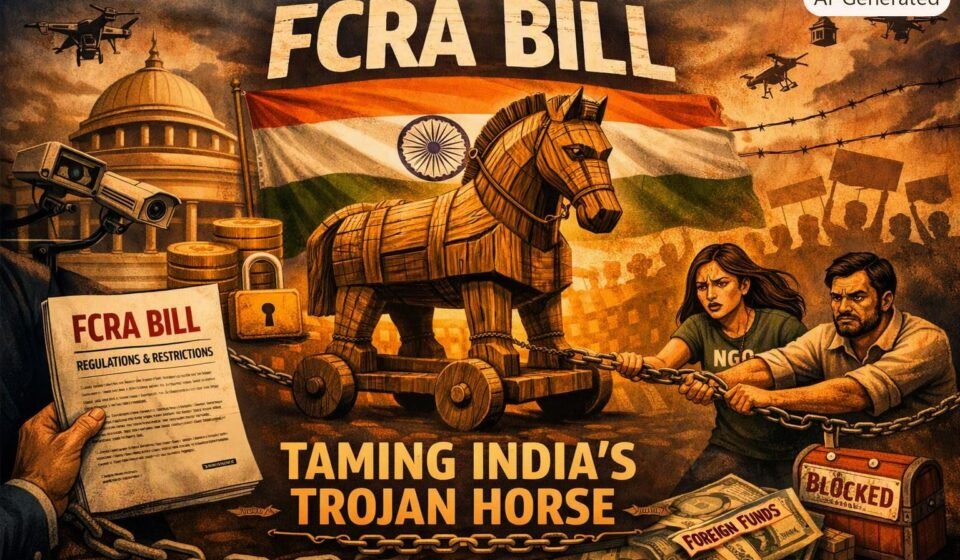
FCRA Bill: Taming India’s Trojan Horse
By Abhinav Shankar
Every civilization learns, sooner or later, that threats do not always arrive wearing the uniform of an invading army. Some come wrapped in the language of friendship, philanthropy and public welfare. History remembers the Trojan Horse not because it was an instrument of war, but because it disguised war as a goodwill. Modern geopolitics has perfected this art. Today, influence often enters a nation not through tanks crossing borders, but through money crossing bank accounts.
It is against this backdrop that India’s Foreign Contribution (Regulation) framework and any effort to strengthen it; must be understood.
The debate around the FCRA has been trapped for years in an artificial binary. On one side are those who portray every regulation as an assault on democracy and civil society. On the other are those who view every foreign-funded NGO with suspicion. Both positions miss the larger strategic question. The issue is not whether NGOs are good or bad. The issue is whether any sovereign democracy can afford to remain indifferent about who finances the shaping of its public discourse, policy priorities and grassroots mobilization.
The overwhelming majority of India’s voluntary organizations are indispensable partners in nation-building. They educate children where schools are absent, run hospitals where healthcare is inadequate, respond first during natural disasters and work among communities that governments often struggle to reach. Their contribution is beyond dispute.
Yet acknowledging this truth should not blind us to another. Institutions, however noble their purpose, can be misused. Money, however generously described, is rarely value-neutral.
Every major power today invests enormous resources in shaping narratives beyond its borders. Influence has become one of the principal currencies of international politics. Governments openly finance think tanks, advocacy groups, academic collaborations, governance initiatives and media projects across the world. This is not conspiracy; it is contemporary statecraft. Nations increasingly compete not merely for territory or markets, but for ideas, public opinion and policy outcomes.
India cannot reasonably assume that it alone stands outside this global contest.
The uncomfortable reality is that foreign funding does not always seek to build schools or dig wells. Sometimes it seeks to shape debates. Sometimes it seeks to influence legislation. Sometimes it seeks to delay strategic infrastructure, alter policy priorities or amplify social fault lines. None of these objectives requires illegal activity. Influence operates most effectively when every individual action appears perfectly legitimate while the cumulative effect gradually redirects national choices.
A research paper influences policymakers. A litigation stalls a project. An advocacy campaign shapes media coverage. An international report affects investor confidence. A secretly funded protest/movement alters electoral discourse.
Viewed individually, each is a normal democratic exercise. Viewed collectively, they may become part of a much larger ecosystem of influence.
This is precisely why transparency matters.
Curiously, many who demand transparency from governments and corporations become uncomfortable when similar transparency is expected from organizations receiving foreign contributions. Yet the principle should be identical. Citizens have every right to know who funds institutions that seek to influence public policy or mobilize public opinion. Transparency strengthens credibility. It does not diminish it.
Critics frequently argue that the FCRA restricts civil society. That criticism deserves careful consideration because any democracy must guard against excessive executive discretion. Regulations should never become instruments of intimidation, nor should compliance requirements become so burdensome that genuine organizations are unable to function. Civil society plays an essential role in holding governments accountable, representing marginalized communities and enriching democratic debate.
But there is an equally important democratic principle that often receives less attention: sovereignty.
No serious democracy allows unrestricted foreign financing of activities that may influence domestic political or strategic outcomes. Across the world, governments regulate foreign funding where it intersects with lobbying, elections, political advocacy or national security. The mechanisms differ, but the underlying philosophy remains remarkably similar. Foreign money deserves greater scrutiny not because it is inherently suspect, but because external financial influence raises legitimate questions about accountability and national interest.
India’s circumstances make this issue even more significant.
The country is no longer merely a developing economy. It is emerging as one of the principal poles of the twenty-first century. Decisions taken in New Delhi on semiconductor manufacturing, artificial intelligence, critical minerals, defence production, energy transition, agriculture, digital governance and climate negotiations increasingly shape global economic and geopolitical calculations. It would be naïve to imagine that competing international interests have no desire to influence these debates.
Influence has replaced invasion as the preferred instrument of power. The battlefield has shifted from borders to narratives.
Perhaps the greatest misunderstanding surrounding the FCRA debate is the assumption that regulation reflects distrust of NGOs. It need not. Good governance distinguishes between institutions and the possibility of institutional misuse. Banking regulations do not imply that every banker is dishonest. Securities regulation does not assume every investor is fraudulent. Anti-money laundering laws do not criminalize financial activity. They exist because systems must be designed not only for honest participants but also for those who exploit institutional weaknesses.
The same logic applies here.
The title of this essay employs a deliberately provocative metaphor—a Trojan Horse The metaphor is not directed at India’s vast and vibrant NGO sector, nor at the countless volunteers who dedicate their lives to public service. It symbolize the hidden risks that can exist within any large institutional ecosystem: opaque funding chains, undisclosed foreign influence, financial irregularities, shell organizations or entities that pursue strategic or political objectives while presenting themselves exclusively as charitable actors. The answer is not to burn down the horse; it is to inspect it before welcoming it through the gates.
This distinction is vital because democracy flourishes when trust is accompanied by verification. Blind suspicion weakens institutions, but blind trust weakens nations.
The real challenge, therefore, is not whether India should regulate foreign contributions. It should. The real challenge is how.
Regulation must be transparent, proportionate and predictable. Genuine organizations should receive timely approvals, clear compliance standards and effective avenues for appeal. Enforcement should target demonstrable violations rather than ideological disagreement. At the same time, financial opacity, diversion of funds and covert foreign influence deserve firm scrutiny. A mature democracy is capable of protecting both civil liberties and national security without treating them as mutually exclusive goals.
Ultimately, the FCRA is not about charity. It is about sovereignty in an era where power increasingly travels through ideas, institutions and influence rather than armies. Ancient Troy did not fall because its walls were weak. It fell because it opened its gates to something it never thought to examine. The lesson endures.
A confident India should remain open to genuine global cooperation, international philanthropy and civil society partnerships. But openness without vigilance is not liberalism; it is strategic complacency. Every sovereign nation has not only the right but the obligation to know what enters its public sphere, who pays for it and to what end and most importantly with what purpose.
In the twenty-first century, the strongest fortresses are not built of stone. They are built of transparent institutions, accountable funding and an alert democratic state.
The Trojan Horse is dangerous not because it comes from outside. It is dangerous because no one bothers to look inside of it.
(Abhinav is an amazon best selling Author, Technocrat & a Commentator on Geopolity, Economy, Tech & public policy matters.)