
Guru Purnima Special
When the Guru Becomes Not Merely a Person, but a Living Tradition
By Kumar Krishnan
“Guru is Brahma, Guru is Vishnu, Guru is Maheshwara; Guru is the Supreme Reality itself. To that revered Guru, I bow.”
The greatest strength of Indian civilization lies not merely in its vast corpus of sacred literature, but in its unbroken Guru–Shishya (teacher–disciple) tradition, through which wisdom has been transmitted as lived experience rather than mere information. In India, education has never been confined to acquiring knowledge; its higher purpose has been the cultivation of discernment, compassion, self-discipline, and self-realization. The Guru is therefore not simply a teacher, but a guide who awakens the seeker to the truth within.
Guru Purnima, observed on the full moon of Ashadha, commemorates Maharshi Vedavyasa, the compiler of the Vedas, author of the Mahabharata, and editor of the Puranas. Revered as the Jagadguru, he symbolizes the eternal debt that every civilization owes to its teachers.
The Mundaka Upanishad declares that the highest truth is attained only under the guidance of a Guru who possesses both scriptural wisdom and direct spiritual realization. Kabir expressed the same truth with poetic simplicity, proclaiming that the Guru deserves reverence even before God, for it is the Guru who reveals the path to the Divine.
In an age dominated by artificial intelligence and limitless digital information, the Guru remains indispensable. Machines may provide answers, but they cannot bestow wisdom; they can process data, but they cannot illuminate the purpose of life. The modern crisis is not a lack of knowledge but a loss of direction.
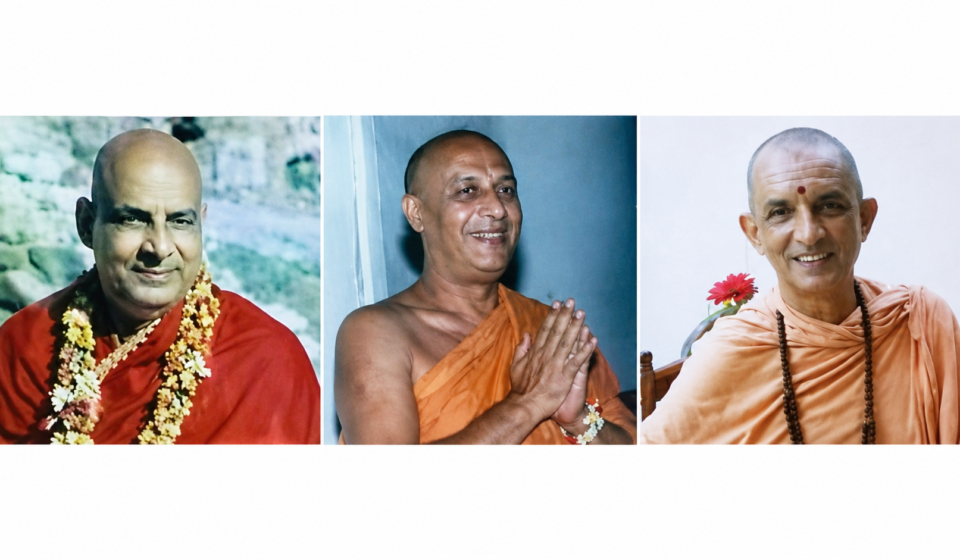
Among the greatest modern exponents of this timeless tradition was Swami Sivananda Saraswati, whose life transformed the ideals of service, love, meditation, and self-realization into a practical philosophy. His celebrated dictum—”Serve, Love, Give, Purify, Meditate, Realize”—remains a universal charter for spiritual living.
His illustrious disciple, Swami Satyananda Saraswati, carried this legacy forward by founding the Bihar School of Yoga at Munger in 1963. He presented yoga as a scientific discipline integrating body, mind, emotions, and consciousness. His pioneering work on Yoga Nidra, Kriya Yoga, and integrated yogic practices has received worldwide recognition, with modern neuroscience increasingly affirming insights long embedded in the yogic tradition.
The lineage continues through Swami Niranjanananda Saraswati, who has emphasized yoga not merely as personal practice but as a means of nurturing responsible families, enlightened education, ethical citizenship, and social harmony.
The Indian Guru tradition is founded not upon blind obedience but upon enlightened inquiry. As Lord Krishna tells Arjuna in the Bhagavad Gita: “Reflect deeply upon this, and then act according to your own understanding.” The true Guru does not create followers; he awakens free and responsible human beings.
Guru Purnima is therefore far more than a ritual observance. It is a celebration of the eternal quest for inner transformation. For the greatest journey is not outward but inward; the greatest victory is not over others but over oneself. The Guru does not give us God—he awakens the divinity already present within us. That is the timeless message of Guru Purnima and the enduring legacy of Swami Sivananda, Swami Satyananda, and Swami Niranjanananda .