The Bird’s Eye and the Blind Spot: What Ails India’s Consumer Commissions
By Prof. Dr. Ashok R Patil $ Adhiraj Sehgal
On 13th August 2026, while hearing the letter petition dated 30th September 2021 (Writ Petition (C) No. 1144 of 2021) relating to the pay and allowances of the Presidents and Members of the Consumer Disputes Redressal Commissions in the State of Uttar Pradesh, the Supreme Court of India raised the question: Why do India’s consumer commissions increasingly resemble the very courts they were created to replace?
The question reminds one of a quote that Nani Palkhivala once wrote: “The law’s delay is not merely inconvenient; it is often a denial of justice masquerading as its administration”. Although Palkhivala wrote about courts, the Supreme Court of India is questioning the functioning of the consumer commissions.
Justice Surya Kant, Supreme Court of India, put it bluntly: “If this is the performance, then what kind of special expert forum have we constituted for consumer redressal?” This question arose because a consumer complaint filed in 2019 had been listed only once, in 2022. Three years and one hearing later, it still has not received a next date.
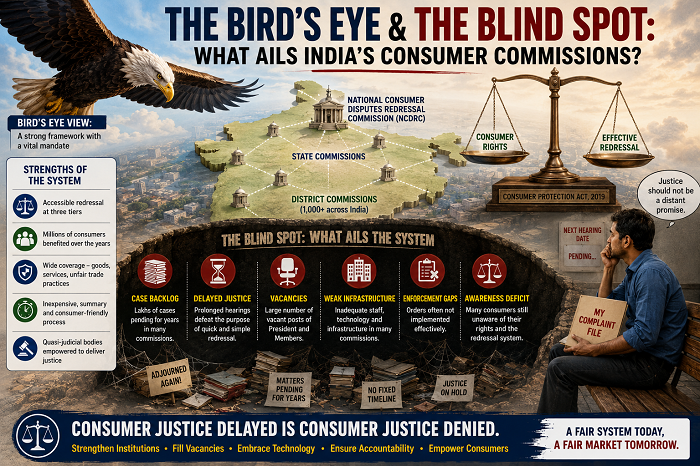
As per a written reply submitted by the Minister of State for Consumer Affairs in Parliament, as of January 2026, there are 5,74,333 consumer cases pending nationwide. The Apex Court demanded a detailed report with respect to (i) the total pendency of cases; (ii) the composition of the commissions; (iii) the average disposal rate of the matters by different benches; (iv) the estimated time likely to be required for disposal of the pending matters; and (v) whether there is a need for increasing the strength of the commissions from the NCDRC President within two weeks.
The bench went further and asked the Presidents of the State Consumer Commissions to forward the performance evaluation report for the last three years of the District Consumer Forums under their respective jurisdictions. The Court also flagged a quality crisis at the district level, where cases are often not decided on their merits and there is inordinate delay in disposal of pending matters, especially when, in some cases, hearings are not taking place for year.
The Consumer Protection Act, 2019 promised faster resolution and a wider ambit of work, but the 2019 Act’s reforms exist largely on paper. On the ground, the consumer remains where they always were, still hoping for another date.
Consumer commissions were designed to be specialized, accessible, speedy quasi-judicial bodies, deliberately different from regular courts. Over time, these forums, which were especially made to be different, have now become exactly what they were meant to replace. They are slow. They are overburdened. They have lost the public’s trust.
The problem may therefore be less about the professional identity of individual members and more about the institutional culture in which consumer disputes are handled. When procedures, case-management practices and expectations are inherited from conventional adjudication, a forum intended to provide summary and accessible redress can gradually take on the characteristics of ordinary litigation.
In the Mahabharata, Guru Dronacharya, pointing to a tree, asked his disciples what they see. Someone mentioned a leaf, another a bird, another a tree, a branch, the sky, but only Arjuna said that he saw only the bird’s eye and nothing else. However, by contrast, consumer commissions risk the opposite problem: the institution sees vacancies, jurisdiction, procedure, infrastructure, and compliance, while the consumer waiting for relief disappears from view.
The outcome of such a perception is a system that is neither fish nor fowl. It has the formalities of a court without the working machinery. It lacks the infrastructure to deliver on its promises. The consumer who walks into a district forum to avoid the courtroom chaos now hustles and still waits for years, with no room for justice.
The apex court identified certain problems concerning the slow disposal rate of cases and poor performance of the National Consumer Commissions. However, it made it very clear that solving the infrastructure and capacity gaps alone would not solve the problems. It requires a sense of accountability, which raises an important question: If consumer commissions were specifically designed to be different from courts, why have they become regular courts?
The answer to this lies in the way things are done, the procedures deeply rooted in the people within the institution. The people in the system are most likely to be retired judges, advocates and bureaucrats, and they tend to share the same work attitude in these commissions. The Act gave the new system with a different mandate, but it did not change the system’s culturally embedded elements, which clearly result in a system whose structure sounds great but is culturally obsolete and produces incorrect outputs.
The Apex Court has also suggested addressing these concerns by allowing States with fewer than 1,000 pending cases to abolish District Commissions and transfer their functions to serving judicial officers. However, structural interventions alone may not resolve what is fundamentally an institutional and procedural problem.
The deeper issue lies in how consumer disputes are processed. Consumer commissions do not merely need more judges; they require strict, time-bound mechanisms for case disposal, a distinct procedural mandate and set of rules, robust performance evaluation of their members, specialised training to enhance the quality and efficiency of adjudication, and a clear institutional commitment to prioritising consumer disputes. Unless these reforms accompany changes in infrastructure and appointments, the system risks reproducing the very procedural delays and institutional practices it was designed to overcome.
Until the system learns to view the consumer as the bird’s-eye, as Arjun saw it, i.e., at the centre of its institutional design, procedural reform alone will not be enough. The question is not merely how many members are appointed or how many cases are pending. It is whether the system can deliver what it was created to provide: accessible, efficient and effective consumer redress.
Prof. Dr. Ashok R Patil, Vice Chancellor, National University of Study and Research in Law, Ranchi.
Adhiraj Sehgal, Student, National University of Study and Research in Law, Ranchi.