Pioneer News Service
Ranchi
A 25-year-old dispute between Bihar and Jharkhand over the sharing of Son river water has finally come to an end, with the two neighbouring states reaching a landmark agreement on a new water-sharing formula at a high-level meeting in New Delhi.
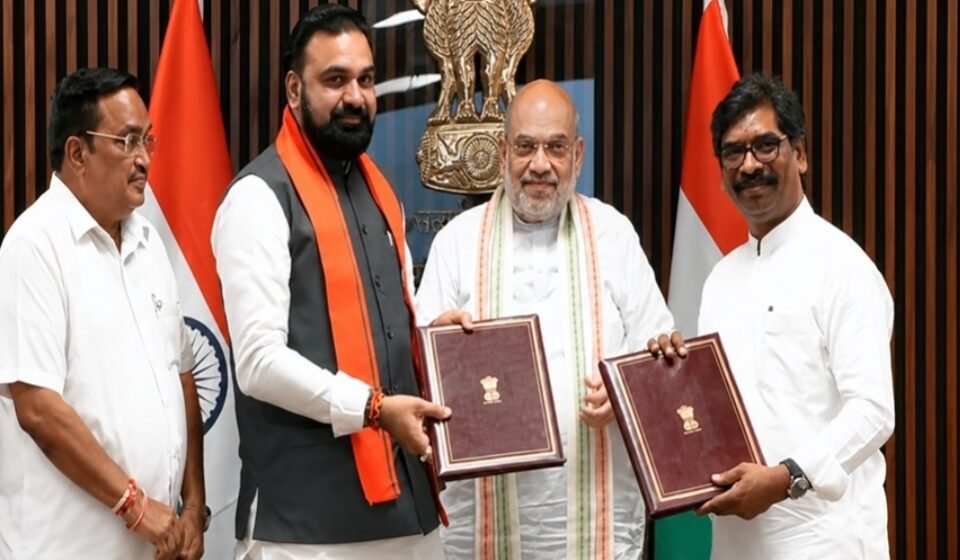
The meeting, held at Kartavya Bhavan under the initiative and mediation of Union Home Minister Amit Shah, brought Bihar Chief Minister Samrat Choudhary and Jharkhand Chief Minister Hemant Soren together to resolve the long-pending issue.
Under the new arrangement, the total 7.75 million acre-feet (MAF) of water allocated under the 1973 Bansagar Agreement will be redistributed between the two states, taking into account their geographical, agricultural and developmental requirements.
Bihar has been allocated 5.75 MAF, with priority given to meeting irrigation and drinking water requirements in its agriculture-dependent regions. The arrangement is expected to benefit farmers in southwestern districts of the state by ensuring more predictable availability of water through the canal network.
Jharkhand will receive 2.0 MAF, with its share taking into consideration the water requirements of its plateau regions and emerging industrial areas. The allocation is expected to strengthen water management in drought-prone areas and support industrial and economic development.
The dispute dates back to the creation of Jharkhand in 2000. The original 1973 Bansagar Agreement had been formulated when Bihar and Jharkhand were part of the same state. Following the bifurcation of Bihar, questions over the division of the state’s share of Son River water remained unresolved, leading to prolonged administrative and political differences.
The uncertainty had also affected the progress of several irrigation and development projects in the two states. The latest agreement is expected to remove the long-standing bottleneck and provide greater clarity for future water management and infrastructure projects.
The agreement is likely to have a significant impact on rural and agricultural areas along the Son basin. In Bihar, districts such as Rohtas, Aurangabad, Bhojpur and Buxar are expected to benefit from a more assured supply of irrigation water. In Jharkhand, improved water availability could help address shortages in drought-affected areas and facilitate industrial expansion and employment generation.
The settlement has also been projected as an example of cooperative federalism, demonstrating that prolonged inter-state disputes can be resolved through dialogue, negotiation and political consensus.
The intervention by Amit Shah and the willingness of the two chief ministers to arrive at a mutually acceptable formula have paved the way for closer cooperation between Bihar and Jharkhand on water resources and other areas of shared interest.