Down Memory Lane- VIAbundance in the Dust : How Dirty water Drove Elephants Away While 3 villages Drunk it
By Gautam Sarkar
I was told by friends that Santhal Parganas was a land of tribal communities, nestled amid serene hills, dense forests, and lush greenery. As a reporter for The Times of India, I began covering this region, once the original homeland of the ancient Paharia tribe – a people who had by then been pushed to the brink of extinction.
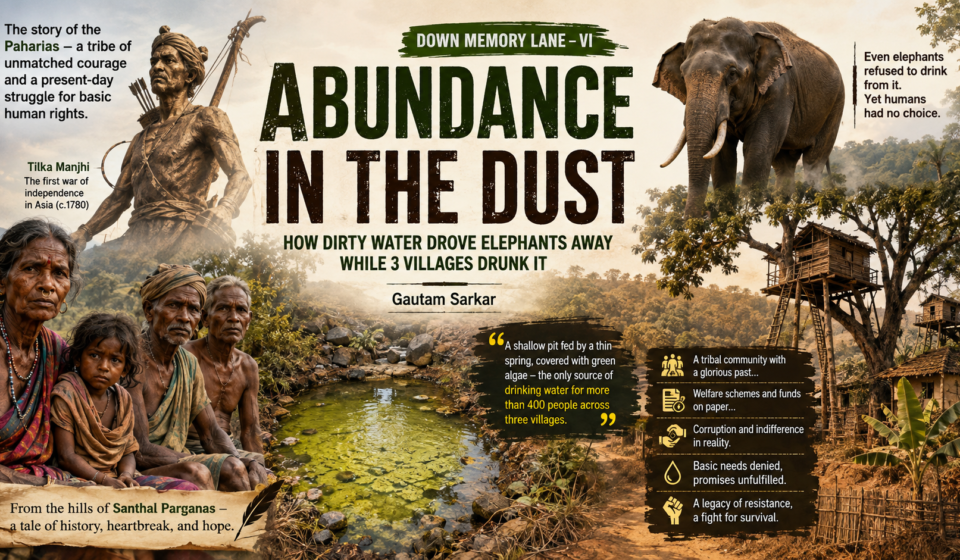
History records that the fiercely independent Paharias never accepted subjugation by any outside power, from the Stone Age to modern times. The armed uprising led by Tilka Manjhi around 1780 is widely recognized as the first organized revolt in Asia against British imperialism. Poorly equipped, wearing little more than a cloth around their waists and armed only with bows and arrows, the Paharia warriors fought fearlessly against British muskets and cannon. Their resistance shook the foundations of British rule in eastern India. Unable to crush the rebellion through force despite killing hundreds of Paharia fighters, the British eventually relied on deception and political maneuvering. In its aftermath, they established the Damin-i-Koh – (a Persian word meaning the “Skirt of the Hills”) – to protect the Paharias’ homeland in the Rajmahal Hills.
Inspired by this remarkable history, I began my work with great enthusiasm. That enthusiasm, however, soon gave way to shock. The reality I encountered in the hilltop villages was one of extreme poverty and neglect.
The government itself had acknowledged the rapid decline of the Paharia population. Both the Government of India and the Government of Bihar had launched numerous welfare schemes, established dedicated Paharia Welfare Department offices across the region, and allocated substantial funds for their development. Yet when I travelled through the hilltop villages, the contrast between official claims and ground reality was heartbreaking. Decades after India’s independence, seeing this heroic community living in such deprivation brought tears to my eyes.
In the forested hilltop villages of Amrapara Block in Dumka district, wild elephants regularly descended to feed on banana and bamboo groves. In many villages, people had even built houses on trees to protect themselves from elephant attacks. Yet one particular village had no such tree-top dwellings. The villagers explained why: although food was plentiful, the elephants avoided the settlement because its only water source was filthy.
Ironically, while even elephants refused to drink from it, the residents of that village and two neighbouring settlements – more than 400 people – had depended on the same contaminated water for years. Their only source was a shallow pit fed by a thin spring emerging through a crack in the rocks. The stagnant water, covered with green algae, served as their drinking water throughout the year.
Experiences like these made me realize that the power corridors of Patna had little concern for who lived or died in the Rajmahal Hills. Almost everywhere I travelled, I saw the same pattern: contractors and middlemen, protected by sections of the local administration and political leadership, siphoned off funds meant for the welfare of these simple, uneducated, and trusting people. Development existed largely on paper, while the real contest was over how public money would be divided among those in power.
There were, however, a few sincere exceptions. Regional Development Commissioner, Ranchi, B. Kathuwama convened a meeting at Amrapara Block with the local MP, MLA, and government officials to prepare a comprehensive welfare programme for the Paharias. Unfortunately, those proposals never progressed beyond the planning stage.
Another remarkable officer was Shankar Prasad, the then Divisional Commissioner of Bhagalpur, under whose jurisdiction Dumka and several neighbouring districts then fell. He initiated several development projects for the Paharias in Kathikund Block and was known for his rare integrity, often purchasing his own bus ticket to travel from Bhagalpur to Dumka every fortnight for official work. Despite his dedication, his untimely transfer prevented many of those initiatives from becoming lasting realities.
My journey through the Rajmahal Hills revealed two contrasting stories: one of extraordinary courage preserved in history, and another of neglect, corruption, and broken promises that continued to haunt the descendants of those very heroes.
(to be continued….. )

Gautam Sarkar