
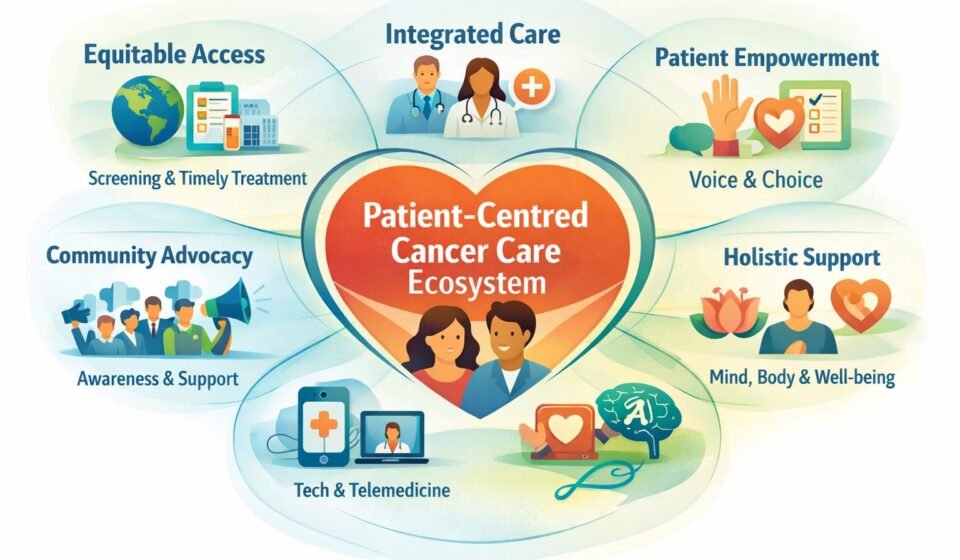
From Access to Advocacy: Building a Patient-Centred Cancer Care Ecosystem
By Prof. Anant Kumar
Cancer is not only a medical challenge. It is a social, economic, and developmental concern that affects individuals, families, and communities alike. While India has made commendable progress in expanding healthcare infrastructure and improving access to diagnosis and treatment, millions of patients continue to encounter barriers long before they reach a hospital. If India is serious about reducing the cancer burden, the conversation must move beyond treatment to patient-centred care, community engagement, and sustained advocacy.
The Indian Council of Medical Research–National Centre for Disease Informatics and Research (ICMR-NCDIR) estimated 1.46 million new cancer cases in 2022 and projected this number would rise to 1.57 million by 2025. Nearly one in every nine Indians is expected to develop cancer during their lifetime. Cancer is now among the leading causes of premature mortality in the country, accounting for more than 900,000 deaths annually, pushing families into emotional distress, financial hardship, and social uncertainty.
The challenge is not only the rising incidence of cancer but also the delayed diagnosis. Nearly 60-70 per cent of cancer patients in India are diagnosed at Stage III or Stage IV, when treatment becomes more complex, costly, and less effective. Quality cancer care, therefore, begins not with chemotherapy or surgery but with awareness, timely screening, early diagnosis, and dignity. In rural and tribal areas, these challenges are compounded by poor transport, inadequate health literacy, and limited access to screening facilities. Delayed diagnosis not only reduces survival but also increases treatment costs and deepens the emotional and economic burden on families.
Jharkhand illustrates many of these challenges. The state reports an estimated 35,000–40,000 new cancer cases annually, with oral, lung, stomach, breast, and cervical cancers being the most prevalent. High tobacco consumption, low screening coverage, delayed diagnosis, and unequal access to specialised oncology services continue to undermine outcomes. Although institutions such as Rajendra Institute of Medical Sciences (RIMS), Tata Main Hospital, and other Cancer Hospital have strengthened cancer care in the state, many patients still struggle with transportation, accommodation, financial hardship, and fragmented referral pathways.
Cancer care, therefore, must extend beyond hospital walls. A diagnosis often triggers not only physical suffering but also psychological distress, social isolation, loss of livelihood, caregiver burnout, and financial catastrophe. Studies estimate that over half of Indian households affected by cancer experience catastrophic health expenditure, pushing many families into debt or poverty. Families frequently navigate a confusing maze of hospitals, diagnostic centres, insurance schemes, government programmes, and treatment protocols with little professional guidance. This is where patient advocacy becomes indispensable.
Patient advocacy is no longer an optional add-on. It is an essential pillar of comprehensive cancer care. Organisations such as Lung Connect India Foundation have demonstrated how patient navigation, emotional counselling, caregiver support, financial guidance, peer support, and policy advocacy can complement clinical care. They recognise that patients require someone to walk alongside them throughout their treatment journey, not only to prescribe medicines.
Globally, patient-centred cancer care has become the norm rather than the exception. Countries such as Canada, the United Kingdom, Australia, and the Netherlands have integrated patient navigators, survivorship programmes, psychosocial counselling, rehabilitation services, and community support into routine oncology care. These interventions improve treatment adherence, reduce anxiety, enhance patient satisfaction, and ultimately improve survival and quality of life. India has an opportunity to adapt these best practices while leveraging one of its greatest strengths, its vast network of Accredited Social Health Activists (ASHAs), Anganwadi workers, self-help groups, and community-based organisations.
Women’s health deserves special attention within this framework. Empowering women with accurate health information, ensuring universal access to breast and cervical cancer screening, expanding HPV vaccination, and creating safe spaces for dialogue can significantly improve early detection. Equally important is engaging husbands, families, Panchayati Raj Institutions, self-help groups, schools, and community leaders in promoting women’s health. Cancer advocacy cannot succeed unless it becomes a collective social movement rather than an individual medical responsibility.
Educational institutions, civil society organisations, corporate social responsibility initiatives, and healthcare providers also have a critical role to play. Universities and academic institutions can contribute through community outreach, health literacy campaigns, implementation research, and evidence-based policy advocacy. NGOs can strengthen patient support networks, while governments must continue expanding financial protection, screening services, palliative care, and district-level oncology infrastructure, particularly in underserved regions.
The future of cancer care lies not only in advanced technologies, precision medicine, and innovative therapies but also in compassionate systems that place patients at the centre of every decision. Building a truly inclusive cancer care ecosystem requires partnerships among governments, healthcare providers, academia, civil society, patient groups, and citizens. Only then can we truly empower voices, inspire change, and build a future where no cancer patient is left behind.
The author is a Professor at Xavier Institute of Social Service, Ranch. The views expressed are personal.
Email: pandeyanant@hotmail.com