Workshop to boost scientific waste management in villages organised
Surendra Soren
Ranchi
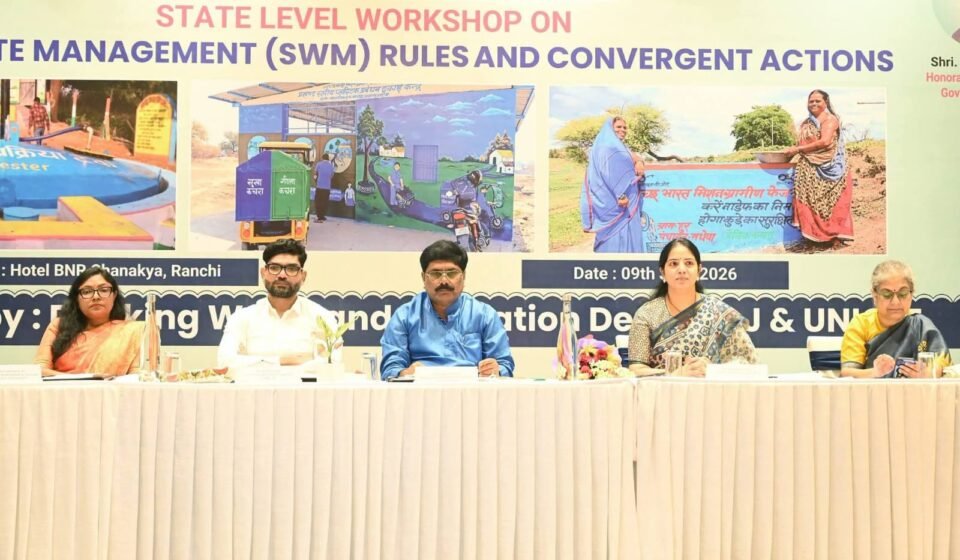
The Department of Drinking Water and Sanitation, in collaboration with UNICEF, on Thursday organised a state-level convergence workshop to strengthen the implementation of the Solid Waste Management Rules, 2026 and promote scientific waste management practices in rural areas.
The workshop brought together officials from the Department of Drinking Water and Sanitation, Rural Development and Panchayati Raj Department, Forest, Environment and Climate Change Department, Jharkhand State Pollution Control Board, Jharkhand State Livelihood Promotion Society (JSLPS), deputy development commissioners, district administration officials, UNICEF representatives and technical experts.
Addressing the gathering, the Minister of Drinking Water and Sanitation said waste should no longer be viewed as a burden but as a valuable resource capable of generating livelihoods, energy and environmental benefits. He stressed source-level waste segregation, recycling, composting, plastic waste management and the promotion of “Waste-to-Wealth” and “Waste-to-Energy” initiatives wherever technically and economically feasible.
The department secretary emphasised that scientific solid waste management should become an integral part of rural development through institutional capacity building, behavioural change, public participation, district-level action plans and robust monitoring mechanisms.
Officials from the Swachh Bharat Mission (Gramin) highlighted that the new rules provide a comprehensive framework for protecting public health, conserving natural resources and supporting climate-resilient development. They called for convergence among schemes such as Swachh Bharat Mission, the 16th Finance Commission grants, MGNREGA, Panchayati Raj institutions, JSLPS and community organisations.
UNICEF’s Jharkhand chief reaffirmed the agency’s technical partnership with the state government, noting that effective solid waste management contributes significantly to child health, environmental protection and the achievement of several Sustainable Development Goals (SDGs).
The workshop concluded with a joint commitment by participating departments and institutions to implement the new rules through coordinated action, community participation and strengthened local governance to build cleaner, healthier and environmentally sustainable rural communities across Jharkhand.