
By Prof. Anant Kumar
A few weeks ago, Chief Minister Hemant Soren handed out appointment letters to newly recruited government school teachers in Ranchi. Some recruits had already crossed the retirement age of 60, and one was due to retire the next day. This happened because half the posts were reserved for para-teachers, who could apply up to age 58. By the end of the recruitment, some candidates were too old to serve. It was not a clerical mistake but a sign of larger issues: good intentions, slow execution, and outcomes that fell short of promises.
A gap between promise and reality remains in Jharkhand’s school system. In May 2026, NITI Aayog released a report based on ten years of UDISE+ data, showing progress. Jharkhand’s primary dropout rate fell from 6.41% in 2014-15 to zero in 2024-25. Upper primary dropped from 7.42% to 1.7%, and secondary from 23.2% to 3.5%.
Jharkhand ranks among the best-performing states. But one number rarely tells the whole story. The same report shows that only 48.6 per cent of Jharkhand’s 16- and 17-year-olds are enrolled in Classes 11 and 12, placing the state among the ten lowest in the country. The message is clear. Jharkhand has improved at preventing children already in school from dropping out, but it still struggles to get them to higher secondary education.
The transition data shows that out of 100 children completing Class 5, about 90 move on to Class 6 now, up from 83 a decade ago, but still below the national average of 92. After Class 8, only 81 out of 100 enter Class 9, versus the national 87. Whether called “dropouts” or “non-transitioning students,” the child at home remains excluded from education.
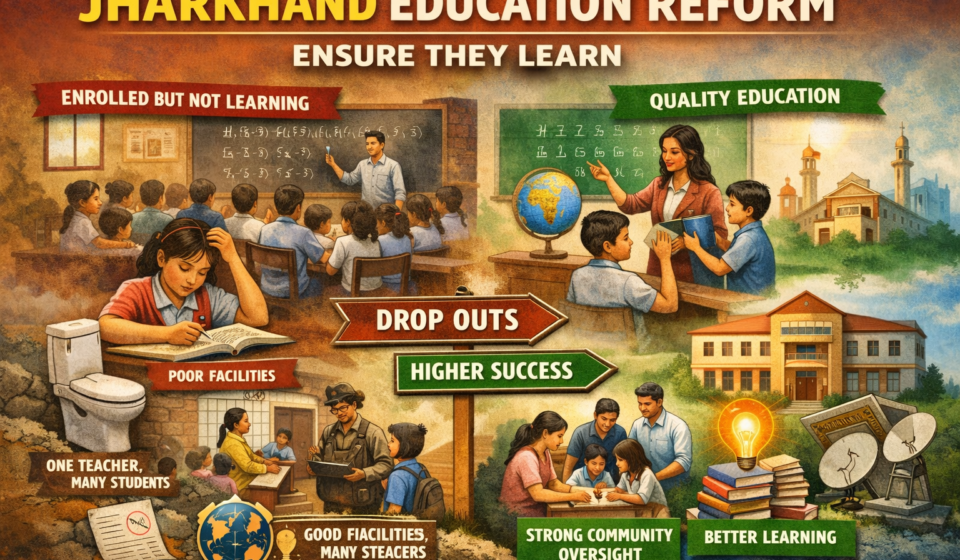
Jharkhand has improved school infrastructure over the past decade, with increased electricity from 15% to 93%, and most schools now have drinking water and toilets for boys and girls. However, many toilets are unusable due to poor maintenance, and drinking water is often unhygienic. Classrooms need repairs, and basic facilities like boundary walls, libraries, playgrounds, and digital learning are unevenly available. These issues affect children’s attendance, health, and learning. Having facilities on paper isn’t enough; they must be functional and well-maintained to support a conducive learning environment.
Jharkhand faces a major challenge with nearly 100,000 vacant teaching posts, mostly in primary schools, leading to overcrowded classrooms and limited individual attention. Despite students attending more regularly, many schools operate with only one teacher for multiple classes.Learning outcomes reveal that many children in upper primary grades struggle with basic reading and math, despite improved enrolment. Keeping children in school is important, but it shouldn’t be the final goal of education policy.
The Village Education Committee, or School Management Committee, was created to involve parents and communities in improving schools. In many villages, they exist only on paper, with irregular meetings, little training, and weak roles in monitoring teacher attendance, facilities, and student learning. Effective oversight depends on empowering these committees to function properly.
None of this diminishes Jharkhand’s success in reducing dropouts. The progress is real and deserves appreciation. However, lower dropout rates don’t necessarily mean better education. A child in a single-teacher classroom without meaningful learning is still being failed.The next reform phase should focus on quality over quantity, prioritising the filling of vacant primary school posts, addressing declining enrolment between Classes 8 and 9 through targeted scholarships and support, and revitalising Village Education Committees through training, meetings, and oversight.
Jharkhand has shown it can enrol and retain children in school. The next challenge is more critical: ensuring every child finds a teacher, a functioning school, and a genuine learning opportunity.
***
The author is a Professor at Xavier Institute of Social Service, Ranchi. The views expressed are personal.
Email: pandeyanant@hotmail.com