
Surendra Soren
Ranchi
A statewide unemployment survey conducted by Gyan Vigyan Samiti (GVS), Jharkhand has painted a grim picture of the state’s employment scenario, revealing that a large proportion of educated youth are struggling to secure stable jobs and are increasingly losing confidence in their future prospects.
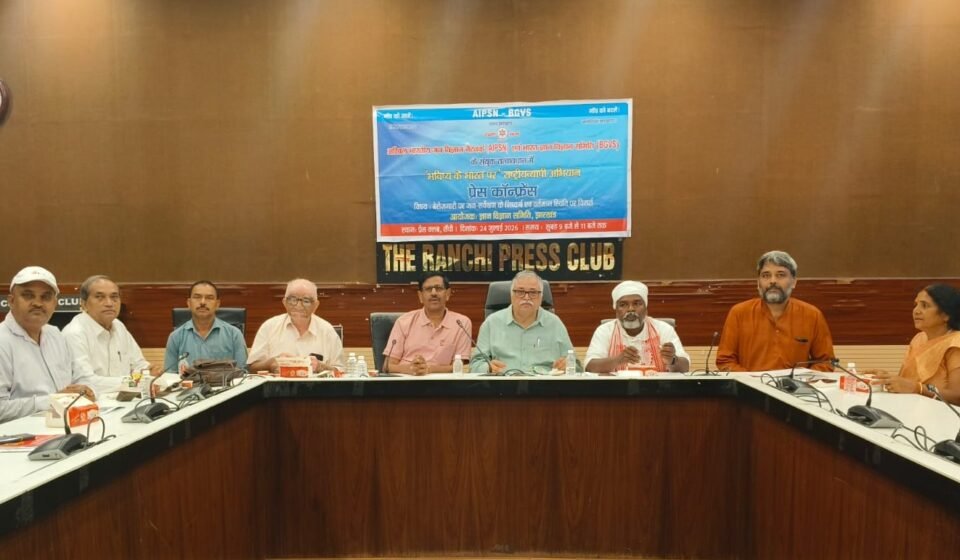
The findings were released at a press conference held at the Ranchi Press Club on Friday in the presence of the organisation’s national and state leadership.
Addressing the media, Dr. Kashinath Chatterjee, National Vice-President of Gyan Vigyan Samiti, said the survey formed part of the organisation’s nationwide campaign, “What Should the Future India Look Like?”, which advocates for an India where every citizen, particularly young people, has access to dignified, secure and sustainable employment.
Conducted between August and September 2025, the survey covered 4,678 respondents across 18 districts of Jharkhand. Of the respondents, 58.47 per cent were men and 41.53 per cent women, with an average age of around 30 years. The survey found that 71 per cent were actively seeking employment, while 15 per cent were students. Others depended on irregular wage labour, agriculture or small-scale self-employment for their livelihood.
Despite 96 per cent of respondents having received formal education—including graduates and postgraduates—employment opportunities remained limited. Nearly 49 per cent said they had very little chance of securing a good job, while 21 per cent believed opportunities were almost non-existent. Only 16 per cent expressed optimism about finding suitable employment.
The survey also highlighted growing mental distress among young people, with 35 per cent describing themselves as highly distressed, 26 per cent worried about their future and over 15 per cent saying they had lost hope of finding employment.
Respondents attributed unemployment to a combination of Central and State government policies, systemic shortcomings, lack of resources, inadequate skill development and unequal distribution of resources. More than 95 per cent believed unemployment has worsened over the years.
Dr. Chatterjee said the findings underscored not only rising unemployment but also increasing underemployment, with many educated youth compelled to accept temporary or low-skilled jobs that do not match their qualifications. He warned that unless quality employment opportunities are created, the aspirations of millions of young Indians would remain unfulfilled.