
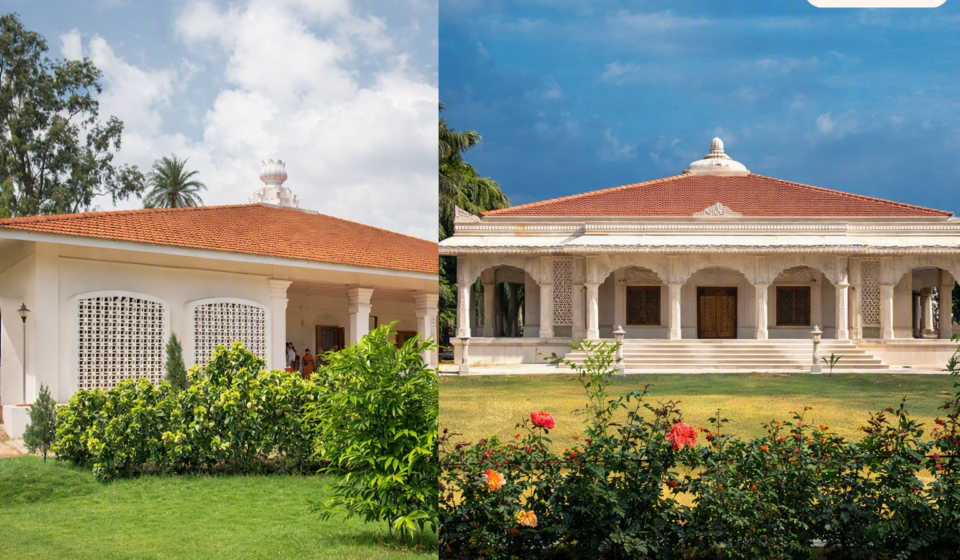
Yogoda Math : Where Education Meets Spirituality
Dr. Mayank Murari
Amidst the serene landscape of Ranchi, the Yogoda Satsanga Society of India (YSS) ashram stands as one of India’s most significant spiritual institutions. More than an ashram, it represents a philosophy that harmonizes education, meditation, and self-realization. Established by Paramahansa Yogananda in 1917, the Ranchi centre became the cradle of a spiritual movement that would eventually introduce India’s ancient science of yoga and meditation to millions across the world.
On 22 March 1917, the young monk Mukunda Lal Ghosh—later revered as Paramahansa Yogananda—founded the Yogoda Satsanga Brahmacharya Vidyalaya at Dihika in Bengal with only seven students. His vision challenged the conventional education of the time. He believed that education should cultivate not merely intellectual ability but also physical vitality, moral strength, emotional balance, and spiritual awareness.
In 1918, the institution was shifted to Ranchi, where the Maharaja of Kashimbazar offered his twenty-five-acre summer estate for the school. This campus later became the headquarters of the Yogoda Satsanga Society of India. During his visit to India in 1935, Yogananda secured the property permanently, ensuring that Ranchi would remain the heart of his mission. The campus continues to preserve the atmosphere in which many of his pioneering educational and spiritual experiments took shape.
The Meaning of “Yogoda”
The term “Yogoda” was coined by Paramahansa Yogananda himself. Derived from Yoga, meaning union or harmony, and Da, meaning “that which imparts,” Yogoda refers to a system that imparts methods for achieving harmony between the body, mind, and soul. It reflects Yogananda’s conviction that education and spiritual practice should awaken the latent divine potential within every individual rather than merely prepare them for material success.
The Science of Kriya Yoga
At the heart of YSS lies the ancient discipline of Kriya Yoga, a meditative technique that Yogananda described as a scientific method for accelerating spiritual evolution.
The lineage of this tradition flows through:
Mahavatar Babaji
Lahiri Mahasaya
Swami Sri Yukteswar
Paramahansa Yogananda
Rather than presenting Kriya Yoga as a sectarian doctrine, Yogananda emphasized its universality. He regarded it as a practical science of consciousness that could be embraced by sincere seekers irrespective of religion, nationality, or cultural background.
Long before holistic education became an accepted ideal, Yogananda introduced what he called “How-to-Live Education.” His educational philosophy sought to integrate: Academic excellence, physical health through yogic practices, Emotional discipline, Moral character and Concentration and meditation
According to Yogananda, education should not merely fill the mind with information; it should build character, strengthen willpower, awaken discrimination, and prepare individuals to lead balanced and meaningful lives. This educational experiment at Ranchi became one of the earliest examples in modern India of combining spirituality with mainstream learning.
The Ranchi Ashram Today
The Ranchi headquarters continues to attract seekers from across India and abroad. Among its notable landmarks are: Paramahansa Yogananda’s preserved room :The historic main building, The Meditation Temple, The Memorial Shrine, Prayer halls and gardens, Exhibits on Yogananda’s life and teachings.The tranquil surroundings encourage contemplation and silence, embodying Yogananda’s ideal that inner peace is not an escape from life but the foundation of purposeful action.
In 1920, Paramahansa Yogananda travelled to the United States as India’s delegate to the International Congress of Religious Liberals in Boston. He later founded the Self-Realization Fellowship (SRF), the international counterpart of YSS. His spiritual classic, Autobiography of a Yogi, first published in 1946, has become one of the most influential books on Indian spirituality. Translated into numerous languages, it introduced generations of readers—including scientists, philosophers, artists, and entrepreneurs—to yoga, meditation, and Vedantic philosophy.Today, YSS and SRF continue to disseminate his teachings through meditation centres, publications, retreats, and online lessons worldwide.
Ranchi’s Spiritual Legacy
For Jharkhand, the Yogoda Ashram represents far more than a religious institution. It is a symbol of the region’s contribution to global spiritual thought. Alongside the state’s rich tribal traditions and natural heritage, the Ranchi ashram demonstrates that Jharkhand has also been a centre for profound philosophical inquiry and transformative education.
The Yogoda Satsanga Society of India is a living institution where spirituality, education, and service converge. Paramahansa Yogananda envisioned an education that nurtures the whole human being and a spirituality that transcends dogma. More than a century later, his message remains deeply relevant in an age marked by technological progress but also by growing psychological and existential challenges.
In reminding humanity that true success lies in balancing outer achievement with inner realization, Yogoda Satsanga Society of India continues to illuminate a path toward a more integrated, compassionate, and meaningful life.