
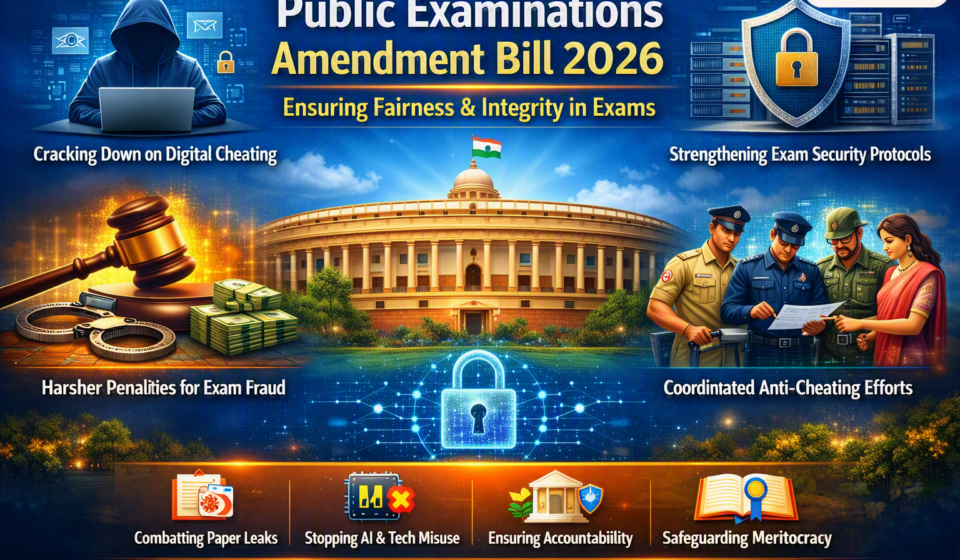
Public Examinations (Prevention of Unfair Means) Amendment Bill, 2026: Strengthening Integrity in India’s Examination System
By Dr. Misfiqua Hasan
Public examinations are the backbone of India’s merit-based education and recruitment system. Every year, millions of students and aspirants invest years of hard work preparing for competitive examinations conducted by various public authorities. Any compromise in the fairness of these examinations not only destroys the dreams of deserving candidates but also undermines public confidence in governance. Against this backdrop, the Public Examinations (Prevention of Unfair Means) Amendment Bill, 2026 marks another significant step towards ensuring transparency, accountability, and credibility in the examination process.
The original legislation was enacted to address the growing menace of paper leaks, impersonation, organized cheating syndicates, and the use of sophisticated technological tools to manipulate examination outcomes. While the law provided stringent penalties, evolving methods of examination fraud have necessitated further legal reforms. The 2026 Amendment Bill seeks to bridge these gaps by strengthening investigative mechanisms, enhancing institutional accountability, and introducing provisions to tackle emerging digital threats.
One of the most notable features of the Amendment Bill is its emphasis on technology-driven offences. Modern cheating networks increasingly rely on encrypted communication, electronic gadgets, artificial intelligence, and cyber platforms to facilitate unfair practices. By recognizing these new forms of misconduct, the legislation equips enforcement agencies with stronger legal tools to investigate and prosecute offenders.
The Amendment Bill also places greater responsibility on examination-conducting agencies and service providers. Institutions are expected to adopt robust security protocols, maintain secure digital infrastructure, and implement effective monitoring systems. This approach shifts the focus from merely punishing offenders to preventing offences through institutional preparedness.
Another significant aspect is the deterrent effect of stricter penalties. Organized crime syndicates involved in paper leaks and examination fraud often operate for substantial financial gain. Enhanced punishments, financial penalties, and stronger investigative powers are intended to dismantle these criminal networks and discourage future offences. At the same time, the law seeks to protect honest candidates from becoming victims of systemic failures beyond their control.
The Amendment Bill also encourages greater coordination among law enforcement agencies, examination authorities, cyber experts, and forensic investigators. Such inter-agency cooperation is essential in dealing with offences that often span multiple states and involve sophisticated digital evidence. Timely investigations and speedy prosecution will be critical to achieving the objectives of the legislation.
However, legal reforms alone cannot eliminate examination malpractice. A comprehensive strategy should include secure digital infrastructure, encrypted question paper transmission, biometric verification of candidates, AI-based surveillance, cybersecurity audits, and regular capacity-building of officials. Equally important is promoting ethical values among students and ensuring transparency throughout the examination process.
If implemented effectively, the legislation can significantly strengthen public trust in examinations, improve institutional accountability, and reinforce the constitutional values of equality, fairness, and equal opportunity. A transparent examination system is not merely an administrative necessity—it is an essential pillar of a just, meritocratic, and progressive India.
(Misfiqua is Advocate, Jharkhand High Court and BJP Minority Morcha National Secretary)