
Inheritance Rights under the CNT Act, the SPT Act and the Hindu Succession Act: Reconciling Tribal Custom with Constitutional Equality
By Richa Sanchita
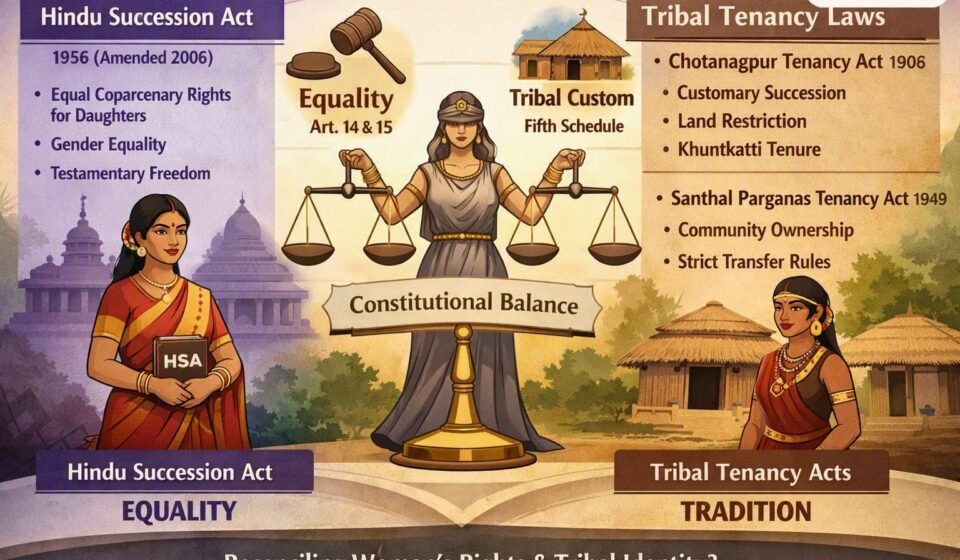
The jurisprudence governing inheritance in Scheduled Areas of Jharkhand presents one of the most complex intersections between customary tribal law, statutory protection of land, and constitutional guarantees of equality. While the Hindu Succession Act, 1956 (HSA) provides an egalitarian framework of succession among Hindus, its applicability to Scheduled Tribes is expressly excluded under Section 2 (2). Consequently, succession among tribal communities in Jharkhand continues to be governed largely by customary law as preserved through the Chotanagpur Tenancy Act, 1908 (CNT Act) and the Santhal Parganas Tenancy (Supplementary Provisions) Act, 1949 (SPT Act). This article critically analyses the statutory framework, constitutional challenges, and leading judicial precedents governing inheritance rights, particularly those concerning tribal women.
I. Introduction
The constitutional promise of equality frequently encounters the reality of legally recognised customary practices. Nowhere is this conflict more pronounced than in the Scheduled Areas of Jharkhand, where succession to immovable property is governed not merely by personal law but by a combination of customary norms and special tenancy legislation designed to prevent alienation of tribal land.
The CNT Act and the SPT Act are welfare legislations intended to preserve tribal identity, protect community ownership of land, and prohibit exploitation through unrestricted transfer. Their objective is fundamentally different from the Hindu Succession Act, whose purpose is to regulate succession among Hindus by creating a uniform statutory scheme.
The continuing judicial challenge has been to determine whether constitutional guarantees of equality can modify customary inheritance without undermining the legislative objective of protecting tribal land.
II. Statutory Framework
A. Hindu Succession Act, 1956
The Hindu Succession Act codifies intestate succession among Hindus, Buddhists, Jains and Sikhs.
The Hindu Succession (Amendment) Act, 2005 brought revolutionary changes by: conferring coparcenary rights upon daughters by birth; abolishing gender discrimination in ancestral property; granting daughters equal rights and liabilities in joint family property.
However, Section 2(2) provides: “Nothing contained in this Act shall apply to the members of any Scheduled Tribe within the meaning of Article 366 (25) of the Constitution unless the Central Government by notification otherwise directs.” (Sci API)
This statutory exclusion forms the foundation of most inheritance disputes involving tribal communities.
B. Chotanagpur Tenancy Act, 1908
The CNT Act was enacted during the colonial period to prevent alienation of tribal land. Its primary objectives are: protection of raiyati holdings; recognition of customary succession; restriction on transfer of tribal land; preservation of Khuntkatti tenure.
The Act does not create a comprehensive code of succession but preserves customary inheritance while imposing statutory restrictions on alienation. (Indian Kanoon)
C. Santhal Parganas Tenancy Act, 1949
The SPT Act adopts an even stricter policy. It protects: community ownership, customary inheritance, village administration, prohibition on transfer except in limited circumstances.
Its philosophy is preservation of tribal land rather than redistribution of proprietary rights.
III. Constitutional Scheme
The constitutional provisions relevant to inheritance include:
Article 14 – Equality before law.
Article 15 – Non-discrimination.
Article 21 – Right to dignity.
Article 46 – Promotion of educational and economic interests of Scheduled Tribes.
Fifth Schedule – Administration of Scheduled Areas.
The constitutional dilemma lies in balancing: gender justice, preservation of tribal customs, socio-economic protection, prevention of land alienation.
IV. Judicial Development
- Madhu Kishwar v. State of Bihar, (1996) 5 SCC 125
This remains the most significant decision on tribal inheritance. The petition challenged customary succession under the CNT Act that substantially excluded women from inheritance.
The Supreme Court declined to strike down the customary system in its entirety, observing that unrestricted application of the Hindu Succession Act could defeat the protective purpose of tribal land legislation. At the same time, the Court recognised the constitutional concerns arising from the exclusion of women and stressed that questions of discrimination should be examined with sensitivity to both equality and tribal autonomy. (Indian Kanoon)
Principles emerging from the decision
Section 2(2) excludes Scheduled Tribes from the Hindu Succession Act. Preservation of tribal identity constitutes a legitimate constitutional objective.
Courts should exercise restraint in invalidating long-standing tribal customs.
Women’s rights require progressive recognition consistent with constitutional values.
Justice K. Ramaswamy, in a separate opinion, favoured extending the equitable principles underlying succession law to tribal women while maintaining statutory restrictions on alienation of tribal land. (CaseMine)
- Labishwar Manjhi v. Pran Manjhi, (2000) 8 SCC 587
This decision clarified an important exception.
The Supreme Court held that where members of a Scheduled Tribe had abandoned tribal customs and had become fully Hinduised, following Hindu customs and practices, the Hindu Succession Act could apply notwithstanding their tribal origin. (Indian Kanoon)
The Court found evidence such as: performance of Shraddha, observance of Hindu marriage customs, application of vermilion, abandonment of Santhal customary practices.
Consequently, the widow became absolute owner under Section 14 of the Hindu Succession Act.
The judgment establishes that the determining factor is not merely tribal status but the continuing applicability of tribal customary law. - Recent Supreme Court Position
Subsequent decisions have reiterated that, so long as Section 2(2) remains un- amended and no Central Government notification extends the Hindu Succession Act to a Scheduled Tribe, inheritance disputes involving members of Scheduled Tribes are ordinarily governed by tribal custom rather than the HSA. The Court has emphasised that any broader reform is a matter for Parliament rather than judicial legislation. (Sci API)
V. Comparative Analysis
Issues: Hindu Succession Act, CNT Act, SPT Act, Source of succession, Statute, Custom recognised by statute, Custom recognised by statute, Applicability, Hindus, Scheduled Tribes in Chotanagpur, Scheduled Tribes in Santhal Parganas, Rights of daughters, Equal coparcenary rights, Governed by tribal custom, Governed by tribal custom, Testamentary succession, Permitted, Limited by land protection laws, Strictly controlled, Objective, Equality in succession, Protection of tribal land and Preservation of tribal land
VI. Critical Analysis
The existing legal framework reveals a continuing tension between two constitutional commitments. The first is equality and non-discrimination. The second is preservation of tribal identity under the Fifth Schedule. The challenge is whether tribal customs excluding women from inheritance should continue to receive constitutional protection. A rigid application of equality may undermine tribal land protection. Conversely, absolute adherence to custom may perpetuate gender discrimination.
The jurisprudence of Madhu Kishwar demonstrates that courts have attempted to balance these competing constitutional objectives rather than permitting either principle to prevail absolutely. (Indian Kanoon)
VII. Conclusion
Inheritance law in Jharkhand cannot be examined solely through the lens of personal law. It represents an interaction between: constitutional law, customary law, land reform legislation, social justice and tribal autonomy.
While the Hindu Succession Act embodies the constitutional vision of gender equality, the CNT Act and the SPT Act pursue an equally significant constitutional objective—the preservation of tribal land and identity.
The future development of inheritance law is likely to emerge through legislative intervention rather than judicial innovation. Any reform must harmonise constitutional equality with the protection of tribal communities, ensuring that the advancement of women’s rights does not inadvertently facilitate the alienation of tribal land.
Footnotes
Hindu Succession Act, 1956, § 2(2). (Sci API)
Madhu Kishwar v. State of Bihar, (1996) 5 SCC 125. (Indian Kanoon)
Labishwar Manjhi v. Pran Manjhi, (2000) 8 SCC 587. (Indian Kanoon)
Chotanagpur Tenancy Act, 1908. (Indian Kanoon)
Santhal Parganas Tenancy (Supplementary Provisions) Act, 1949. (Indian Kanoon)
Constitution of India, Arts. 14, 15, 21, 46 and the Fifth Schedule.
See also recent Supreme Court decisions reaffirming that Section 2(2) excludes Scheduled Tribes from the HSA unless extended by Central Government notification. (Sci API)
(Richa Sanchita is an advocate of Jharkhand High Court with more than 24 years of experience. Her area of expertise are Civil, Writs, Criminal and Banking.)