
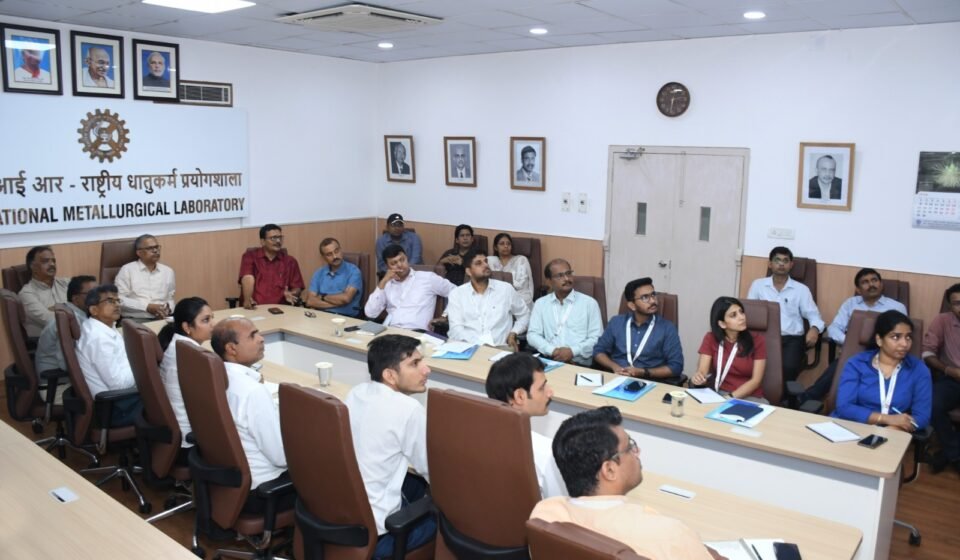
CSIR-NML launches E-Waste training drive to formalise recycling sector
PNS
Jamshedpur
In a major step towards sustainable e-waste management and environmental protection, CSIR-National Metallurgical Laboratory (CSIR-NML), Jamshedpur, on Monday launched a week-long training programme for master trainers aimed at transforming India’s informal e-waste recycling sector into a safer and more organized ecosystem.
The programme, inaugurated by CSIR-NML Director Dr. Sandip Ghosh Choudhury, brings together master trainers from TERI and REKART, who will be equipped with scientific knowledge and practical skills to train thousands of informal e-waste handlers across the country.
Led by Dr. Manis Kumar Jha, Chief Scientist and Project Leader, the training focuses on safe handling, segregation, dismantling and recycling of electronic waste generated from mobile phones, computers, printed circuit boards, wires and other electronic devices. Participants are also being sensitized about the environmental and health hazards of unsafe practices such as open burning and uncontrolled chemical use.
A key highlight of the programme is hands-on exposure to indigenous technologies developed for recovering valuable metals such as copper, silver and gold from discarded electronics. The initiative seeks to help informal recyclers view e-waste not as waste, but as a valuable secondary resource and business opportunity.
The programme is part of a national project jointly implemented by C-MET Hyderabad, CSIR-NML Jamshedpur and CIPET-LARPM Bhubaneswar, with support from the Ministry of Electronics and Information Technology, Government of India.
Project officials said the long-term goal is to train 15,000 informal e-waste operators, create 75 recycling clusters, formalise at least 30 units and establish eco-parks where scientific recycling can be carried out safely. The initiative will also support implementation of E-Waste Management Rules, 2016 and strengthen India’s circular economy by promoting resource recovery and reducing environmental pollution.
Experts noted that while India’s e-waste generation is growing rapidly, much of it still flows through informal channels where unsafe recycling practices pose serious risks to both human health and the environment. The CSIR-NML initiative aims to bridge this gap through technology transfer, skill development and formalisation of the sector.
The programme is expected to play a crucial role in promoting resource efficiency, creating green livelihoods and advancing sustainable e-waste management across the country.