
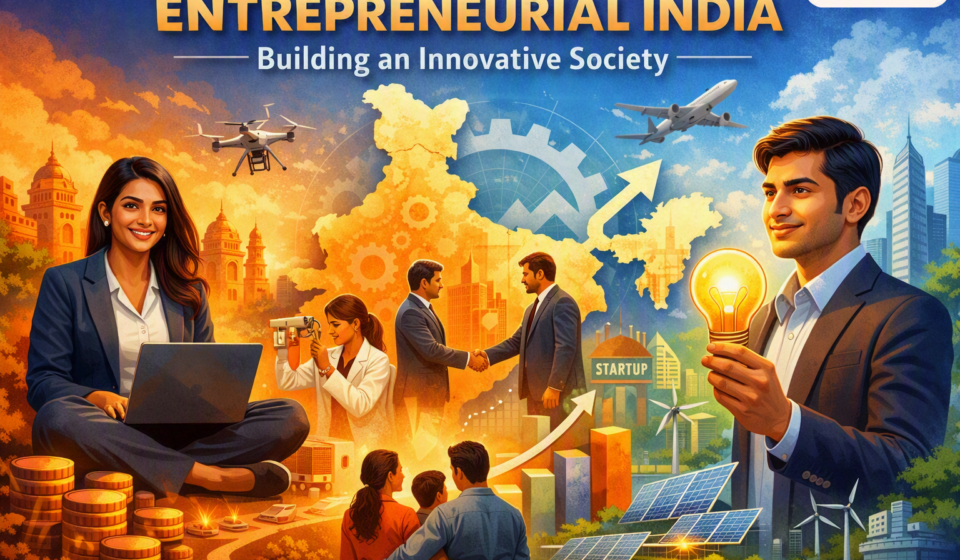
From Startup India to Entrepreneurial India: The Next Frontier of Economic Policy
BY DEVANSHU JHA
PART 1
India has spent the past decade doing something remarkable: building a startup ecosystem at extraordinary speed.
When Startup India was launched in January 2016, India had roughly 500 DPIIT recognised startups. By 31 March 2026, the number had crossed 2.23 lakh, with recognised startups generating more than 23.36 lakh direct jobs. In FY2025-26 alone, more than 55,200 startups were recognised the highest annual addition since the initiative began.
The transformation is not merely numerical. Recognised startups now exist across every State and Union Territory, while around 50% originate from Tier-II and Tier-III cities. More than 1.07 lakh recognised startups have at least one woman director or partner, accounting for approximately 48% of the recognised ecosystem.
The institutional architecture has expanded alongside this growth: Startup India, state startup policies, incubators, seed funding, credit guarantees, venture capital and public-procurement mechanisms have created an increasingly sophisticated support system. The Government has also launched Startup India Fund of Funds 2.0 with a INR 10,000 crore corpus, targeted at deep-tech, early-growth and innovative manufacturing ventures. This is a major policy success.
But precisely because the first phase has been so successful, India should now ask a different question: What comes after Startup India?The answer may not be another fund, incubator or hackathon. It may be the creation of an entrepreneurial society.
From the Startup to the Household India’s implicit life script remains remarkably linear:
Study → Job → Salary → Safety → Marriage → EMI → Retirement.
For much of the twentieth century, this was a rational way of managing uncertainty. Education provided credentials, employment provided predictable income, and savings and property provided security.
But the economic environment has changed. Artificial intelligence, automation, technological disruption, platformisation and rapidly changing skill requirements are making careers less linear and economic uncertainty more persistent.
The problem, therefore, is not that India lacks entrepreneurs. The deeper problem is that entrepreneurship remains a choice made by a relatively small subset of people who have already crossed the psychological threshold of becoming founders.
Existing policy largely begins after that decision: an individual has an idea, establishes an enterprise and then seeks finance, incubation, mentoring or market access. The next policy frontier should begin before that decision.
The question should become: How can entrepreneurship become a normal economic option for an ordinary Indian household?
Entrepreneurship as Household Resilience
This does not mean that every Indian should become a full-time founder. Nor should employment be portrayed as inferior to entrepreneurship. The proposition is subtler: every household should possess entrepreneurial optionality. Consider a young person who does not know what the labour market will look like ten years from now. AI may transform occupations; industries may disappear; entirely new markets may emerge.
Under such uncertainty, making one irreversible career bet may be less resilient than developing multiple forms of economic capability. An entrepreneurial attempt can generate much more than financial returns. It can build market knowledge, networks, sales capability, problem-solving skills, confidence and the ability to create economic value rather than only seek employment.
Entrepreneurship can therefore be reframed not simply as risk-taking, but as a mechanism for building optionality and resilience. This changes the policy question fundamentally. Instead of asking: “How do we persuade more people to become entrepreneurs?”we should ask: “How do we make entrepreneurial experimentation sufficiently accessible, affordable and reversible that ordinary people can rationally consider it?
Breaking the Linear Life Model
The objective is not to abolish the Stud-Job-Marriage-EMI model. It is to insert entrepreneurial optionality before life becomes difficult to reverse. The critical intervention points are therefore likely to be:
Education → Entrepreneurial Experiment → Job/Startup/Hybrid
And
First Job → Entrepreneurial Experiment → Return/Scale/Continue Employment.
A young person should not have to choose between being an employee and an entrepreneur permanently. India can instead encourage a portfolio model of economic life, in which people can move between employment, entrepreneurship, freelancing, professional work and enterprise. The key institutional principle is reversibility.
If failure means permanent financial damage, social stigma and loss of employability, entrepreneurship will remain disproportionately accessible to people who already possess wealth, networks and family security. If failure becomes a manageable learning episode, the potential pool of entrepreneurial experimentation can expand substantially.
Devanshu Jha is a public policy expert.