
Kumar Prabhat
Dumka
In a major initiative to document and preserve Eastern India’s prehistoric legacy, the Jharkhand Council for Science, Technology and Innovation (JCSTI), under the Department of Science and Technology, has sanctioned the multidisciplinary “GEO-RAJMAHAL” project.
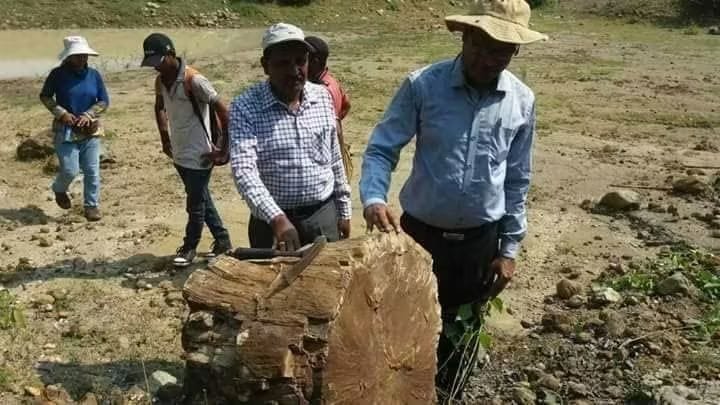
The 36-month project will focus on the Rajmahal Hills in northeastern Jharkhand’s Santhal Pargana, where ancient basaltic formations meet the Ganga. The region contains rare petrified wood and fossilised leaf impressions dating to the Cretaceous period, nearly 118 million years ago.
The project will seek to connect this geological record with evidence of ancient human-environment interactions. Prof. Deepak Kumar Jha of the Department of Applied Geology, IIT (ISM) Dhanbad, is the Principal Investigator, while Prof. Ranjeet Kumar Singh of the Department of Geology, Sahibganj College, SKMU, is the Co-Principal Investigator. Senior Geologist Shreya Shrey of the Geological Survey of India, Ranchi, is also part of the scientific team.
The Rajmahal Trap formations extend across Sahibganj, Dumka, Godda and Pakur and into adjoining West Bengal. The GSI declared Mandro in Sahibganj a Geological Heritage Site in 2014, while the State Forest Department established Mandro Fossil Park in 2022.
GEO-RAJMAHAL will investigate unexplored fossil-bearing horizons, study abiotic factors influencing the Ganga ecosystem and examine prehistoric tribal settlements and their adaptation to the environment.
The initiative also aims to support geo-tourism, ecological conservation and sustainable livelihoods for indigenous communities, aligning scientific research with broader sustainable development goals.