
Pioneer News Service
Ranchi
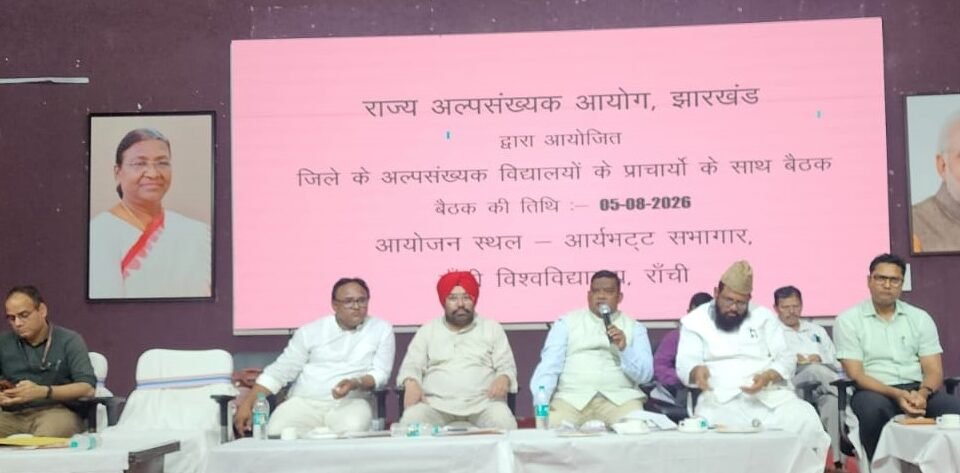
The Jharkhand State Minority Commission on Wednesday held a review and consultation meeting with principals of government-aided and unaided minority schools in the state to discuss their academic, administrative and infrastructural challenges.
The one-day meeting was held at the Aryabhatta Auditorium at Ranchi University, where representatives of minority schools and education department officials discussed issues related to the functioning and development of the institutions.
Key issues discussed included approval of teaching posts, timely availability of textbooks, access to bicycle distribution schemes for students and the process of granting Minority Status to schools.
The meeting also reviewed the availability of basic infrastructure, including functional toilets, drinking water, electricity, furniture, laboratories, libraries and sports equipment.
The commission stressed the need to ensure that students from minority communities receive maximum benefits from welfare schemes run by the Jharkhand and Union governments.
Officials and school representatives also discussed pre-matric and post-matric scholarships, the Chief Minister’s bicycle distribution scheme, uniforms and textbooks, hostel facilities, digital education, skill development and career counselling, besides various schemes implemented by the Minority Welfare Department.
The meeting was attended by Jharkhand State Minority Commission vice-chairpersons Pranesh Solomon and Jyoti Singh Matharu, members Qari Barkat Ali and Waris Qureshi, social worker Anshu Lakra, along with the Ranchi District Education Officer, District Education Superintendent, District Welfare Officer, principals of minority schools and officials of the Education Department.
The commission directed the concerned officials to ensure that problems faced by minority schools are addressed on a priority basis. It also called for effective implementation of government welfare schemes so that eligible students and institutions receive the intended benefits without delay.
The commission emphasised the need to provide students from minority communities with quality education, adequate resources and equal opportunities, while ensuring overall improvement in the academic and infrastructural standards of minority schools across the state.