
Nakshatras: The Celestial Code of Consciousness
By Neha M. R. Aggarwal
As one flips the Sunday editorial, intrigued by the thought… ‘What does my zodiac sign read this week ?’… while the Vedic seers resorted to a question the gravitas of which falls beyond imagination – ‘Under which star did our mind awaken?’
To the modern eye, the night sky is filled with stars. To the sages, it was filled with stories, science and sacred symbolism.
Every civilisation looked at the sky.
The Vedic civilisation learnt to read it.
Long before astronomy became an academic discipline and psychology emerged as a modern science, the sages of ancient India contemplated the heavens with extraordinary precision. Besides observing the movements of celestial bodies, they as well registered the remarkable harmony between the cosmos and consciousness, between the rhythm of the heavens and the rhythm of human life.
They recognised that while the Sun governed the external rhythm of seasons, it was the Moon that quietly governed the inner rhythm of life – the mind, emotions, memory, imagination and intuition.
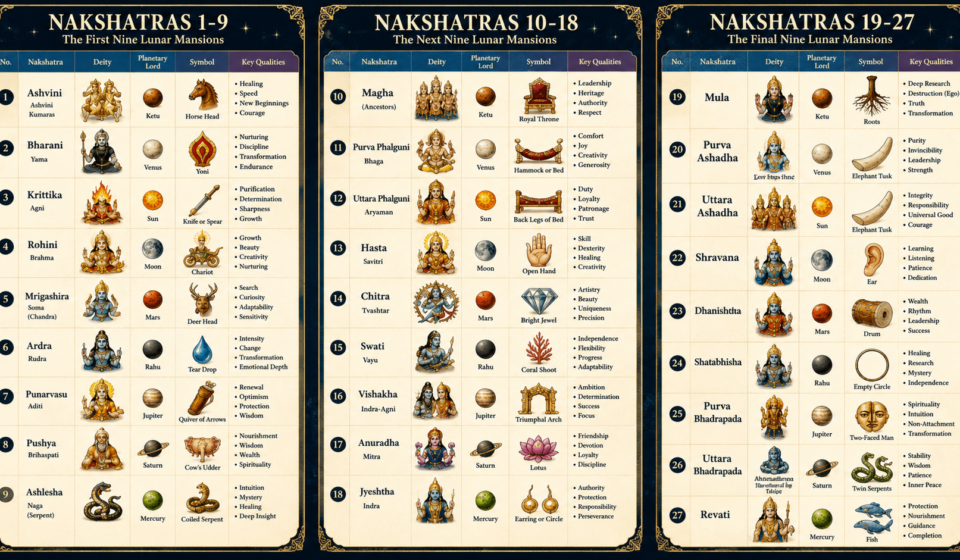
From this profound observation emerged one of humanity’s oldest and most sophisticated systems of celestial understanding – the Nakshatras, the twenty-seven lunar mansions that continue to form the very foundation of Jyotiṣh.
Nakshatra (constellation- cluster of stars), a celestial marker – occupied by the Moon at the exact moment of birth.
While the zodiac often describes our outward personality, the Nakshatra reveals something subtler – our emotional blueprint, instinctive responses, psychological tendencies, karmic inclinations, spiritual lessons and the very architecture of the mind.
What Exactly is a Nakshatra?
A Nakshatra is often translated as a lunar mansion or constellation, but neither expression fully captures its significance within the Vedic worldview.
The word itself has fascinated Sanskrit scholars for centuries.
Traditional etymologies derive it in several ways.
One interpretation understands it as Na + Kṣarati – that which does not perish or decay – symbolising the eternal celestial markers that have silently guided humanity across millennia.
Another derives it from Nakṣa + Tra, referring to that which maps or measures the heavens, emphasising its role in celestial navigation and cosmic timekeeping.
Whatever its precise linguistic derivation, one idea remains beautifully constant: Nakshatras are the enduring signposts of the night sky. Astronomically, the zodiac spans 360 degrees. The Vedic seers divided this celestial belt into twenty-seven equal sections, each measuring 13°20′. Every section became a Nakshatra. The specific stellar field occupied by the Moon at the exact moment of birth becomes one’s Janma Nakshatra – the Birth Star.
Each Nakshatra is further divided into four equal Padas, making a total of 108 Padas, each offering a finer understanding of temperament, destiny and spiritual evolution.
Why Twenty-Seven?
This question reveals the remarkable astronomical sophistication of ancient India.
The Moon completes one sidereal revolution around the Earth in approximately 27.3 days.
In other words, during its journey through the fixed stars, the Moon traverses nearly one Nakshatra every day. Thus, sages divided the zodiac into twenty-seven equal celestial sectors so that each day’s lunar position could be precisely identified.
Every time the Moon entered a new stellar division, it entered a new field of observation.
Long before mechanical clocks, printed calendars or astronomical observatories, the Moon moving through the Nakshatras became Nature’s celestial clock, regulating rituals, agriculture, navigation, seasonal activities and eventually the intricate science of Vedic Astrology.
Unlike our civil day, that changes at midnight by convention, a Nakshatra changes only when the Moon crosses into the next 13°20′ division of the zodiac. Consequently, a Nakshatra may begin at dawn, noon, sunset or midnight – entirely according to the Moon’s motion.
Cosmos became humanity’s first calendar long before they became its observatory.
Why Did the Rishis Choose the Moon?
The answer lies deep within the philosophical foundations of Sanātana Dharma.
The Puruṣa Sūkta of the Ṛg Veda (10.90.13) declares: चन्द्रमा मनसो जातः। (Chandramā manaso jātaḥ).
“From the Cosmic Being arose the Moon – the source of the mind.”
This profound declaration establishes the very philosophical foundation upon which classical Jyotiṣa stands.
In Vedic thought, the Moon represents Manas (the mind). It governs memory, emotions, imagination, habits, intuition, perception and our responses to the world around us.
The Sun reveals the outer world. The Moon reveals the inner one.
The Moon governs memory, mood, mind and mindfulness.
It is therefore hardly surprising that Maharishi Parāśara, in the Bṛhat Parāśara Horā Śāstra, repeatedly identifies the Moon as the significator of the mind, emotional disposition, happiness, nourishment, mother and psychological well-being.
The Nakshatra occupied by the Moon at birth therefore becomes far more than an astronomical coordinate. It becomes a map of one’s inner landscape. “If the horoscope is a book, the Nakshatra is its opening chapter.”
Every Nakshatra possesses its own:
Presiding Deity, Planetary Lord, Sacred Symbol
Innate Śakti (Divine Power), Psychological Attributes, Spiritual Lesson and Karmic Purpose.
This remarkable multi-layered framework makes the Nakshatra system one of the most refined psychological, symbolic and spiritual classifications preserved in any ancient civilisation. Every Nakshatra is more than a celestial location. It is an archetype. A field of consciousness. A language through which the cosmos speaks.
Every Nakshatra is a celestial classroom where astronomy meets spirituality, mythology meets mathematics, and time meets consciousness.
Yet, at this point, another fascinating question naturally arises.
Every Nakshatra possesses a deity.
Behind every deity lies a philosophy.
Behind every philosophy lies a way of living.
But why did the Vedic tradition associate every Nakshatra with a specific presiding deity?
Were these divine personalities simply assigned to stars through mythology?
Or did the Rishis perceive timeless principles operating within nature itself, expressing them
through symbolic forms that later generations came to know as Devatās?
To answer that question, we must first understand what the Vedic mind truly meant by the word Devatā…
Why Does Every Nakshatra Have a Presiding Deity?
Did the Rishis discover universal principles hidden in nature?
“The stars became sacred as the Rishis perceived timeless principles reflected through them.”
When one studies the twenty-seven Nakshatras, a fascinating pattern immediately emerges.
Each Nakshatra possesses a name, a symbol, a planetary ruler, and also a presiding deity.
Ashwini belongs to the Ashwini Kumāras.
Kṛttikā to Agni. Ārdrā to Rudra. Pushya to Bṛhaspati. Śravaṇa to Lord Viṣṇu. Revatī to Pūṣan.
Naturally, an inquisitive mind asks: Who decided this?
Why was Bṛhaspati associated with Pushya and not with Rohiṇī? Why Rudra with Ārdrā? Why Pūṣan with Revatī?
Surprisingly, none of the surviving Vedic texts explicitly records a meeting of sages assigning deities to the Nakshatras.
Instead, the answer lies in understanding how the Vedic mind observed Nature itself.
The Modern Mind Sees Gods. The Vedic Mind Saw Principles.
Perhaps the greatest obstacle in understanding Vedic literature lies in how we interpret the word Devatā. Today, many imagine a deity as a supernatural personality residing somewhere beyond the heavens. The Vedic understanding was considerably subtler.
A Devatā was first recognised as a governing intelligence – a universal principle through which creation continuously functions.
Agni Dev represented transformation as it transformed food, water… anything that it embraced.
Vāyu Dev represented movement, communication and life-force.
Varuṇa Dev symbolised cosmic order, depth and containment.
Maa Sarasvatī embodied flowing intelligence and inspired speech.
Lord Viṣṇu represented preservation, balance and continuity.
Dev Bṛhaspati embodied wisdom, guidance and nourishment through knowledge.
Before a deity became an object of worship, it was first understood as a law of Nature.
“In the Vedas, a Devatā is a principle through which creation operates.”
The Rishis Were Extraordinary Observers.
Long before telescopes, satellites or observatories, the Rishis spent centuries observing the heavens.
Yet they never observed the sky in isolation.
They observed the Earth simultaneously.
The flowering of trees. The migration of birds.
The changing seasons. The tides. Agricultural cycles. The behaviour of animals.
The growth of civilizations. The human mind itself. Slowly, they recognised recurring rhythms.
Certain periods consistently favoured beginnings. Others nurtured learning.
Some encouraged leadership. Others demanded discipline. Some dissolved what had outlived its purpose. Others restored harmony after chaos.
Nature appeared to move through recurring patterns of expression.
The Moon, travelling steadily through twenty-seven stellar divisions, became the most reliable celestial indicator of these changing rhythms.
The Nakshatras became dependable markers through which these qualities could be recognised.
Observation preceded instrumentation. Curiosity preceded calculation.
The Nakshatra Was Never the Cause. This distinction is fundamental.
Ancient Jyotiṣa never suggests that distant stars compel events to occur. Rather, it recognises that celestial movements and terrestrial life unfold within the same cosmic order. Just as sunrise does not create morning but announces it…
Just as spring does not manufacture flowers but creates conditions favourable for blossoming…
The Nakshatra does not force human behaviour.
It reflects the prevailing quality within Nature’s unfolding rhythm.
The deity associated with that Nakshatra symbolises that governing quality.
The stars did not command life; they reflected its rhythm.
Why Tell the Story Through a Deity?
Modern science explains Nature through equations. Ancient India often explained Nature
through symbols. Neither approach is superior.
They simply communicate knowledge differently.
An equation conveys precision. A symbol conveys meaning. A story ensures memory.
The Vedic civilisation understood something modern education is rediscovering – that knowledge survives longest when it can be remembered. Instead of exclaiming,
“This Nakshatra represents nourishment,”
the sages spoke of Bṛhaspati, the Guru of the Devas, whose wisdom nourishes kingdoms and seekers alike. Likewise rather than expressing,
“This Nakshatra transforms,” they invoked Agni, whose very existence is transformation.
Rather than saying, “This Nakshatra destroys illusion before rebuilding truth,” they remembered Rudra, whose fierce compassion clears the path for renewal. The deity became a living metaphor through which generations could remember an eternal cosmic principle.
Let us under through the Nakshatra Pushya and its presiding deity Bṛhaspati: A Window into Vedic Symbolism
Consider Pushya, one of the most revered among all Nakshatras. The Sanskrit root ‘Puṣ’ means to nourish, strengthen, sustain and help flourish. Its presiding deity is Bṛhaspati, the Guru of the Devas. What does a true Guru accomplish?
Nourishes wisdom. Strengthens character.
Protects Dharma. Guides rulers. Elevates society.
The symbolism becomes strikingly coherent.
Pushya signifies nourishment. Bṛhaspati personifies nourishment through wisdom.
The deity does not merely decorate the Nakshatra. The deity expresses its governing principle.
Perhaps this explains why Sage Vasiṣṭha selected Pushya Nakshatra for Lord Rāma’s proposed coronation.
Kings chose armies to protect kingdoms.
The Rishis chose auspicious moments to optimise destiny.
Even a coronation was governed by the cosmos.
For the Vedic mind, the right moment was as sacred as the right action.
Every Nakshatra therefore communicates through four interconnected dimensions.
Its symbol offers a visual key. Its deity reveals the governing principle. Its planetary ruler explains how that principle expresses itself.
Its Śakti describes the unique power that Nakshatra brings into manifestation. Nothing stands in isolation. Everything explains something else. The more one studies the Nakshatras, the more one realises that they are not merely astronomical divisions but an integrated language through which the Vedic sages described both the universe and the human psyche.
The next concept that logically follows is:
What is Nakshatra Śakti?
The Hidden Power That Makes Every Nakshatra Unique !
If the deity reveals the principle, Śakti reveals its purpose.
One of the most extraordinary yet least understood aspects of the Nakshatras is that each one possesses its own Śakti – a unique power or capacity to accomplish something specific. Unlike the planetary ruler, which describes how a Nakshatra expresses itself, or the presiding deity, which reveals what universal principle it represents, the Śakti answers a different question altogether:
What is this Nakshatra designed to do?
In Sanskrit, the word Śakti literally means power, energy, ability or capacity to manifest – the inherent function through which Nature expresses herself.
Every force has a form.
Every form has a function.
Every Nakshatra has a Śakti.
The sages observed that no two phases of Nature perform the same function.
Spring awakens. Summer ripens.
Autumn harvests. Winter conserves.
Each season possesses its own purpose.
Similarly, every Nakshatra contributes something unique to the cosmic rhythm.
Ashwini heals. Bharani carries.
Krittika purifies. Rohini nourishes.
Ardra transforms. Pushya strengthens.
Shravana learns. Revati protects. None is superior. None is inferior. Each performs a task that no other Nakshatra can perform in exactly the same way.
Nature thrives through diversity, not duplication. and so do the Nakshatras.
Śakti is Functional, Not Symbolic. Perhaps the simplest way to understand Śakti is through everyday life. A seed possesses the Śakti to
become a tree. Fire possesses the Śakti to transform. Water possesses the Śakti to nourish.
Gravity possesses the Śakti to attract. None of these forces requires belief. They simply function according to their inherent nature.
The Rishis recognised the same principle in the Nakshatras. Every stellar division appeared to correspond with a particular pattern of activity repeatedly observed in Nature and human experience. Thus each Nakshatra was assigned its unique Śakti – not as poetry, but as a description of function.
Symbols inspire the mind. Śakti explains the mechanism.
Pushya: The Śakti to Nourish
Take Pushya once again. Its deity is Bṛhaspati.
Its meaning is to nourish. Its Śakti is called Brahmavarchasa Śakti – the power to generate spiritual brilliance, wisdom and inner radiance.
Notice how beautifully every layer aligns.
Its name signifies nourishment. Its deity is the Guru of the Devas. Its Śakti nourishes consciousness itself. Nothing is accidental.
Every dimension reinforces the same governing principle.
Ardra: The Śakti to Renew Through Storm
Ārdrā, governed by Rudra, offers another remarkable example. Its symbolism is often associated with storms, tears and upheaval.
Its Śakti is the power to bring effort into fruition through destruction of the old. At first glance, destruction appears negative. Nature teaches otherwise. A forest fire destroys.
It also prepares the soil for new life. Storms uproot. They also cleanse the atmosphere.
Likewise, Rudra’s fierce energy removes what no longer serves growth. Transformation often begins where comfort ends.
Śakti Explains Why Every Nakshatra Feels Different.
Why does one Nakshatra encourage learning while another inspires leadership?
Why does one support healing while another promotes exploration?
The answer lies in Śakti. It is the underlying function that gives each Nakshatra its unique psychological flavour. This is why two individuals born under the same zodiac sign may behave very differently. Their Moon may be expressing entirely different Nakshatra Śaktis.
The Universe Operates Through Purpose.
Modern biology studies the function of every organ. Physics studies the function of every force. Ecology studies the function of every species. Similarly, Vedic astrology studies the function of every Nakshatra. Śakti reminds us that nothing in creation exists without purpose.
Every star… Every season… Every element…
Every human being… is designed to contribute something unique to the larger harmony.
A Lesson Beyond Astrology
Perhaps the greatest teaching of Nakshatra Śakti is deeply personal. Just as every Nakshatra possesses its own irreplaceable function, every individual carries a unique capacity waiting to unfold. Life becomes less about comparison and more about discovering one’s own inherent design. It did not interest the sages as to if and which Nakshatra was superior, instead they pondered over finding the answer to ‘What is this Nakshatra here to accomplish?’
Perhaps the same question is worth asking ourselves!
(Neha is a Lawyer, Writer, Pranic Healer, Vedic Kriya Practitioner – currently based in New Delhi)