
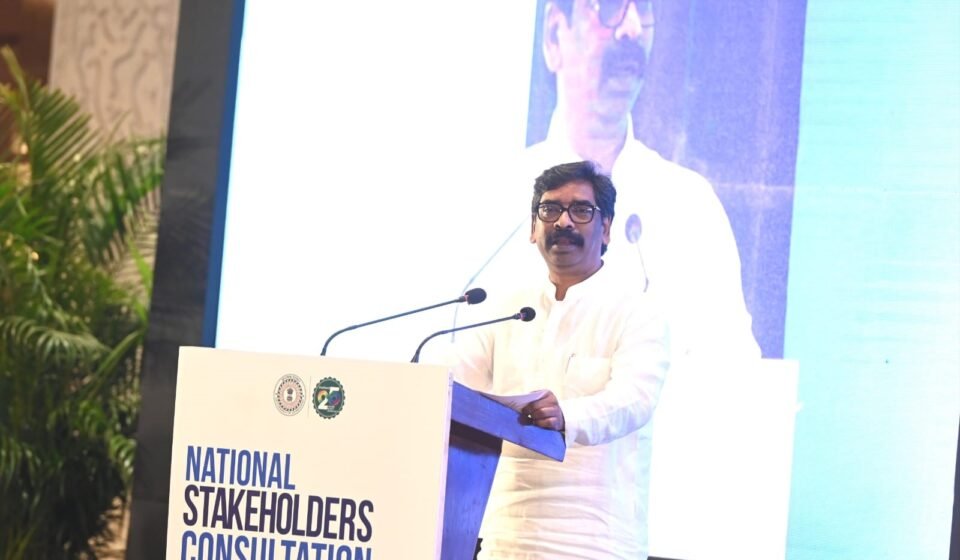
NATIONAL STAKEHOLDERS’ CONSULTATION
Jharkhand signs 14 MoUs to shift focus from ‘Mines’ to ‘Minds’
Targets Rs 10,000 crore investments, invites global investors
PRANAV PRATYUSH
New Delhi/Ranchi
Seeking to reposition Jharkhand as a technology-driven knowledge economy, Chief Minister Hemant Soren on Thursday unveiled an ambitious AI-powered Vision 2050 roadmap, declaring that the state is determined to move from being identified by its mineral wealth to becoming a hub of innovation, research and digital governance.
Addressing the concluding session of the two-day National Stakeholders’ Consultation in New Delhi, Soren said the government’s commitment was not limited to policy announcements but was focused on creating tangible opportunities for investment, employment and technological advancement.
“Jharkhand has long been known for its mines. The time has come for it to be recognised for its minds,” the Chief Minister said, asserting that the state intends to build a robust ecosystem for research, innovation and emerging technologies. He invited research institutions, technology companies and innovation-driven enterprises to partner in transforming Jharkhand into a centre of intellectual excellence.
A key outcome of the consultation was the signing of 14 Memorandums of Understanding (MoUs) with leading corporate groups and global organisations, including Tata Group, Jindal Group, Varun Beverages, Google, EaseMyTrip, Jindal Steel and Power Nuclear. The agreements span digital governance, artificial intelligence, industrial development, tourism, innovation and technology partnerships, while draft policies from several government departments were also deliberated during the event.
Calling the agreements “achievements rather than mere paperwork”, Soren said they represented fresh opportunities for the state’s future and directed officials to ensure their implementation within fixed timelines. He stressed that the government was prioritising long-term partnerships over short-term initiatives to ensure sustainable and inclusive development.
The consultation also marked the unveiling of Jharkhand’s proposed Artificial Intelligence Policy 2026-2031, which envisages the integration of AI across governance, healthcare, agriculture, education, mining, environmental management and disaster response while emphasising transparency, cybersecurity, responsible AI use and data privacy.
Among the flagship initiatives proposed under the roadmap is the Chief Minister Data Intelligence Platform (CM-DIP), an AI-enabled decision support system designed for real-time monitoring of government programmes, infrastructure projects and departmental performance. The state also plans to roll out AI-powered multilingual citizen services, including WhatsApp-based service delivery, digital grievance redressal mechanisms and Panchayat-level digital access to government services.
The roadmap identifies three flagship AI platforms—CM-DIP, the Health and Nutrition Vigilance System (HNVS) and the Critical Minerals Administration System (CMAS)—to strengthen governance, healthcare delivery and mineral administration through advanced data analytics.
To support the digital transformation agenda, the government has proposed an investment of ₹1,150 crore over the next five years for AI infrastructure, digital capacity building, innovation and technology adoption across departments.
As part of its long-term strategy, Jharkhand also unveiled plans for a 100.97-acre IT Park in Ranchi to attract Global Capability Centres (GCCs), IT companies, startups and innovation-led enterprises. Under Vision 2050, the state aims to draw more than Rs 10,000 crore in investments, establish over 50 GCCs, nurture 1,000 AI startups and generate more than one lakh AI-enabled jobs.
Highlighting inclusive development, Soren said the government was also considering increasing the existing 25 per cent concession available to tribal entrepreneurs under Jharkhand Industrial Area Development Authority (JIADA) regulations to 50 per cent, with the objective of integrating tribal communities more closely into the state’s industrial and technological growth.
Acknowledging that Jharkhand’s potential had often remained under-recognised because of inadequate outreach, the Chief Minister said the government would strengthen engagement with domestic and international investors through sustained dialogue. Inviting industry leaders, technology firms, startups and academic institutions to collaborate with the state, Soren said Jharkhand’s development journey would be driven by innovation, partnerships and citizen-centric governance, concluding his address with the traditional greeting, “Johar.”