
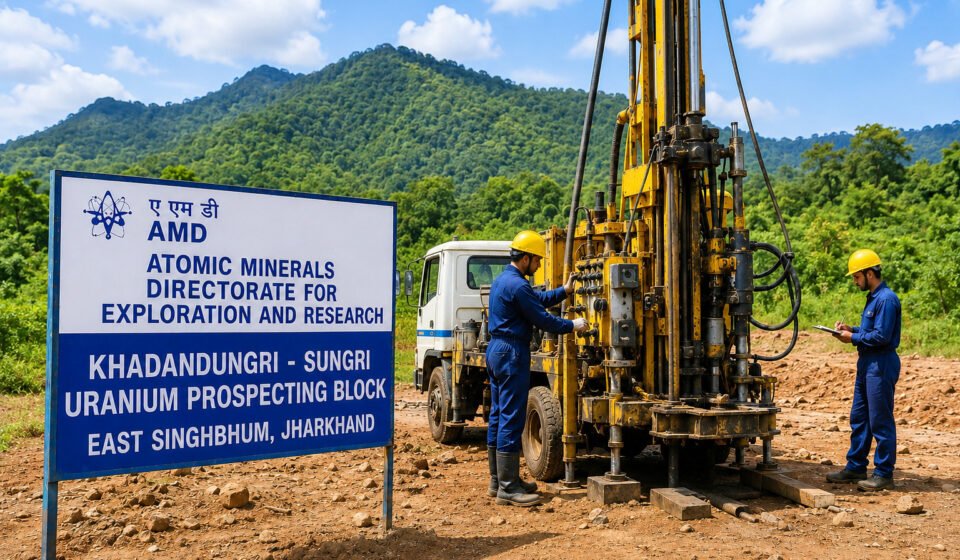
New uranium reserves discovered in E. Singhbhum, Centre approves prospecting
PNS
Jamshedpur
In a significant development for India’s nuclear energy sector, a new uranium reserve has been identified in the Khadandungri-Sungri block of East Singhbhum district, with the Central Government granting Stage-I approval for prospecting activities in the area. The approval covers 0.225 hectares of land, including 0.142 hectares of forest land and the remaining agricultural land, under the provisions of the Forest Conservation and Development Act, 1980.
The exploration project will be led by the Atomic Minerals Directorate for Exploration and Research (AMD), whose regional centre is located in Khasmahal, Jamshedpur. The proposal for prospecting was submitted by AMD Regional Director Dr. Bhattacharya and has now received clearance from the Centre. Uranium, a strategic mineral, plays a crucial role in powering the country’s nuclear reactors and supporting long-term energy security.
Officials associated with the project have indicated that the newly identified reserve could potentially meet India’s domestic uranium requirements for the next decade. The discovery further strengthens East Singhbhum’s position as a key uranium-producing region. Uranium mining operations are already underway in nearby Jaduguda, Musabani and Potka under the Uranium Corporation of India Limited (UCIL). Earlier, substantial uranium deposits of around 11,000 tonnes were discovered in the Banadungri-Simridungri area, while another 5,000-tonne reserve was identified in the Rajda region.
As part of the exploration programme, AMD plans to drill 30 boreholes in the block, including 25 within forest areas. To minimise environmental impact, the Centre has imposed several conditions during the two-year approval period. These include compensatory afforestation involving the plantation of 2,750 large trees in coordination with the state government and the use of advanced satellite imaging to identify precise drilling locations.
Experts have assured that the prospecting activities pose no radiation risk to nearby residents or the environment. The exploration process involves collecting core samples through specialised three-centimetre pipes, which are then sent to laboratories for analysis. Once testing is completed, the designated sites are secured to prevent unauthorised access.
The discovery is expected to strengthen India’s efforts towards self-reliance in nuclear fuel resources while enhancing the country’s long-term strategic and energy security prospects.