
Pioneer News Service
Ranchi
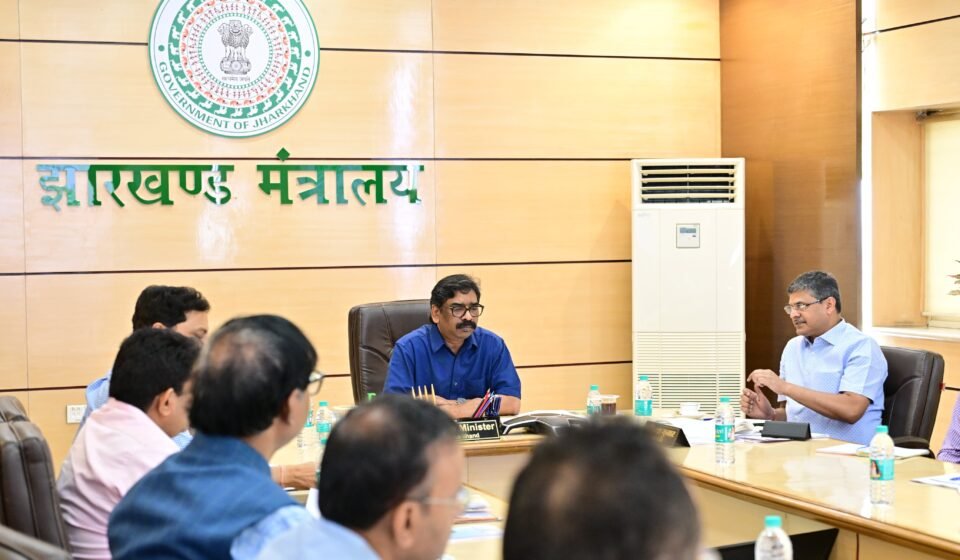
Chief Minister Hemant Soren directed officials to prepare a comprehensive technical and digital record of all forest areas in the state within one month. This includes implementing a layered digital map system. The system will enable authorities to assess the current status, structure, and ground reality of Jharkhand’s forests with a single click, tracking changes such as forest expansion, eco-tourism projects, deforestation, mining, and shifting wildlife sanctuary borders since the state’s formation.
The Chief Minister emphasized that tree plantation campaigns must move beyond mere statistics and focus on local ecological and economic utility. The department will prioritize planting fruit-bearing and economically viable trees like Mahua, Jamun, Karanj, Palash, Kusum, Ber, and Arjun. These species will enrich local biodiversity, support rural livelihoods, provide nutrition, and boost the traditional lac and tussar silk industries. Conversely, planting non-utilitarian trees will be discouraged. To regenerate remote forest areas, the department will formulate a plan for aerial seeding via helicopters. It was also focussed that state will aggressively promote commercial cultivation, specifically targeting large-scale cashew and bamboo farming on identified land tracts. This initiative aims to create new income streams for farmers. Additionally, promoting bamboo-based handicrafts and industries will generate self-employment opportunities, strengthening the rural economy.
The government will heavily publicize this urban greening initiative, which rewards citizens with five units of free electricity for every tree planted, balancing urban development with environmental conservation.
Fast-tracking pending forest land leases (Forest Pattas) to eligible beneficiaries remains a top priority, ensuring transparent and time-bound delivery. Officials were instructed to expedite compensation payouts for crop damage, house destruction, and casualties caused by wild elephant attacks.
The Chief Minister highlighted Jharkhand’s immense eco-tourism potential, directing the Forest and Tourism departments to work in tandem. For urban areas, large-scale planting of shade-giving trees like Acacia is mandated to improve air quality and expand green cover. Finally, the state will enforce strict action against violators of environmental and pollution control standards, leveraging the Jan Vishwas App for transparent and swift dispute resolution.
The meeting concluded with a direct virtual interaction between the Chief Minister and Divisional Forest Officers (DFOs), including those from Dumka, Jamtara, and Koderma, to review field-level progress and address operational bottlenecks.
The meeting was attended by State Chief Secretary Avinash Kumar; Development Commissioner Ajay Kumar Singh; Secretary of the Department of Forest, Environment and Climate Change Abu Bakr Siddique P.; Secretary of the Scheduled Tribes and Scheduled Castes Welfare Department Kripanand Jha; Principal Chief Conservator of Forests-cum-Head of Forest Force (PCCF HoFF) Sanjeev Kumar; PCCF (Wildlife) Ravi Ranjan; PCCF (ED) A.T. Mishra; Chairman of the Jharkhand Biodiversity Board Vishwanath Shah; PCCF (Wildlife) Shri S.R. Natesh; MD of the Forest Development Corporation Jabbar Singh; APCCF D. Venkateshwarlu; Member Secretary of the Jharkhand State Pollution Control Board Rajiv Lochan Bakshi; RCCF Dumka R. Thanga Pandian; Additional Secretary of the Department of Forest, Environment and Climate Change Bhor Singh Yadav; Additional Secretary Dilip Tirkey; and other officials.