Pioneer News Service
Ranchi
AJSU Party central president Sudesh Kumar Mahto on Thursday called for granting the Jharkhand government the power to levy a cess on mineral-bearing land, while alleging irregularities in the use of District Mineral Foundation Trust (DMFT) funds and poor utilisation of the state budget.
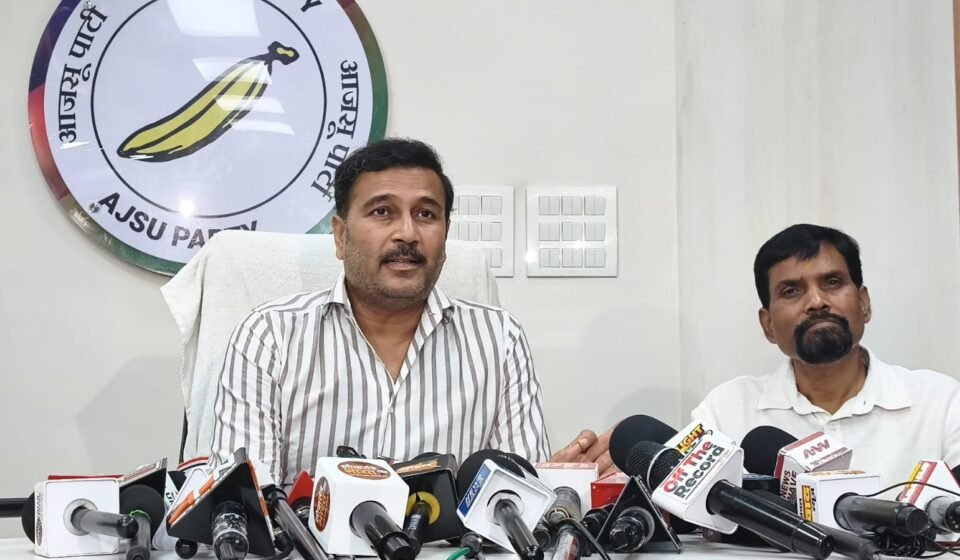
Addressing the media at the party’s central office in Harmu, Ranchi, Mahto said Jharkhand’s statehood movement was fundamentally rooted in the demand that the state’s natural resources, including water, forests, land and minerals, should be used to improve the lives of its people. He said communities living in mineral-rich areas should be the first beneficiaries of the state’s mineral wealth.
AJSU central chief spokesperson Devsharan Bhagat was also present at the media interaction.
Mahto said the existing provisions of the Mines and Minerals (Development and Regulation) Act (MMDR Act) appeared to restrict the state government from independently imposing a cess on mineral-bearing land, despite the authority granted to states by the Supreme Court. He, however, pointed to Section 9D of the Act, under which the Centre can permit state governments to levy such a cess subject to specified conditions and restrictions.
The AJSU leader urged the Union government to allow Jharkhand to impose the cess on the condition that the revenue generated would be used exclusively for welfare and development schemes in mineral-producing areas.
He alleged that despite clearly defined provisions governing the use of DMFT funds, the state government had violated the prescribed conditions. Referring to the approximately Rs 10,000 crore DMFT corpus, Mahto alleged that irregularities amounting to thousands of crores had come to light and demanded greater accountability in the utilisation of the funds.
“Revenue generated from mineral areas must directly benefit the people living there,” Mahto said, adding that the party would support the state’s demand for cess powers only if strict safeguards were put in place to ensure that the money was spent on local development.
Taking aim at the ruling Jharkhand Mukti Morcha (JMM), Mahto alleged that the party was opposing the cess for reasons unrelated to the interests of mineral-bearing regions. He alleged that illegal mining was continuing with the alleged protection of sections of the police and government machinery.
Mahto further alleged that the government’s policies could make legally produced coal more expensive, potentially widening the scope for illegal coal trading and production. He claimed that annual growth in coal production, which was around 8 per cent before the cess issue, had declined to nearly 2 per cent after the cess was imposed.
The AJSU chief said the decline indicated the need for stricter monitoring of coal production and alleged that illegal mining had received indirect support from the system. He maintained that the removal of the state’s power to impose the cess was the reason behind JMM’s opposition to the issue.
Mahto also rejected the state government’s argument that the absence of cess revenue would lead to a shortage of funds for development schemes. Referring to the state’s budget expenditure during the 2025-26 financial year, he claimed that the government failed to utilise nearly 25 per cent of its total budget allocation.
The AJSU leader said the party’s position was clear: Jharkhand should have the power to levy a mineral cess, but its utilisation must be legally tied to the welfare, infrastructure and development of people living in mineral-rich areas.