
An Argument That Missed the Lesson
The Inner Classroom
By Sheetal Bagaria
I recently shared a podcast by a spiritual teacher in one of my groups. I was looking forward to a discussion on the ideas he had presented. Instead, within minutes, the conversation took an unexpected turn.
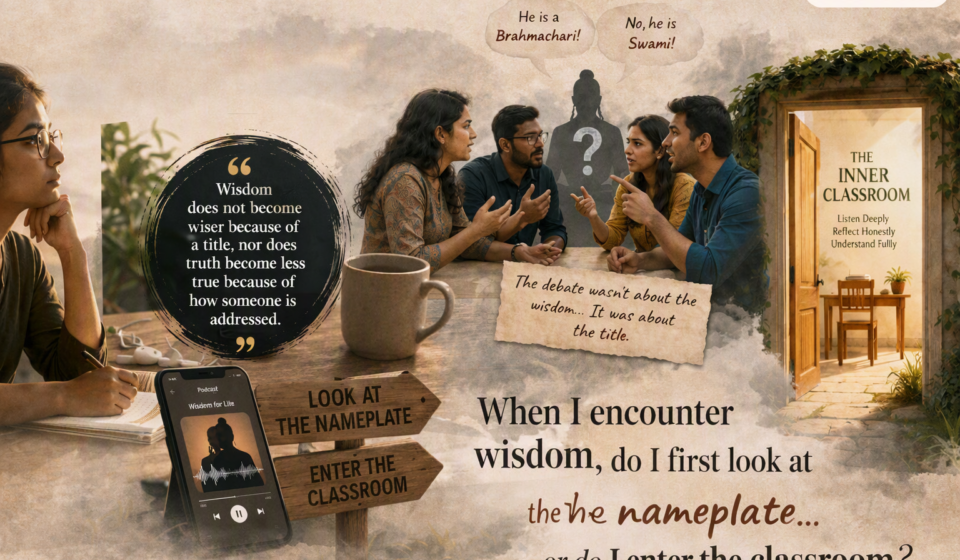
The debate wasn’t about the wisdom in the podcast. It wasn’t about whether his words made anyone think differently or inspired a new perspective. It became an argument over how he should be addressed. Was he a Brahmachari or a Swami? People passionately defended their positions, corrected one another, and quoted traditions to prove they were right.
I quietly watched the discussion unfold.
The truth is, I don’t know the technical distinction well enough to enter that debate. Perhaps there is a valid difference. Perhaps the title matters within a particular tradition. But I couldn’t help wondering whether we had all missed something far more important.
The podcast had offered an opportunity to pause, reflect and look inward. Yet we found ourselves looking at a label instead.
It struck me that this is not confined to spirituality. We do it everywhere. We become preoccupied with titles, degrees, designations, surnames and identities. We often decide how much attention to give a person based on the name that comes before or after theirs. Labels become shortcuts. They save us the effort of listening deeply.
The inner classroom teaches a different lesson.
It reminds us that wisdom does not become wiser because of a title. Nor does truth become less true because someone addressed the speaker differently. A profound insight remains profound, regardless of the label attached to the person who spoke it.
Perhaps our attachment to labels is really an attachment to certainty. It feels easier to classify than to contemplate. Easier to correct someone than to correct ourselves.
As I watched the discussion continue, I wondered how often I do the same thing in my own life. How often have I judged a book by the author’s reputation before reading it? How often have I accepted or rejected an idea because of who said it rather than what was said?
That day, I realised the podcast had not only offered a spiritual lesson; it had quietly held up a mirror. The real conversation wasn’t taking place on the discussion forum. It had begun within me.
Maybe the Inner Classroom is not the place where we learn the difference between a Brahmachari and a Swami. Maybe it is the place where we ask ourselves why the title captured our attention more than the teaching. Why our minds rushed to classify before they chose to understand.
The argument eventually faded. As most arguments do.
But the question has stayed with me.
When I encounter wisdom, do I first look at the nameplate… or do I enter the classroom?