Down Memory Lane -V
By Gautam Sarkar
I had the opportunity to get to know the Santhal Parganas much more intimately through a special reporting assignment – a large-scale social audit initiated by UNICEF and The Times of India. To assess the social conditions of women and children in rural Bihar, thirty reporters, along with several writers and social activists, were assigned to the field.
We were asked to interview villagers and collect data on a wide range of issues, including livelihoods, access to safe drinking water, civic amenities, healthcare, childhood education, economic conditions, self-employment opportunities, and other related matters. We also had to interview the concerned government officials. Finally, all our reports were compiled into a booklet titled “pledge”.
I was assigned for the districts of Dumka, Jamtara (which had not yet become a separate district at that time), Godda and Sahebganj in the then undivided Bihar. I visited nearly thirty remote villages. Most of these villages were so inaccessible that the only way to reach them was on foot.
Government of India was implementing a number of rural development programmes under different schemes at that time. Among the most significant was the Development of Women and Children in Rural Areas (DWCRA) programme, which was specifically designed to improve the welfare and economic prospects of women and children living in rural communities.
This assignment gave me the rare privilege of spending nearly two months travelling through some of the region’s most remote, predominantly tribal villages. It allowed me to observe their lives, customs, hardships, and resilience at close quarters – an understanding impossible to gain from official reports or statistics alone.
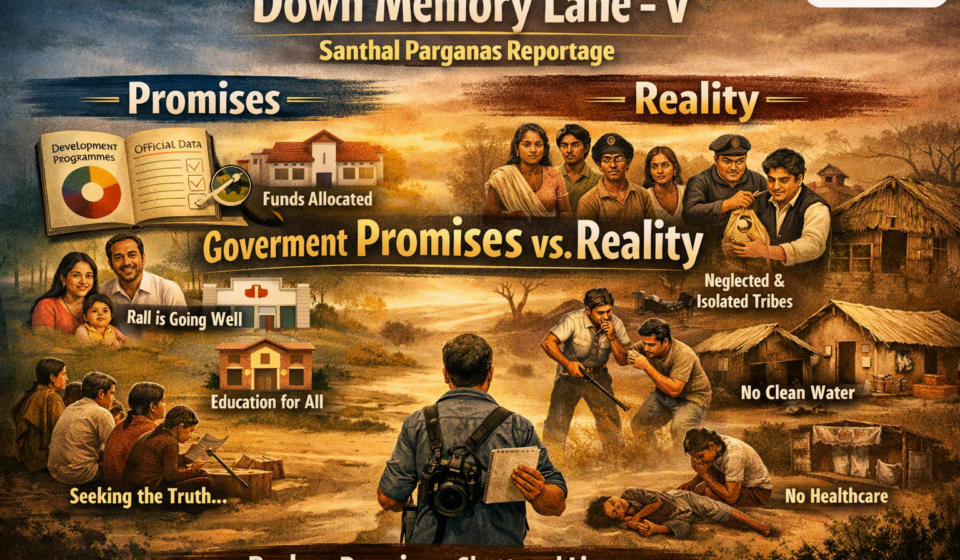
To understand and verify the ground reality, I followed a systematic approach before interviewing the villagers. I first collected all relevant data and official figures from the officer in charge of the concerned department for that area. Armed with those records, I then spoke to the villagers to determine whether the government’s claims and development work matched the reality on the ground.
After completing the interviews, I would return to the same officer, present the villagers’ complaints and observations, and seek the officer’s response. Whenever necessary, I would even approach the Block Development Officer (BDO) or the Deputy Commissioner (DC) for clarification.
Although I had never been instructed to follow such a procedure, I did it entirely on my own initiative to cross-check every fact. It required a great deal of hard work, but the experience and investigative discipline I gained during that assignment proved invaluable throughout my later career as a journalist.
Whenever I recall those villages and the ordinary people who lived there, I still shudder. Owing to the complete neglect and failure of the power corridors in Patna, those remote villages inhabited by the nearly extinct Paharia tribe and the Santhal community were, at that time, living in conditions that resembled the darkest days of the Middle Ages. They had virtually no basic amenities. Government funds never reached those villages, and no one seemed to care.
The simple, uneducated villagers did not know a single government official; no official ever came to see them. The only representatives of the state they saw, from time to time, were police inspectors who arrived from distant police stations with armed constables. Often, for no apparent reason, they would tie ropes around the villagers’ waists and drag them away to the district headquarters.
In those villages, the moneylenders (mahajans) and contractors responsible for implementing government development schemes functioned as a parallel government. Whenever the villagers faced hardship or misfortune, these innocent and trusting people would surrender their livestock, the produce of their fields, and whatever little money they possessed—either to the police or to these local power brokers. If illness struck, they had no access to proper medical care. They depended on the village Manjhi (traditional headman) or untrained quacks, and after losing everything they owned, many ultimately lost their lives as well.
At that time, I had no opportunity to write openly and extensively about the suffering of those people. I did, however, ask my editor whether the report prepared from the data and figures we had painstakingly collected would bring any real benefit to those unfortunate villagers. I received no answer that day.
(to be concluded……. )