
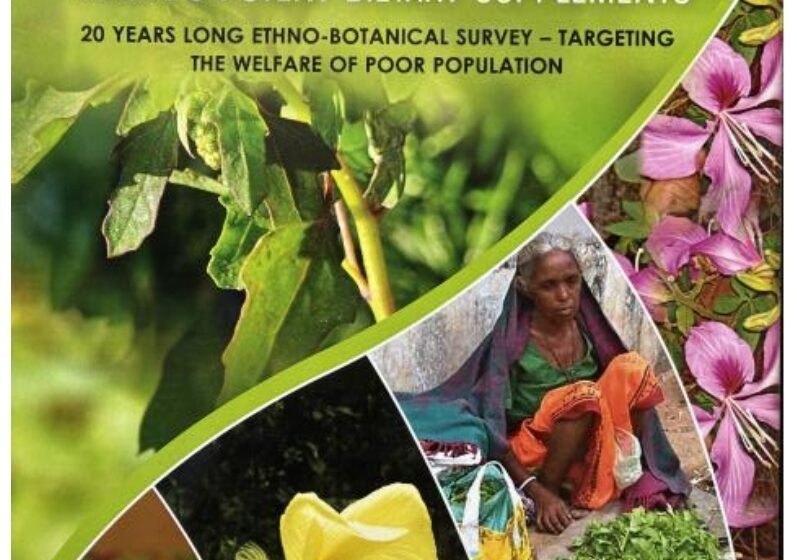
Book Review of ‘Wild Leafy Vegetables and Flowers (Nature’s Potent Dietary Supplements)’
Jharkhand state was crafted from Bihar during the year 2000. It is chiefly a tribal dominated state extremely rich in the tribal, indigenous and plant diversity besides famous for the coal mines as well as the mineral deposits.
The predominant tribal communities in Jharkhand are: Birhors, Kharias, Mundas, Oraons, Paharias, Santhals as well as the Asurs. Authors of this book: Drs. Sudhanshu Kumar and Bandana Kumari are well acclaimed ethnobotanists who have intensively travelled the forests and tribal regions in Jharkhand to document the vast indigenous knowledge possessed by the tribal/indigenous communities.
The authors have gathered information on the wild leafy vegetables and flowers collected during the survey of the tribal hats and various wild locations in the state during their 20 years long extensive ethnobotanical explorations among the indigenous communities in Jharkhand.
The generated information is very important from the bio-prospection point of view leading to the ethno-neutraceutical research. This publication is first hand information and is quite comprehensive and handy targeting the leafy vegetables and flowers. The book has been broadly divided in 8 chapters viz.: Wild leafy plants used as green vegetables; Dried leaves used as potherb in off-season and famine food; Potherbs used and consumed in festivals, rituals and special occasions; Potherbs used for therapy and disease prevention; Potherbs found in Jharkhand but unknown to the locals yet used elsewhere;
Wild flowers used as pot herbs in Jharkhand; Wild flowers found in Jharkhand but not used as vegetables like in other regions; Leafy vegetables as a source of micro-nutrient supplementation in vegetarian diets followed by the Bibliography, Index by local names of plants and Index by the botanical name of the plants.
The authors had surveyed for the leafy vegetables sold in tribal hats in Jharkhand followed by their verification in the field studies either in wild or under cultivation along with their intense photographic documentation. One chapter has been included by the authors about the potherbs which are found in Jharkhand region but not commonly known to the indigenous communities while used in the other states.
As these wild leafy vegetables and flowers are extremely rich in minerals and nutrients which may serve as an excellent source of the supplementary diets for the indigenous communities. Some of the interesting uses may be very useful in research for validation for their medicinal and nutraceutical attributes which may be taken-up in project mode for obtaining the financial aid from various funding agencies.
It is interesting to record that authors have also analyzed 15 non-conventional leafy vegetables for validation of their micro-nutrient contents which can comprise the unconventional foods in the dietary supplements. It will also make a basis for the focused researches and for the development of the aggro-technology of some of the most promising and potential pot-herbs in this publication.
These herbs may become as new potential pot herbs in the market and beneficial for the progressive vegetable growers. The photographs are excellent along with their local names, brief description as well as uses. Overall presentation of this book is up to the mark with very good information, printing and photography. It will provide enough research material for the several potential research projects.
Besides it will be extremely useful for the students, teachers, researchers, policy makers, managers as well as the scientists. Considering the good quality of publication, the cost of book has been on the higher side but it is a must for the libraries of the postgraduate colleges, universities, botanical institutions and other research organizations.
The Book review has been done by Dr. Anil K. Goel, Former Scientist-G, CSIR-National Botanical Research InstituteLucknow-226001 (INDIA)Email: akgoelofcsirnbri@gmail.com