
DMF can drive Jharkhand’s Just Transition, says new report
PNS
Ranchi
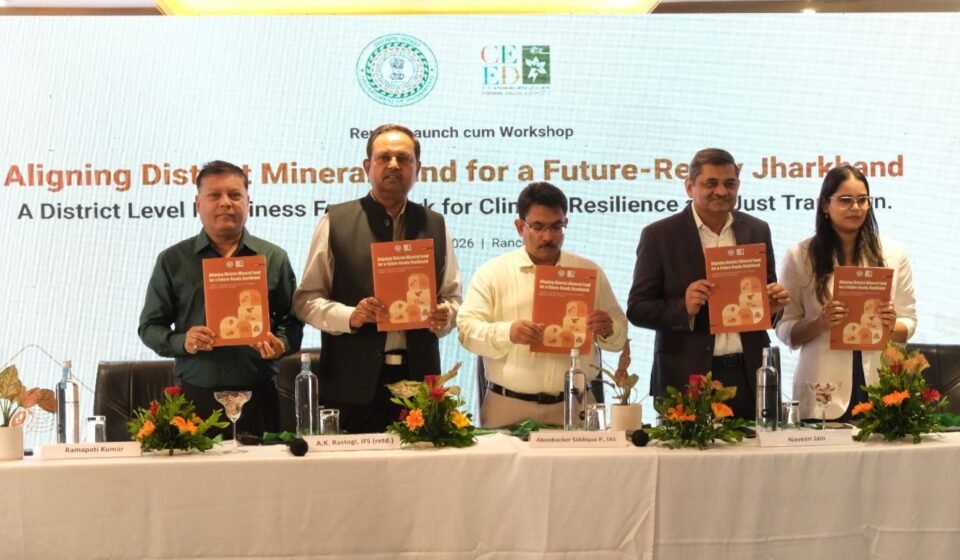
A new report released jointly by the Task Force-Sustainable Just Transition, Government of Jharkhand, and the Center for Environment and Energy Development (CEED) has highlighted the growing role of District Mineral Foundations (DMFs) in shaping a resilient and future-ready development model for mining-dependent districts in the state.
Titled “Aligning DMF for a Future-Ready Jharkhand: A District-Level Readiness Framework for Resilience and Just Transition”, the report analyses district-wise spending trends, governance gaps and socio-economic preparedness linked to DMF funds. It argues that DMFs should move beyond being compensation mechanisms for mining impacts and instead evolve into strategic financing tools for inclusive and sustainable transition planning.
According to the report, Jharkhand has collected Rs 18,231 crore under DMF as of April 2026, accounting for 16.3 per cent of the national total and placing the state second after Odisha. Coal contributes nearly 69.15 per cent of the state’s DMF revenues, while Jharkhand alone accounts for around 29.83 per cent of the country’s coal-linked DMF collections.
Districts including Dhanbad, West Singhbhum, Chatra, Ramgarh, Bokaro and Hazaribagh together account for nearly 78 per cent of total DMF funds. However, the report noted that Jharkhand still has an unspent DMF balance of Rs 8,434 crore.
Addressing the event, Aboobacker Siddique P., IAS, Secretary, Department of Forest, Environment and Climate Change, said DMFs can become locally sourced financing mechanisms for long-term socio-economic transformation if funds are deployed strategically beyond basic infrastructure needs.
A.K. Rastogi, retired IFS officer and Chairman of the Sustainable Just Transition Task Force, said the revised PMKKKY guidelines provide a major opportunity to strengthen the role of DMFs in economic diversification, livelihood promotion, energy security and environmentally sustainable development.
The report also pointed out that districts such as Bokaro, East Singhbhum and Ramgarh are better positioned to convert DMF investments into long-term development outcomes due to relatively stronger human development indicators. In contrast, districts like Pakur, West Singhbhum and Latehar require more targeted and community-focused investments.
Experts at the event stressed the need for better financial execution, institutional innovation, skill development, environmental restoration and community participation to ensure a just transition in mining regions across Jharkhand.