
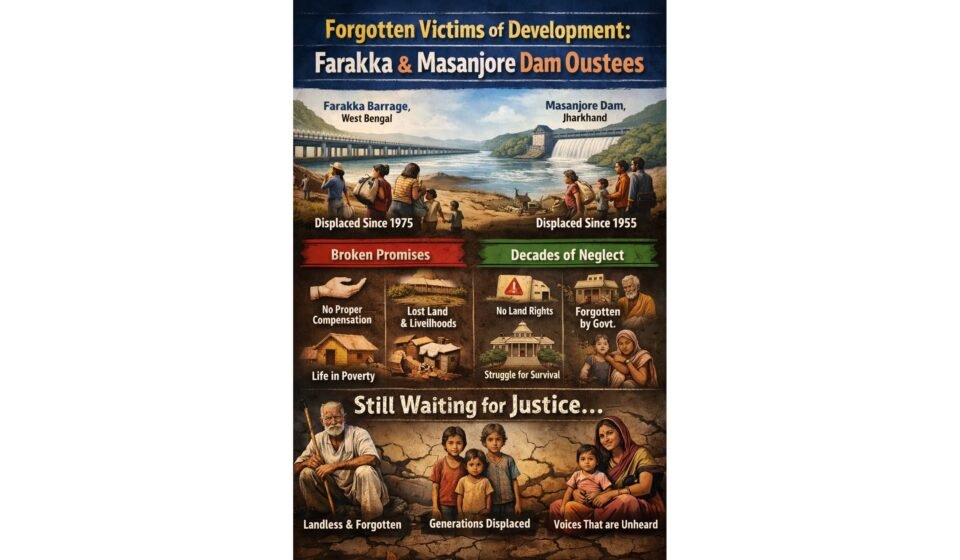
What happened to the land oustees of Farakka and Massanjor ? Who even knows?
By GAUTAM SARKAR
One of the first major issues I covered while reporting for the Times of India, Patna Edition, from Santhal Parganas on 1994, was the tragedy of displacement.
At that time, the tribal-dominated Santhal Parganas region of the then undivided Bihar was among the most underdeveloped parts of the state. Ironically, several government-sponsored mega projects were introduced there with the promise of development. Instead of improving the region, however, these projects only accelerated its decline.
More importantly, they forced thousands of ordinary people—among whom a substantial proportion belonged to the tribal communities – to face the devastating and deeply inhumane reality of displacement. I deliberately use the word inhumane because, although the displacement was carried out in full, the government made virtually no meaningful arrangements for the rehabilitation or resettlement of those who had lost their homes and livelihoods.
In addition to the human suffering, many of these mega projects also triggered severe ecological degradation, leaving the region to grapple with the consequences of an environmental disaster.
Before I joined The Times of India in Santhal Parganas, I was working as a freelance journalist in Bhagalpur. During that period, I toured the Rajmahal and Sahibganj region with Abhay Singh, the senior reporter of The Times of India, Bhagalpur. We were accompanied by Nathmal Dokania, the former MLA from the Rajmahal Assembly constituency.
He took us around the Rajmahal area and, particularly along the border with West Bengal, showed us firsthand the devastating consequences that had unfolded on the Rajmahal side after the construction of the Farakka Barrage in the 1970s. Through our journey, he vividly explained the immense human and environmental tragedy that had befallen the region.
We witnessed one distressing scene after another – seasonal flooding during the monsoon, vast stretches of fertile agricultural land rendered unproductive, the collapse of the local agrarian economy, and the resulting large-scale migration of impoverished villagers to other states in search of livelihoods. The human suffering was impossible to ignore.
The construction of the Farakka Barrage undoubtedly fulfilled several important national objectives. It ensured direct connectivity with India’s strategically vital northeastern region, facilitated the release of India’s allocated share of water to neighbouring Bangladesh, and maintained sufficient water in the Hooghly River flowing through Kolkata so that it remained navigable for ships throughout the year before emptying into the Bay of Bengal. The project also provided irrigation and hydroelectric benefits to Malda district and adjoining areas of West Bengal through the joint efforts of the Central Government and the then Government of West Bengal.
Unfortunately, owing to the indifference of the then Government of Bihar, the poor inhabitants of the Rajmahal region were left to bear almost all the adverse side effects of the Farakka Barrage. They paid a heavy price for a project whose benefits largely accrued elsewhere.
Abhay Singh wrote an excellent series of reports on this issue for The Times of India. Later, around 1996, after I joined the Bhagalpur Bureau of The Times of India, I revisited the subject and published another series of reports highlighting the continuing plight of the people affected by the Farakka Barrage.
But in 1994, I travelled to Dumka. This time, I was accompanied by a guide similar to Nathmal Dokania, former MLA of the Nala Assembly constituency, Raj Kumari HimmatSinghka. She took me to Kumrabad village in Dumka. Also accompanying us were two well-known social workers from Dumka, Ranjit Jaiswal and Md. Mohsin, along with several local journalists – Suman Singh, Anup Kumar Vajpayee, Shiv Shankar Choudhary – and my photographer, Shashi Shankar.
I still vividly remember Raj Kumari ji showing me the present-day Kumrabad village and telling me that it was not the original Kumrabad. Pointing towards the vast expanse of water stretching up to the foothills of the Black Hills, just beyond the village, she said that beneath those waters lay the real Kumrabad, along with many other villages that had been permanently submerged due to the construction of the Massanjore Dam on the Mayurakshi River, a project jointly undertaken by the Governments of India and the United States.
Naturally, I asked Raj Kumari ji about the fate of the villagers. She not only arranged for me to speak with the displaced residents but also personally took me to each of their temporary settlements, where I witnessed the heartbreaking condition of those who had lost their homes.
The government had failed to arrive at any meaningful solution for these unfortunate displaced villagers. Having lost their cultivable land, many of them were left without any means of livelihood. Forced into extreme poverty and hunger, they began living on the fringes of the forests, putting together makeshift shelters with straw and whatever materials they could find, struggling to survive under the most difficult circumstances.
That day, I truly understood the cruel irony of fate that had befallen hundreds of innocent villagers, a significant number of whom were Adivasis.
The Government of
West Bengal constructed the Farakka Barrage within its own territory. But the Massanjore Dam was built across the Mayurakshi River inside Dumka district of Bihar (now in Jharkhand). While the hydroelectric power generated by the dam and its irrigation network were largely reserved for the development of several districts in West Bengal, the people of Dumka district in Bihar were left with little more than deprivation, hardship, and despair.
I still remember how, in several villages, local residents showed me the irrigation canals that had supposedly been constructed to improve Bihar’s irrigation system. Yet not a single one was functional. The reason was astonishing: instead of being designed with a gradient towards Bihar, every irrigation canal had been constructed with its slope facing the opposite direction – towards West Bengal. As a result, whenever water was released from the dam for irrigation, it naturally flowed away from Bihar’s canals and into West Bengal instead.
I reported these facts in a series of articles, and The Times of India published them. What the government or the policymakers did afterwards, however, I do not know.
My greatest surprise came after the 2002 Dumka Lok Sabha by-election. I met Biswajit, a resident of Kumrabad village who was then working at the UTI office in Dumka. I was stunned when he told me that the villagers had jointly filed a case in the Dumka court to protest the injustice they had suffered at the hands of the government. Unfortunately, the impoverished villagers could not even raise enough money to pay the court fees. As a result, the case could not proceed beyond its initial stage.
Ironically, during that very 2002 by-election, the BJP government led by Babulal Marandi in Jharkhand, lost the Dumka Lok Sabha seat to the JMM candidate, Shibu Soren. The voters of Dumka voted against the BJP because of their resentment over the displacement in the region and the government’s failure to rehabilitate the displaced families for many years.
( to be concluded ….)

GAUTAM SARKAR