
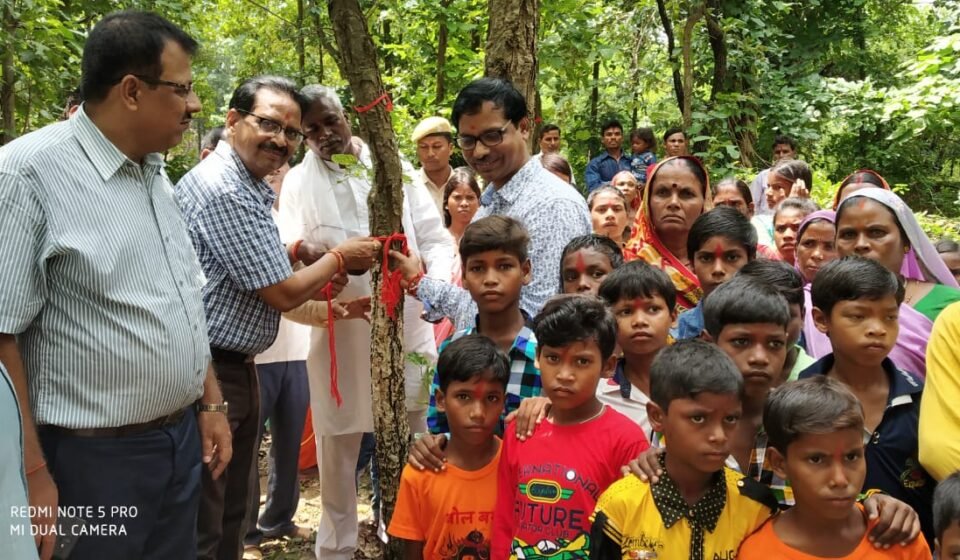
PCCF Sanjeev Kumar launches Save Tree campaign from Gumla
Roshan Kumar
Ranchi
This Raksha Bandhan, the traditional bond of protection between brothers and sisters took on a new meaning in Jharkhand, as rakhis were tied to 100,000 trees across 700 villages under the state’s Save Trees campaign.
The initiative aims to deepen the emotional connection between communities and nature, with a target of tying rakhis to 300,000 trees across all 24 districts of Jharkhand over the next month.
Jharkhand’s Principal Chief Conservator of Forests-cum-Head of Forest Force, Sanjeev Kumar, formally launched this year’s campaign on Friday by tying a rakhi to a tree in Jorad village of Gumla.
For Kumar, the initiative is not new. He began the campaign in 2004 in Lukaiya village under Tundi block of Dhanbad, seeking to turn the symbolism of Raksha Bandhan into a pledge to protect trees and forests.
According to Kumar, more than 12,000 villages across Jharkhand have been connected with the campaign since its inception. He also claimed that the initiative has contributed to the state’s increasing forest cover, which has risen by 1,128 sq km over the past two decades.
“On Raksha Bandhan, sisters tie rakhis and brothers pledge to protect them. Protecting the environment is also our supreme duty because our lives depend on it,” Kumar said, explaining the philosophy behind the campaign.
Under the initiative, villagers tie sacred threads around trees after performing traditional rituals and take a collective pledge to protect them.
The impact, Kumar said, can be seen in villages such as Lukaiya, where more than 20,000 trees were saved through the initiative. The trees have since become an important source of livelihood for local residents, while the campaign has also helped increase the availability of minor forest produce in several villages, contributing to higher incomes.
Kumar cited Forest Survey of India data to highlight the broader changes in Jharkhand’s forest cover. The state had 22,637 sq km of forest cover in 2001, which increased to 23,765.78 sq km in 2023, accounting for approximately 29.76% of Jharkhand’s geographical area.
Of the total forest cover recorded in 2023, 2,635.35 sq km was classified as very dense forest, 9,640.99 sq km as moderately dense forest, and 11,489.44 sq km as open forest.
On Raksha Bandhan, Kumar, along with forest department employees and villagers, visited villages where trees were worshipped according to local traditions before rakhis were tied around their trunks. The ritual was followed by a pledge to protect the trees.
A similar programme was organised last year in the forests of Gumla and Lohardaga, where villagers and forest officials pledged to protect the environment.
For Kumar, the message behind the campaign goes beyond symbolism. Jharkhand’s forests are closely linked to agriculture, livelihoods and the state’s ecological balance.
“If the forests are protected, there will be good rainfall. Good rainfall means better farming,” Kumar said, pointing out that forests also support biodiversity, which in turn benefits agriculture.