
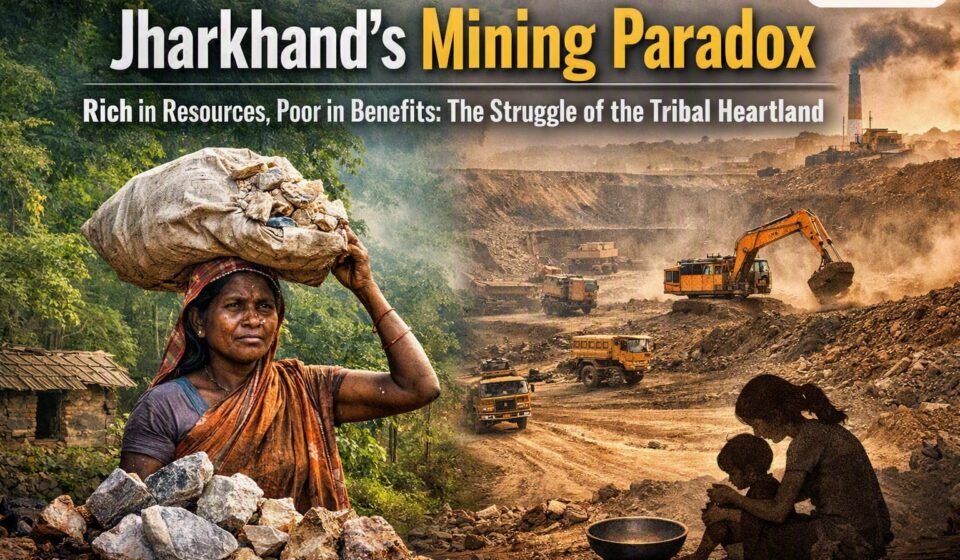
Jharkhand’s Mining Paradox: Forest Rich, People Poor
By Deepak Kumar
Rich in Resources, Struggling in Poverty — The Tribal Heartland’s Unresolved Crisis
Jharkhand, the “land of forests,” embodies a paradox of wealth and deprivation. With 30% forest cover, far higher than Bihar (6%), Gujarat (7%), Uttar Pradesh (6%), and Rajasthan (4.9%), the state is blessed with natural abundance. Yet its people remain among the poorest, caught between ecological restrictions and bureaucratic hurdles.
Corporate giants, adept at navigating mining and forest laws, continue to profit. Meanwhile, tribals in Koderma and Giridih districts survive by collecting mica scraps from abandoned mines. Far from being supported, they are prosecuted, even as malnutrition deaths rise. The injustice is glaring: Jharkhand holds some of the world’s richest mineral deposits, but its citizens struggle for basic sustenance.
Legal complexities have deepened the crisis. The High Court’s extension of mining lease distance from 250 to 400 meters, combined with the Deepak Kumar vs State of Haryana ruling, has created a labyrinth of paperwork. Under the Forest Conservation Act, 1980, files must pass through nearly 20 layers of clearance, leaving hundreds of applications in limbo. Even compensatory afforestation provisions fail to expedite approvals.
Despite discoveries of rare earths and lithium deposits, exploration has stalled. Exporters are forced to sell mica scrap at 20% of global value, while foreign markets, especially China, reap profits from Jharkhand’s unique ruby mica. A diamond‑bearing state is thus left on the verge of starvation.
Experts argue that a single‑window clearance system, paired with compensatory afforestation, could unlock ₹10,000–20,000 crore annually without harming forests. Recognizing that nearly 15% of Jharkhand’s forest cover consists of shrubs, afforestation offsets could balance mining expansion. Legalizing and regulating mica collection by tribals would transform informal survival activity into a formal livelihood, ensuring dignity and income.
The paradox of Jharkhand is not merely about minerals versus forests. It is about poverty amidst abundance, about a state rich in resources but poor in benefits. Unless governance bridges the gap between ecological protection and economic justice, Jharkhand risks remaining a land of untapped wealth and unfulfilled promise.


Nice arguments but misplaced diagnosis hence wrong prescription. The so called Compensatory Afforestation which the author is arguing that ll be helpful in protecting the forest has not worked in the first place. It has proved to be an instrument of corporate grabbing of forested area laden with underlying minerals. The main crux of the problem for the tribals is the abysmally slow pace of Community Forest Rights(CFR ) recognition in the state. The rampant corporate hand over of the resources and failure to recognise the rights of the traditional forest dwellers is main problem, which the author is not talking about, rather arguing for further privatisation of the resources to unlock supposedly 15k crores. CAG reports 2024 on CAMPA reveals that the fund meant for afforestation has been (mis)used for purchasing vehicles for jungle safaris, building construction, legal court case fees, in many cases the survival rate of afforestation has been less than 33% as against minimum recommended 66% etc etc. The recommendation will further impoverish the people of Jharkhand and entrench the very paradox, the author is talking about.