
Jharkhand’s Unfinished Fight for Gender Equality
By Prof. Anant Kumar
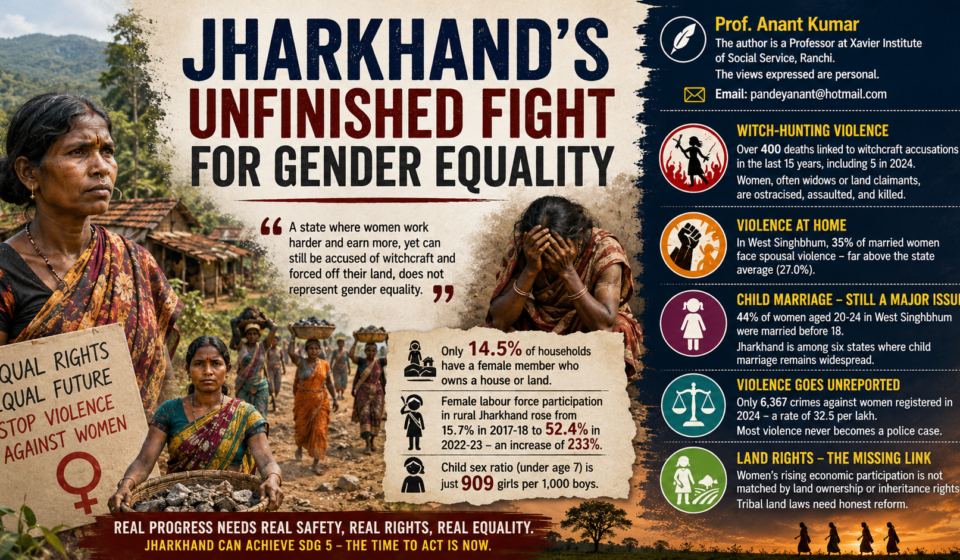
According to the National Crime Records Bureau, over the past fifteen years, Jharkhand has recorded more than 400 deaths linked to witchcraft accusations, including five in 2024 alone. Women, often widows or those who challenge patriarchal claims to land and property, continue to be socially ostracised, assaulted, stripped, and killed in the name of witchcraft. This pattern is concentrated in rural areas, where women’s land rights and inheritance claims are contested. Across the state, NFHS-6 reports that only 14.5 per cent of households have a female member who owns a house or land, even jointly with others. Sustainable Development Goal 5 calls for the end of all forms of violence against women. Jharkhand cannot claim progress on gender equality while this remains unresolved in its villages.
Despite this, it is noteworthy that female labour force participation in rural Jharkhand rose from 15.7 per cent in 2017-18 to 52.4 per cent in 2022-23, an increase of roughly 233 per cent. This means more than half of rural Jharkhand’s women are part of the paid workforce, yet women do not feel safe, underscoring that economic participation alone does not ensure physical safety.
A district-level study in West Singhbhum found spousal violence and child marriage well above the state average, with 35 per cent of married women reporting spousal violence and 44 per cent of women aged 20-24 married before 18. Both figures are sharply higher than Jharkhand’s NFHS-6 statewide numbers of 27.0 and 28.1 per cent, respectively, and exceed NCRB’s own count of just 6,367 registered crimes against women in 2024, a rate of 32.5 per lakh. Most of this violence, it seems, never becomes a police case at all. At the state level, this places Jharkhand among six states, namely Bihar, West Bengal, Assam, Andhra Pradesh, Rajasthan, and Telangana, where child marriage remains a major issue rather than a declining practice. A girl married before 18 has limited control over her body, education, and economic future, regardless of her workforce participation statistics.
Interestingly, contrary to the above, Jharkhand’s NFHS-6 data show notable progress on Goal 5, gender equality, with increases in women’s education, internet use, paid work, bank account ownership, and participation in decision-making, alongside declines in child marriage and reported violence. However, women’s land ownership, at just 14.5 per cent, remains a significant issue. The rise in pregnant girls aged 15-19, from 9.8 per cent to 11.7 per cent, is a puzzling contradiction.
None of this erases the genuine improvements towards gender equality. NFHS-5 data for Jharkhand also show that 18 per cent of the state’s households are now headed by women, a meaningful shift in family structure and decision-making that deserves recognition. Jharkhand’s own numbers complicate the picture further. The state’s overall population sex ratio stands at 1,050 females per 1,000 males, but its child sex ratio, among children under age 7, is just 909. The progress is real, but it is not evenly distributed across the dimensions required for gender equality.
To achieve SDG 5 on gender equality, three things deserve more attention than they currently receive. First, witch-hunting-related violence needs to be treated as the serious, ongoing criminal pattern that the NCRB’s own numbers show it to be, with dedicated tracking and prosecution in the districts where it recurs, rather than as an occasional shocking news story. Second, Jharkhand’s tribal land and inheritance framework needs honest reform so that women’s rising economic participation is matched by an actual right to own and inherit the land they increasingly work on, not just a wage. Third, child marriage interventions need to be targeted specifically at districts with high rates, such as West Singhbhum’s 44 per cent.
A state where women work harder and earn more, yet can still be accused of witchcraft and forced off their land, does not represent gender equality.
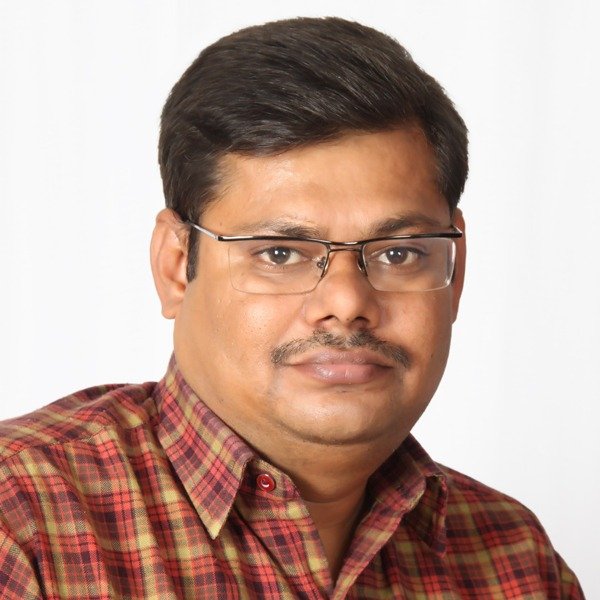
The author is a Professor at Xavier Institute of Social Service, Ranchi. The views expressed are personal.
Email: pandeyanant@hotmail.com