
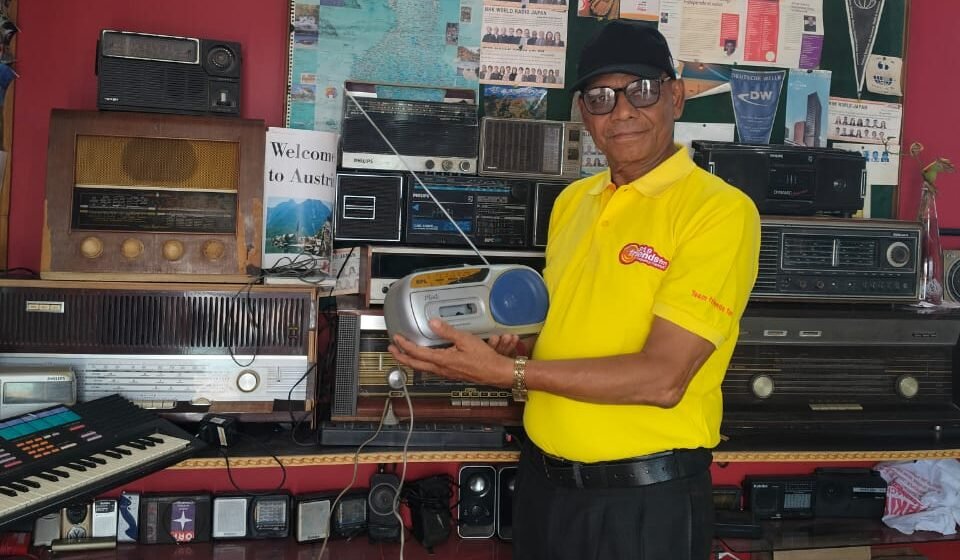
National Broadcasting Day: 1,000 radios bring history alive in Jamshedpur
Pioneer News Service
Jamshedpur
Long before smartphones, podcasts and social media connected the world, radio was the heartbeat of millions of homes. Bringing that rich legacy back to life, the Guide International Radio Listeners Club organised a unique Radio Exhibition in Kadma on Thursday to mark National Broadcasting Day, attracting radio enthusiasts, students and curious visitors from across the city.
Held at the club’s premises in Ulyan, Kadma, the exhibition remained open from 8.30 am to 4 pm and showcased nearly 1,000 radio sets, ranging from vintage valve radios and transistor sets to modern digital receivers. The impressive collection offered visitors a rare opportunity to witness the evolution of broadcasting technology over nearly a century.
Children were among the biggest attractions at the exhibition, eagerly exploring radios that had once connected generations to news, music, cricket commentaries and world events. Many were fascinated to learn how families once gathered around a single radio to listen to their favourite programmes.
Club President Chinmoy Mahato guided visitors through the history of broadcasting in India and explained the significance of National Broadcasting Day. He said the day commemorates July 23, 1927, when the Indian Broadcasting Company launched the country’s first radio broadcast from Mumbai, marking the beginning of organised radio broadcasting in India.
Mahato also highlighted key milestones in Indian broadcasting history. He said the service was renamed All India Radio on June 8, 1936, and in 1957 it officially came to be known as Akashvani. After Independence, Akashvani played a transformative role by carrying information on agriculture, education, healthcare, weather updates and government welfare schemes to even the remotest villages of the country.
The exhibition also served as a reminder of radio’s enduring relevance despite the digital revolution. Visitors were introduced to shortwave, medium wave and FM receivers, with enthusiasts explaining how radio continues to be an important communication medium during emergencies and natural disasters when other communication networks may fail.
The event drew an enthusiastic response from people of all age groups, with many spending hours exploring the collection and interacting with club members. For older visitors, the exhibition evoked memories of a bygone era, while for younger generations it offered a fascinating glimpse into the technology that shaped modern mass communication.