
By Dr. Simi Mehta
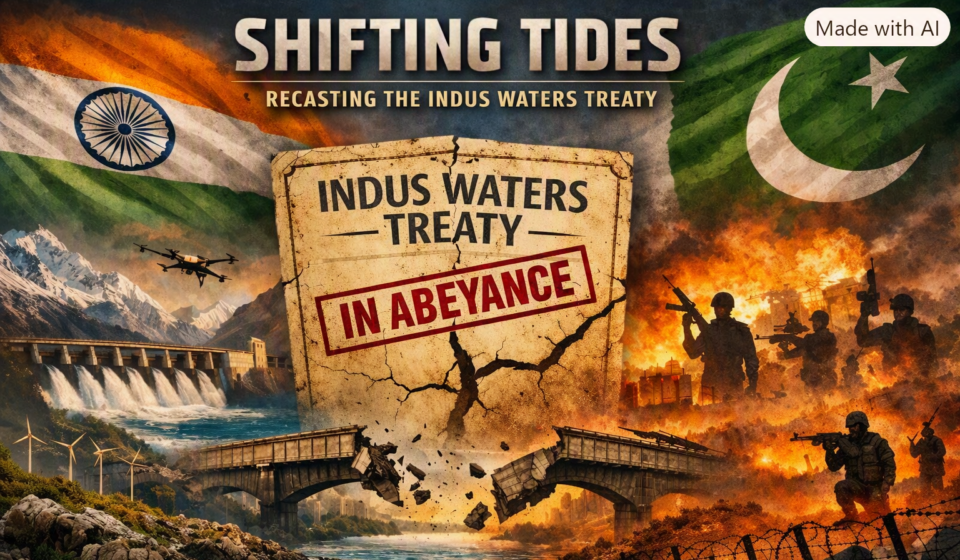
India’s decision to place the Indus Waters Treaty in abeyance after the Pahalgam terrorist attack marks a fundamental shift in its Pakistan policy. The issue is no longer about water alone; it is about whether sustained bilateral cooperation can survive in the face of persistent cross-border terrorism. Recasting the Treaty is not a rejection of international cooperation, but an acknowledgement that lasting agreements require trust, reciprocity, and responsible state conduct. It also questions whether a country is expected to continue extending the benefits of institutional cooperation to a neighbour that persistently employs terrorism as an instrument of policy?
For more than six decades, the Indus Waters Treaty (IWT) stood as one of the world’s most enduring examples of water diplomacy. Signed in 1960, it survived wars, military confrontations, diplomatic crises, and decades of cross-border terrorism. Through every major rupture in India-Pakistan relations, New Delhi honoured its commitments under the Treaty, demonstrating that responsible statecraft could prevail over political hostility. Few international agreements have endured such prolonged geopolitical turbulence with the same degree of continuity.
That era has now come to an end.
The terrorist attack in Pahalgam on 22 April 2025 was not merely another tragic episode in the troubled history of India-Pakistan relations. It marked a strategic inflection point that compelled New Delhi to reassess one of the foundational assumptions of its Pakistan policy: technical cooperation could remain insulated from persistent security threats. India’s decision to place the Indus Waters Treaty in abeyance, followed by the government’s declaration that the Treaty “will not remain operational in its present form,” represents far more than a response to a single act of terrorism. It signals a broader recalibration of India’s strategic thinking: cooperation cannot be unconditional when the very foundations of trust have been repeatedly undermined.
Critics have argued that water should never be linked to politics or security. In principle, this is an attractive proposition. In practice, however, international agreements are sustained not merely by legal texts but by mutual trust, good faith, and responsible state conduct. The Indus Waters Treaty itself was negotiated in the expectation that the two countries would seek peaceful coexistence despite their differences. When one party persistently undermines that objective through cross-border terrorism, it becomes legitimate to ask whether the assumptions underpinning the agreement still hold.
India’s record on the Treaty strengthens the credibility of its current position. Successive governments honoured the IWT during the wars of 1965 and 1971, throughout the Kargil conflict, and after major terrorist attacks including the assault on Parliament in 2001, the Mumbai attacks of 2008, the attacks in Uri in 2016, and Pulwama in 2019. Even amid intense political hostility, New Delhi continued to implement the Treaty in the belief that humanitarian cooperation over shared rivers should remain separate from broader disputes.
That policy reflected strategic restraint rather than strategic weakness. India consistently demonstrated that it was willing to separate technical cooperation from political conflict in the hope that institutional continuity would contribute to regional stability. Few countries confronted with repeated acts of terrorism would have displayed such patience.
Pahalgam altered that calculus.
The attack forced India to confront a difficult but unavoidable question: can a country be expected to continue extending the benefits of institutional cooperation to a neighbour that persistently employs terrorism as an instrument of policy? The answer increasingly appears to be no. Cooperation cannot become an unconditional entitlement when the broader relationship is characterised by sustained hostility and recurring violence.
This does not mean that India seeks to weaponise water. Rather, it recognises that cooperation over shared natural resources cannot exist in isolation from the wider strategic environment. Water agreements are ultimately political agreements, requiring confidence that both parties are acting in good faith. Where trust has been systematically eroded, the framework governing cooperation must inevitably be reconsidered.
The Government of India’s statement that the Indus Waters Treaty will not remain operational in its present form signals precisely such a reassessment. The objective is not simply to suspend an agreement but to acknowledge that the strategic, environmental, and developmental realities of today are vastly different from those of 1960. Climate change has altered hydrological patterns, technological capabilities have transformed river management, and the developmental aspirations of Jammu and Kashmir have evolved significantly. Above all, the security environment has deteriorated in ways that the original architects of the Treaty could scarcely have anticipated.
The decision to place the Indus Waters Treaty (IWT) in abeyance following the Pahalgam terrorist attack of 22 April 2025 triggered an extensive diplomatic offensive by Pakistan to internationalise the issue and mobilise global opinion against India. Beginning in May 2025, Islamabad repeatedly raised the matter at the United Nations, accusing India of “weaponising water” and seeking international intervention. Simultaneously, it persisted with treaty-related proceedings through the World Bank-facilitated dispute resolution mechanisms and the Court of Arbitration over the Kishanganga and Ratle hydroelectric projects in an effort to preserve the existing treaty framework. Pakistan also reached out to several friendly capitals, culminating in its appeal to Canadian Foreign Minister Anita Anand during her visit to Islamabad in July 2026 to support the restoration of the Treaty.
Yet, despite sustained diplomatic outreach over more than a year, Pakistan has failed to rally meaningful international support. The United Nations has confined itself to generic appeals for dialogue, the World Bank has remained within its limited procedural mandate without questioning India’s sovereign policy decision, and Canada declined to publicly endorse Pakistan’s request, with the official bilateral joint statement making no mention of the Indus Waters Treaty. Equally significant, no major power including the United States, United Kingdom, France, Germany, or the European Union, has publicly called upon India to restore the Treaty or challenged New Delhi’s position.
This restrained international response suggests a growing recognition that transboundary water cooperation cannot be viewed in isolation from the broader security environment. While governments have generally refrained from endorsing India’s decision explicitly, neither have they mounted coordinated pressure for the immediate restoration of the Treaty.
The broader significance of India’s decision extends well beyond the Indus basin. It reflects a recognition that compartmentalising bilateral engagement has diminishing returns when the underlying security relationship continues to deteriorate. Durable cooperation is not built solely on treaties; it rests on trust, reciprocity, and a shared commitment to peaceful conduct. Where those foundations are repeatedly undermined, even the strongest agreements require re-evaluation.
The debate, therefore, is no longer about water alone. It is about the conditions under which meaningful cooperation between neighbours can endure. Peace, stability, and mutual confidence are not optional extras; they are the foundations upon which agreements such as the Indus Waters Treaty are built. Without them, legal commitments risk becoming detached from strategic reality.
India’s decision should therefore be viewed not as an abandonment of cooperation but as an attempt to redefine the conditions under which cooperation can be sustained. Recasting the Indus Waters Treaty is not about discarding an important international agreement; it is about ensuring that such agreements remain relevant to contemporary geopolitical realities. A framework negotiated in 1960 cannot be immune from the profound strategic, environmental, and security transformations that have reshaped South Asia over the past six decades.
The Indus Waters Treaty survived for sixty-five years because India believed that peace was always worth another chance. Pahalgam has forced a painful reassessment of that belief. New Delhi’s message is not that water should become a weapon, but that cooperation cannot become an entitlement. If Pakistan genuinely seeks the restoration of a stable and mutually beneficial water-sharing arrangement, the path does not lie through appeals to international forums or foreign capitals. It lies in demonstrating, through credible and irreversible action, that terrorism will no longer define its relationship with India.
The real question, therefore, is no longer whether the Indus Waters Treaty should survive. It is whether the assumptions that sustained it for sixty-five years still do. As India recalibrates its Pakistan policy, one principle has become unmistakably clear: durable cooperation is built not merely on legal agreements, but on trust, reciprocity, and responsible state conduct. Until those conditions are restored, India is justified in insisting that there can be no water without peace, no partnership without trust, and no return to the status quo without accountability.
(Dr. Simi Mehta is CEO and Editorial Director, IMPRI Impact and Policy Research Institute, New Delhi. She is also the Academic Director of Oxford Group of Institutions, Jharkhand. She holds a PhD in American Studies from the School of International Studies, Jawaharlal Nehru University (JNU), and was a Fulbright Nehru Doctoral Research Fellow at Ohio State University, USA.)