
Shiv Worship in Shravan: From Worship to Experience
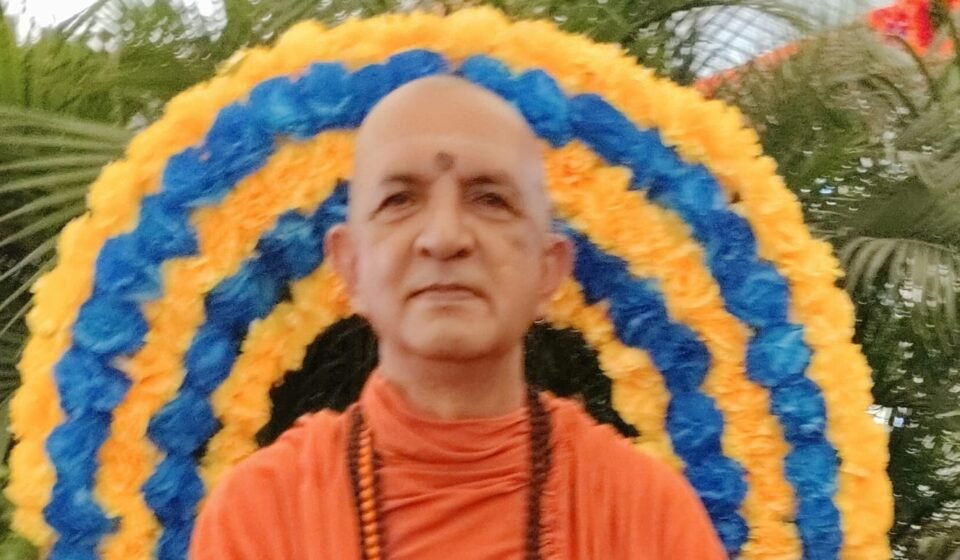
By Padma Bhushan Swami Niranjananand Saraswati
The month of Shravan arrives and a change begins to appear in the atmosphere. Water is offered at Shiva temples, the sound of “Om Namah Shivaya” is heard, people observe fasts, perform worship, and adopt some rules and restraint in their lives.
One question should be asked to oneself: Is Shiva only in the temple? If Shiva is only in the temple, then when we come out of the temple after worship, where is Shiva? This is the very question from where the real experiential practice of Shiva begins.
Shiva is not merely to be worshipped. The Shiva principle has to be understood. Shiva is not merely to be understood either. The Shiva principle has to be experienced. And the Shiva principle is not merely to be experienced. It has to be expressed in one’s own life. This is the practice of Shravan.
Who is Shiva? We see Shiva in many forms. He is a yogi. He is a sannyasi. He is a householder. He is Bholanath. He is Mahakal. He is Nataraj. He is Neelkanth. Why are these different forms in one personality? Because Shiva is not the name of a particular personality. Shiva is a principle.
The meaning of Shiva is: benevolent, auspicious.
Therefore, whatever thoughts, whatever feelings and whatever actions in life take us from unrest to peace, from ignorance to knowledge, from bondage to freedom, from selfishness to service, and from ego to surrender, therein lies the expression of the Shiva principle.
From this perspective, in Shravan we should not ask, “What should I offer to Shiva?” We should also ask, “How do I bring Shiva into my life?”
Shiva’s Silence: Training of the Mind*
What is Shiva’s Most Beautiful Form?
Meditating Shiva. The world around is moving. Changes are taking place. Creation is happening, it is disappearing. Circumstances are changing. But Shiva remains established in his centre. This is the teaching of yoga.
In life, circumstances will not go according to us. People will not behave according to us. The family will not behave according to us. Society will not behave according to us. The world will not behave according to us.
Yet we want everything to happen according to our wishes. And when it does not happen? Anger. Disappointment. Stress. Complaints. Blame. We say, “That person disturbed me.” In reality, the other person merely said some words or performed some action. The reaction of unrest arose within our own mind.
Meditating Shiva tells us: Before changing the situation, look at your reaction.
This is the psychological practice of Shravan. For one month, observe one of your reactions. If you get angry quickly, observe the anger. If you have a habit of complaining, observe the complaint. If you have a habit of criticising, observe the criticism. If you expect too much from others, observe the expectation. Do not suppress it. Do not fight with it either. Just remain aware. The moment you begin to observe your reaction, in that very moment you become a little separate from the reaction. And this is where transformation begins.
Learn to Become Neelkanth
Neelkanth is one of the names of Shiva, Neelkanth. The churning of the ocean took place. Poison emerged before the nectar. Who would bear this poison? Shiva accepted it. But he did not allow the poison to spread throughout his entire existence.
This is not merely a mythological story; understand it in the context of your own life as well. In our lives too, a little poison emerges every day. Someone insulted us.
Someone did not listen to us. Someone criticised us. Someone did not fulfil our expectations. Sometimes we met with failure. Sometimes disappointment. Sometimes opposition. This is the state of our daily life.
Now what do we do with it? Mostly, we do two things. Either we throw the poison at someone else, in the form of anger, harsh words, criticism, or we take it inside ourselves, in the form of hatred, pain, resentment. Neither of the two situations is right.
Shiva shows us the third path. Recognise the poison. Hold it. Observe it. Transform it. Do not let it spread further. If someone hurt me and I carry the same hurt to five other people, then I have increased the poison in the world. If someone hurt me and that hurt ended with me, then perhaps at that moment I tried to become Neelkanth. This too is Shiva worship.
Where Should Abhishek Take Place?
In Shravan, we offer water on the Shivlinga. Water is cooling. Now look within yourself. There is the fire of anger. There is the fire of jealousy. There is the fire of ambition. There is the fire of expectations. There is the fire of competition. There is the fire of ego. So where should the real abhishek take place? Within the mind.
Offer a pot of water on the Shivlinga and along with it make a resolution: “Today I will not be angry with anyone.”
Second day: “Today I will not unnecessarily criticise anyone.”
Third day: “Today I will reduce complaints and increase gratitude.”
Fourth day: “Today I will provide selfless help to one person.”
Then see how Shravan changes. Outer abhishek and inner abhishek will begin to move together.
Shiva’s Social Message
Who stays around Shiva? Everyone stays. There are deities, ganas, animals, snakes, and also such creatures whom ordinary society does not accept. Shiva does not cast anyone out. Therefore, Shiva has one great social message: Accept.
One of the biggest problems of human beings today is that we want to accept only people like ourselves. The one who thinks like me is good. The one who agrees with me is good. The one who likes what I like is good. We keep the rest away from us.
But the Shiva principle says: Recognise unity even in diversity. Every person will not be like me. Every person will not think in my language. Every person will not behave according to my values. Yet I can live with that person with respect, cooperation and harmony. This is the social yoga of Shiva.
From Worship to Service
Swami Satyānand Ji gave a special place to service in spiritual life. Merely worrying about one’s own liberation is not the completion of spirituality. It is also necessary to look around. Who is unhappy? Who needs help? Who is alone? Who needs food? Who needs two words of love? Who needs only someone to listen to them? If in Shravan we offer water to the Shivlinga every day and do not see the tears of a distressed person, then we will have to make our worship a little broader.
Shiva is in the temple as well as in life. Therefore, remember one simple formula: Worship Shiva within, serve Shiva outside.
Shiva Is My Guide
Now connect the symbols of Shiva with your own life.
When the mind is restless and you see meditating Shiva, tell yourself: “First become calm, then make a decision.”
When someone speaks harsh words to you and you remember Neelkanth: “Do not take this poison forward.”
When ego begins to grow and you see the ashes of Shiva: “One day everything will turn to ashes. What is there to be so proud of?”
When desires become very large and you remember Shiva’s simplicity: “How little is needed to live, and how much does the mind ask for?”
When the mind becomes restless and you see the moon on Shiva’s head: “The mind is my instrument; I am not a servant of the mind.”
When your strength and energy are being wasted and you see Shiva’s snake: “Control your energy, give it the right direction.”
When you cannot understand a situation and remember Shiva’s third eye: “Do not look only at what is visible. Look a little deeper.”
And when some achievement, knowledge, power or grace is attained in life and the stream of Ganga is visible: “Do not keep what you have received only for yourself. Let it flow for the welfare of others too.”
Then Shiva will no longer remain merely an idol of worship for us. Shiva will become our guide.
Three Resolutions
Three resolutions can be taken in this Shravan. First: Social resolution.
“May a little happiness come into someone’s life because of me.”
Second: Psychological resolution.
“I will identify one negative habit of mine and try to change it.”
Third: Spiritual resolution.
“I will develop silence, awareness, simplicity and faith within myself.”
If we can live these three resolutions in Shravan, then worship will not remain merely worship. It will become practice.
From Worship to Experience
There is a sequence in the spiritual journey. First, I worship Shiva. Then, I remember Shiva. After that, I begin to understand the Shiva principle. Then, I begin to experience the Shiva principle within myself. And ultimately, the effort is made, I live the qualities of Shiva in my life. This is the journey from worship to practice and from practice to experience.
Then the greatest Shivlinga becomes our own consciousness. Offer the water of *awareness upon it. Offer the bilva leaves of *purity, simplicity and innocence.* Offer the flowers of positive thoughts. Offer the fruits of service. Light the incense of cooperation. Light the lamp of discrimination. And offer the ego at the feet of Shiva.
Then Shiva will not be only on Kailash. Shiva will be in our silence. He will be in our awareness. He will be in our restraint. He will be in our compassion. He will be in our service. He will be in our positivity. And in difficult times, when we do not understand which direction to take, a peaceful inspiration will arise from within: Do not react, become aware. Do not spread the poison, transform it. Do not live only for yourself, serve. Do not get entangled in ego, surrender. Do not flow in unrest, return to your centre.