
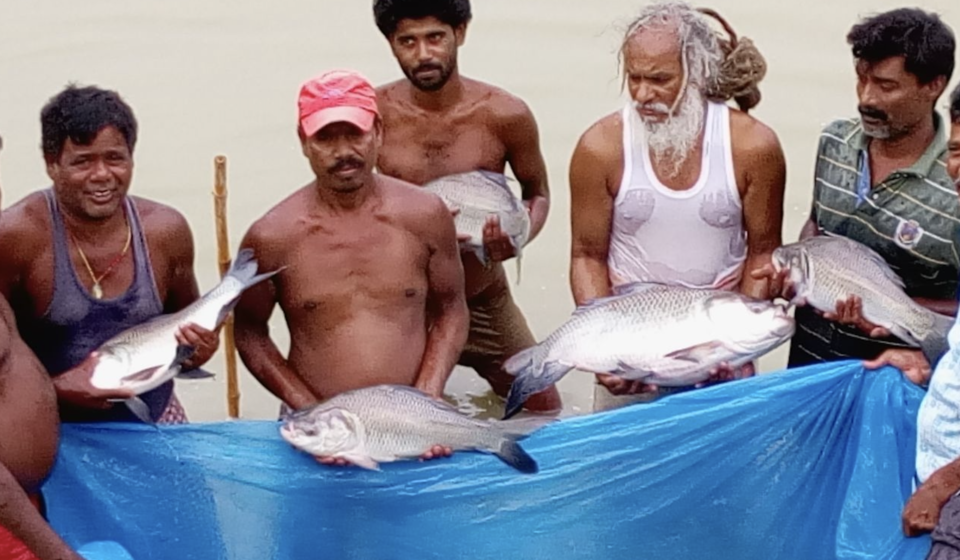
Specialised training to be provided to boost fishermen’s income
Ranchi
A significant initiative has been undertaken to enhance the efficiency of fish farming and fishing operations in Jharkhand’s major reservoirs. A special field survey has been successfully concluded to assess the current status of fishing activities in the State’s reservoirs and to evaluate the potential for adopting modern technologies.
This survey was completed under the leadership of Dr. Shravan Kumar Sharma, a Senior Scientist at the Mumbai Research Centre of the Central Institute of Fisheries Technology (CIFT)—a wing of the Indian Council of Agricultural Research (ICAR).
During the survey, a team of experts conducted an extensive tour of Jharkhand’s major reservoirs: Getalsud, Tenughat, Kanke, Hatia, Maithon, and Panchet. The team conducted a ground-level study of the available fishery resources, traditional fishing methods, the types of nets and boats currently in use, and the fundamental challenges faced by local fishermen.
Furthermore, through direct interactions with local fishermen, fisheries cooperative societies, and other stakeholders, the team compiled a list of practical challenges and their potential technical solutions.
The survey report reveals that there is immense potential to increase fish production in Jharkhand’s reservoirs. However, the lack of scientific fishing techniques, the absence of modern and selective fishing nets, the use of unsafe boats, and the lack of adequate training constitute the most significant hurdles in achieving this goal.
The report explicitly states that, given the unique geographical and local conditions of the reservoirs, there is now an urgent need to adopt region-specific technologies.
Based on this comprehensive survey, a blueprint is currently being prepared to launch an ‘Advanced Fisheries Technology Training Program’ for the state’s fishermen. Under this program, fishermen will receive specialized training on various technical aspects—such as scientific methods to maximize catch volume in shorter durations, the use of selective fishing nets that are eco-friendly and sustainable for fish stocks, and the operation of solar- and electric-powered boats to reduce fuel costs. Furthermore, in addition to the consistent use of safety equipment and resources during deep-water boat operations, live demonstrations of these modern fishing nets and solar-powered boats will be conducted in selected reservoirs in the future. This initiative is expected to boost the income of fishermen while simultaneously ensuring that no harm is caused to the environment.
In this regard, the State Director of Fisheries, Amarendra Kumar, stated that through the application of scientific techniques, proper training, and modern equipment, a historic improvement can be brought about in both fish production and the livelihoods of fishermen in Jharkhand. Keeping local requirements in mind, this technology dissemination program will be rapidly advanced in collaboration with CIFT.
Dr. Shravan Sharma expressed confidence that this initiative would prove to be a milestone in promoting a clean, energy-efficient, and sustainable fishing system in Jharkhand, as well as in building the capacity of the fishermen.